
The US spends a lot more per college student than every country except Luxembourg, but that’s not to say that those students are better educated than students in countries that spend a lot less. From Ryan McMaken at mises.org:
Presidential candidates Bernie Sanders and Elizabeth Warren have both come out in favor in “free” public colleges and universities. The scheme could be funded, as CNN describes it, by “drastic increase in federal spending on higher education.”
Much of the rhetoric around swirling around this issue relies on the idea that government spending on higher education in the United States is significantly lower than most other wealthy countries.
The narrative goes like this: “everyone knows that Americans are incredibly stingy when it comes to spending on government services. ‘Public spending’ on higher education is much lower here than in Europe and Japan, and because of this, people must spend much more on higher education.”
But here’s the rub: that statement isn’t true. Governments in the United States pay more (as a percentage of GDP) toward higher education than many other so-called “peer” countries.
According to the OECD’s 2018 “Education at a Glance” report, public spending on higher education in the United States is 1.3 percent of GDP. That’s equal to public spending in Switzerland and the United Kingdom. And it’s higher than spending rates found in Germany (1.2), France (1.2), Canada (1.2), Spain (1.0), Italy (0.8), and Japan (0.7).
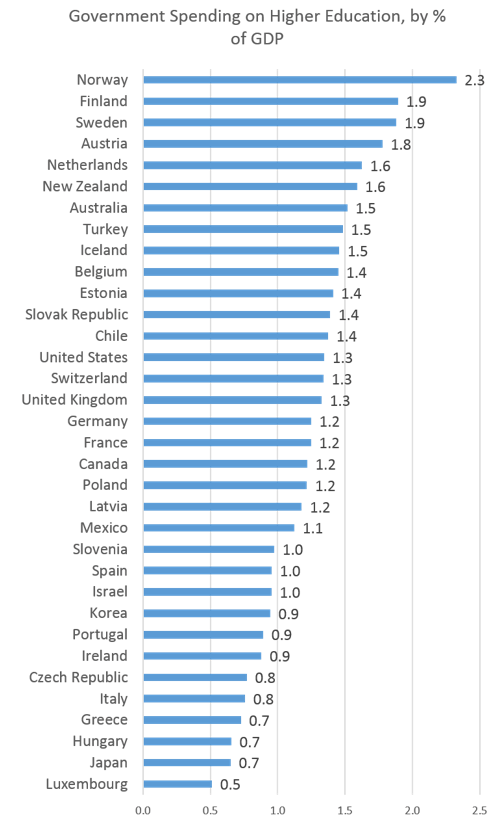
Source: “Public expenditure on education as a percentage of GDP, total tertiary,” Table C4.1, Education at a Glance, 2018. Similarly, see UNESCO: Government expenditure on education as a percentage of GDP. (http://data.uis.unesco.org/index.aspx?queryid=3373.)
But how can this be, since we’re told constantly how expensive it is to attend a higher education institution in the United States?


