
Alasdair Macleod sees inflation ahead. Deflation is much more likely, the inevitable consequence of the bursting of history’s greatest debt bubble. The peak and decline of international reserves mentioned in the title points in that direction. The report also ties in the quantity of international reserves to the price of oil, a unique, and potentially valuable perspective. From the SRSrocco Report via zerohedge.com:
The world is sitting at the edge of a massive deflationary cliff. Even though Central Banks are desperately trying to keep the world’s financial assets from plunging down into the great depression below, signs suggest they are losing the battle.
One critical sign is the peak and decline of International Reserves. Hugo Salinas Price has been keeping an eye on International Reserves for quite some time. In his recent article, A Reversal In The Trend Of International Reserves, he stated the following:
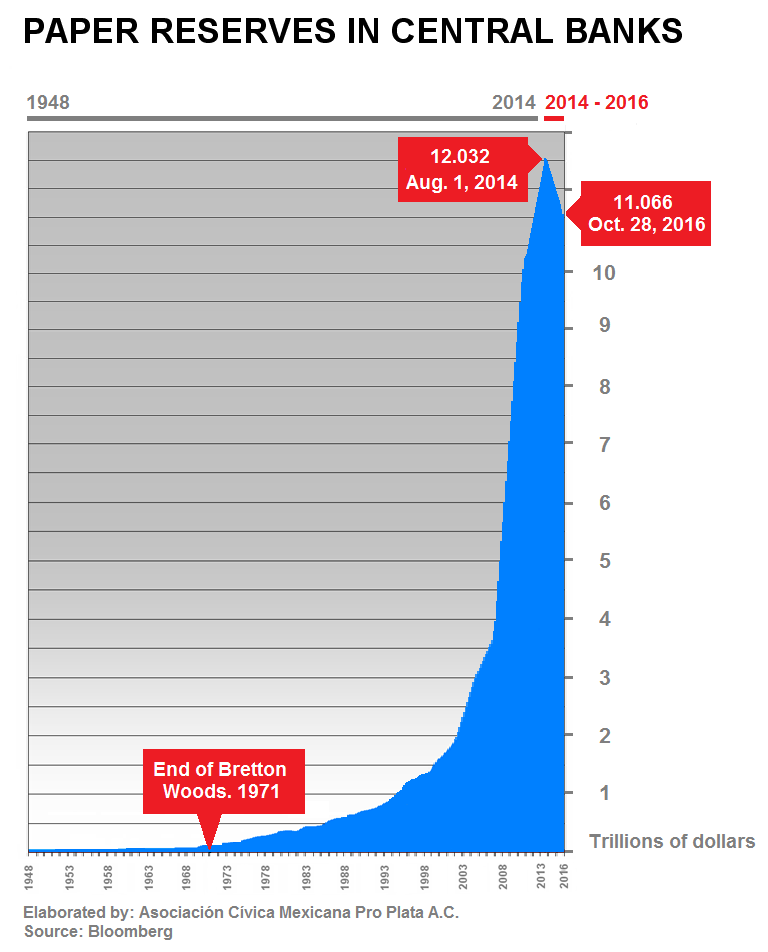
International Reserves peaked on August 1, 2014, at $12.032 Trillion dollars, and as of October 28, 2016 they stood at $11.066 Trillion dollars.
International Reserves stood at about $10 Trillion in 2011, but the rate of growth slacked off; the weekly increases in Reserves (which Bloomberg used to publish every Friday) stalled and became smaller, week by week. As mid-2014 came around, the increases were quite small. It was clear that the trend was for ever-smaller increases, and that could only mean that finally there would be no increase, which would be immediately followed by decreases in the total of International Reserves held by Central Banks. That is exactly what took place.
Here is a chart of International Reserves from Hugo Salinas Price’s article:
https://srsroccoreport.com/wp-content/uploads/2016/11/International-Reserves-Hugo-Salnas-Price.png
Hugo Salinas Price explains in the article, “that the increases of International Reserves take place when the Reserve Currency issuing countries effect payments to the rest of the world.” Basically, countries such as the United States that run trade deficits, exchange fiat money or Treasuries for goods from other countries. This shows up as an increase in International Reserves.
Now, what is important to understand about the chart above is the timing of the PEAK & DECLINE of International Reserves. I had an email exchange with Mr. Salinas on what I believe was the leading factor in why the International Reserves peaked and declined.
When I went back and looked at a five-year price chart of a barrel of oil (West Texas), I found a very interesting coincidence:

The price of a barrel of West Texas Crude fell below $100 starting at the beginning of August, 2014…. TO THE DATE. Even though the oil price had traded between $85-$100 over the past three years, it averaged over $95. However, by the end of 2014, it had fallen by more than half.
This had a profound impact on International Reserves as the low oil price gutted the energy-commodity-goods producing countries. These are the countries that hold the majority of International Reserves. So, as the price of oil continued to stay below $50 a barrel, these countries had to sell Bonds and acquire cash to fund their own domestic account deficits.
Thus, the peak and decline of International Reserves occurred right at the same time, the peak and decline of high oil prices. THIS IS NO COINCIDENCE.
To continue reading: The Peak & Decline Of International Reserves Warns Of Massive Asset Deflation Ahead


Reblogged this on behindertvertriebentessarzblog.
Reblogged this on behindertvertriebentessarzblog.