Tag Archives: Corporate Debt

Corporate Mirage: Debt out the Wazoo, Sales Languish, Stocks Soar, by Wolf Richter

One of the miracles of cheap credit is an improving stock price for companies whose fundamentals are deteriorating. From Wolf Richter at wolfstreet.com:

What the phenomenon of cheap credit has accomplished.

You’d think that corporate debt would grow in proportion to total sales, as this additional debt is used to fund investments in productive activities that create more sales and contribute to the economy, and that higher sales, and presumably higher earnings would create a proportionate increase in the value of the company, and thus in its stock price, and that they all go up together, not in lockstep but over time more or less at the same rate.

But that relationship between debt, sales, and share prices has gone completely out of whack.

First things first: Debt at nonfinancial companies – this excludes banks and nonbank lenders such as mortgage lenders – has soared. To get a feel for just how much, I have pulled the data on three major components of corporate debt:

Bonds issued by US companies in the US. Outstanding balances never even dipped during the Financial Crisis; they only flattened for a few quarters at around $2.97 trillion. Since them, outstanding bonds have soared from record to record, in total 76%, to $5.2 trillion.

This does not include bonds that US companies issue in other currencies in other countries. For example, it does not include euro bonds (“reverse Yankees”) that are hot in Europe, where junk bond yields are at a ludicrously low 2.35% on average, and the high-grade yield is just above zero.

Commercial & Industrial loans fell sharply during the Financial Crisis as banks stopped lending and as demand from companies withered. After peaking in Q4 2008 at $1.56 trillion, C&I loans fell to $1.19 trillion by Q3 2010. Then they soared and started setting new records in early 2014. By October 2016, they were up 35% from the prior peak and 77% from the trough – though they have largely flat-lined since then.

To continue reading: Corporate Mirage: Debt out the Wazoo, Sales Languish, Stocks Soar

Brick and Mortar Retail Meltdown Fueled by Asset Stripping. Details Emerge in Bankruptcy Courts, by Wolf Richter

American law criminalizes many productive transactions, and often legalizes theft. Case in point: private equity larceny, whereby a private equity firm buys a company, loads it with debt, has the company issue a special dividend so large it decimates the company (but makes the private equity firm whole), then at the first sign of trouble leaves the company for roadkill. From Wolf Richter at wolfstreet.com:

PE firms win again. Stiffed creditors not amused in bankruptcy court.

Nearly every retail chain caught up in the brick & mortar meltdown is an LBO queen – acquired in a leveraged buyout by a private equity firm either during the LBO boom before the Financial Crisis or in the years of ultra-cheap money following it. During a leveraged buyout, the PE firm uses little of its own capital. Much of the money needed to buy the retailer comes from debt the retailer itself has to issue to fund the buyout, which leaves the retailer highly leveraged.

The PE firm then makes the retailer issue even more junk bonds or leveraged loans to fund a special dividend back to the PE firm. Come hell or high water, the PE firm has extracted its money.

Then the PE firm charges the retailer hefty management fees on an ongoing basis.

This form of asset stripping removes cash from the retailer and leaves it struggling under a load of debt. It works wonderfully until it doesn’t – until booming online sales started eating their lunch, sending these overleveraged retailers, one after the other, into bankruptcy court, where creditors learn what it means to end up holding the bag. But they’re not amused, as we now see. But first the numbers…

Since 2010, retail chains owned by PE firms have issued $91 billion in junk bonds and leveraged loans just to raise the money for the special dividends paid to their PE owners, according to data by LCD of S&P Global Market Intelligence, cited by the Wall Street Journal. This does not include debt piled on retailers during the LBO itself. And it does not include drug stores and food retailers – such as PE-firm-owned Safeway-Albertsons, caught up in the middle of the meltdown.

To continue reading: Brick and Mortar Retail Meltdown Fueled by Asset Stripping. Details Emerge in Bankruptcy Courts

Chart of The Day: Corporate Debt-To-GDP Ratio At Peak Recession Levels, by David Stockman

http://davidstockmanscontracorner.com/chart-of-the-day-corporate-debt-to-gdp-ratio-at-peak-recession-levels/

Leverage Soars to New Heights as Corporate Bond Deluge Rolls On, by Sally Bakewell

Heading to a recession that has probably already arrived, this may not be the best time for corporations to be taking on more debt. That, unfortunately, is what they’re doing. From Sally Bakewell at blomberg.com:

The safe ’part of the market is becoming the most dangerous’
Debt growth most pronounced in energy and healthcare

Here’s a gut check for bond investors: corporate America is now more leveraged than ever.

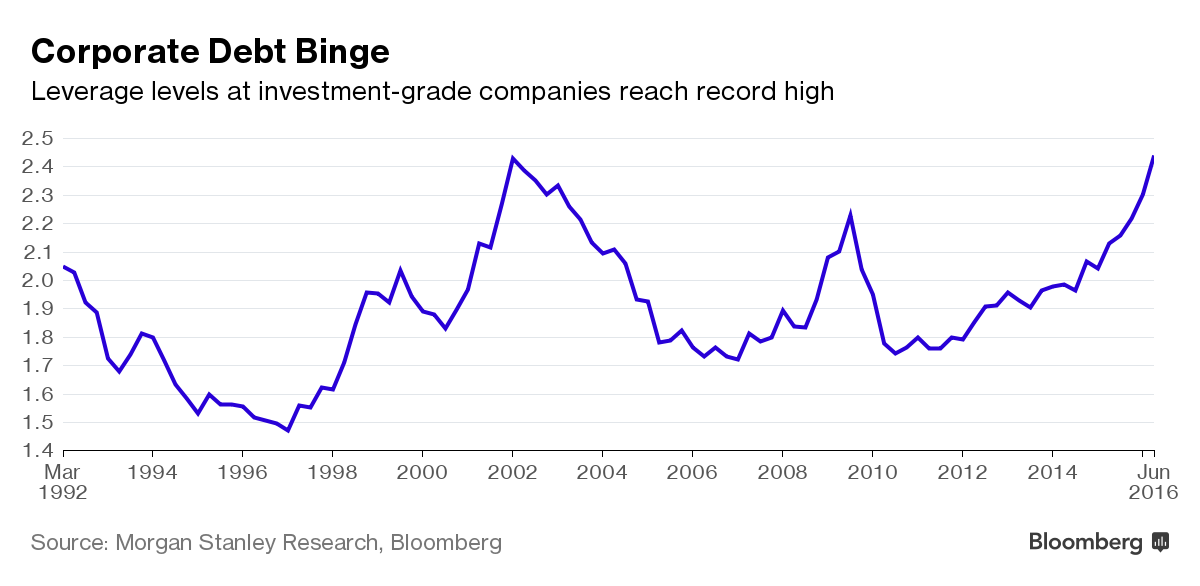
As this year’s corporate bond sales raced past $1 trillion on Wednesday — marking the fifth consecutive year of trillion-plus issuance — Morgan Stanley published a report Friday highlighting the growing strains on company balance sheets. The report, which estimated US companies’ collective debt at a record 2.4 times their collective earnings as of June, comes at a time of growing angst in global bond markets

“The investment-grade ‘safe’ part of the market is becoming the most dangerous,” said Ashish Shah, chief investment officer at AllianceBernstein LP. “There are so little returns out there. People are crowding into whatever they can.”

The debt metric, which doesn’t include banks and other financial companies, has climbed for five straight quarters as corporate profits decline at the same time companies load up on the increasingly cheap borrowings, Morgan Stanley analysts led by Adam Richmond wrote in a note to clients. In 2010, when the U.S. economy started recovering from the longest recession since the Great Depression, the ratio fell to 1.7 times.

https://assets.bwbx.io/images/users/iqjWHBFdfxIU/iZHbZOyU9PUc/v2/-1x-1.png

But what has the analysts uneasy isn’t just the speed at which leverage is climbing, but that it’s happening while the economy continues to grow.
“Leverage tends to rise most in a recession — so the fact that it is this high in a ‘healthy economy’ is even more concerning,” the analysts wrote. In other words, they said, “mistakes are both more likely and more costly.”

The analysts’ assessment wasn’t totally worrisome. Years of near-zero interest rates have made it a lot easier to service those debt loads. The typical company’s annual earnings before interest, taxes, depreciation and amortization, known as Ebitda, is still almost 10 times its interest payments, Morgan Stanley’s data shows. Even that number has been declining, though, as earnings slump.

Aggregate cash levels are also still growing, although the pace of growth has slowed, according to the report.

Stimulus Concern

The weakening balance sheets could become more worrisome if investors lose confidence that central banks will keep extending their unprecedented stimulus efforts that have driven yields to record lows. Those concerns flared up the past week, and rates on 30-year Treasuries recorded their biggest two-day selloff in more than a year.

Corporate-bond issuance this year is on pace to exceed last year’s record $1.3 trillion, data compiled by Bloomberg show. That would push sales during the past five years to more than $6 trillion. Companies that sold dollar bonds this week included Home Depot Inc., Cox Communications Inc. and TJX Cos.

Total debt at companies grew steadily at about 10 percent year-on-year since 2009 and accelerated to 16 percent year-on-year at the end of 2015. As that happened, Ebitda fell 4 percent for twelve months through the end of 2015, according to the report.

Debt loads are swelling across most all industries, the analysts said. But it’s been most pronounced among energy and healthcare companies. Companies have also borrowed to buyback stock rather than investing, a factor that contributed to weak productivity in the U.S. economy, and that does not “bode well for earnings,” the analysts wrote.

http://www.bloomberg.com/news/articles/2016-09-09/leverage-soars-to-new-heights-as-corporate-bond-deluge-rolls-on

S and P Sees A “Crisis Of Confidence Around The Globe” As Corporate Debt Hits $75 Trillion In 2020, by Tyler Durden

If you keep piling on debt, eventually something’s got to give. S&P agrees. From Tyler Durden at zerohedge.com:

In an analysis that may rival that infamous “McKinsey report” from early 2015 which found that not only had there been no deleveraging since the financial crisis but that total global debt has risen to an unprecedented $199 trillion as of 2014, or up by $52 trillion in 7 years, earlier today S&P Global Raters issued a new report in which it forecasts that global corporate debt is set to rise by 50% over the next four years, rising from $51.4 trillion currently to $75 trillion by 2020 as a result of easy central bank monetary policy and low interest rates.

Not surprisingly, the world’s biggest credit creator, China, is expected to account for the bulk of the credit growth, with the nation projected to add $28 trillion or 45% of the $62 trillion in expected global demand increase (the other $13 trillion of the $75 trillion total are refinancings). The U.S. is estimated to add $14 trillion, or 22%, in new debt, with Europe adding $9 trillion, or 15 percent.

In the latest attack on unorthodox monetary policy yet, S&P notes that central banks may be trying to reinflate their economies, but they’re doing so to the detriment of credit quality. “Central banks remain in thrall to the idea that credit-fueled growth is healthy for the global economy. In fact, our research highlights that monetary policy easing has thus far contributed to increased financial risk, with the growth of corporate borrowing far outpacing that of the global economy.”

Continuing their assault on central banks, authors David Tesher, Paul Watters and Terry Chan say that “nearly half of corporate debt issuers are estimated to be highly leveraged, strongly suggesting that a correction in global credit markets is unavoidable. In fact, analysts believe that the credit correction began in late 2015 and will likely stretch through the next few years as defaults spike.”

This is best visualized in a recent report from Morgan Stanley which indeed shows that if history is precedent, the current default cycle will continue for a long time.

Here, once again, S&P explains how global central banks are now trapped: they no longer wish to push rates lower on one hand, but on the other any sharp spike in rates would wreak havoc on global credit markets, and the financial system in general. As a result, S&P considers a correction in the credit markets to be “inevitable.” The only question, as MarketWatch notes, is degree of that unwinding. An unexpected sharp economic slowdown and an aggressive reversal of ultra-low interest rates pose big risks to what otherwise could be an orderly drawdown of the global pile of IOUs.

The problem is that the default cycle has already started, and any sharp changes to interest rates will only accelerate it. As we pointed out last week, there has already been a sharp uptick in corporate defaults. Global corporate bankruptcies reached a milestone 100 so far in 2016 in July. That puts the current tally, led mostly by U.S. energy companies, up more than 50% from the same time last year. In fact, the last time the global count was higher at this point in the year was in 2009, during the financial crisis, when it reached 177. At this pace, 2016 is set to see a new all time high number in corporate defaults.

To continue reading: S&P Sees A “Crisis Of Confidence Around The Globe” As Corporate Debt Hits $75 Trillion In 2020

Corporate Debt Hangover That Could Spark a Recession, by Sally Bakewell

Who would have thought that corporate debt could spark a recession? Add in government and individual debt and it could spark a depression. From Sally Bakewell at bloomerg.com:

Leverage at companies worldwide swells to highest in 12 years

Capital not working hard enough at third of all firms

There’s been endless speculation in recent weeks about whether the U.S., and the whole world for that matter, are about to sink into recession. Underpinning much of the angst is an unprecedented $29 trillion corporate bond binge that has left many companies more indebted than ever.

Whether this debt overhang proves to be a catalyst for recession or not, one thing is clear in talking to credit-market observers: It’s a problem that won’t go away any time soon.

Strains are emerging in just about every corner of the global credit market. Credit-rating downgrades account for the biggest chunk of ratings actions since 2009; corporate leverage is at a 12-year high; and perhaps most worrisome, growing numbers of companies — one third globally — are failing to generate high enough returns on investments to cover their cost of funding. Pooled together into a single snapshot, the data points show how the seven-year-old global growth model based on cheap credit from central banks is running out of steam.

“We’ve never been in a cycle quite like this,” said Bonnie Baha, a money manager at DoubleLine Capital in Los Angeles, which oversees more than $80 billion. “It’s setting up for an unhappy turn.”

While not as pronounced as the rout in global equity markets, losses are beginning to pile up in the bond market too. The average spread over benchmark government yields for highly rated debt has widened to 1.84 percentage points, the most in three years, from 1.18 percentage points in March, according to Bank of America Merrill Lynch indexes. Investors lost 0.2 percent on global corporate bonds in 2015, snapping a string of annual gains that averaged 7.9 percent over the previous six years, the data show.

Debt at global companies rated by Standard & Poor’s reached three times earnings before interest, tax, depreciation and amortization in 2015, the highest in data going back to 2003 and up from 2.8 times last year, according to the ratings company. Total debt at listed companies in China, the world’s second-largest economy, has climbed to the highest level in three years, according to data compiled by Bloomberg.

To continue reading: The $29 Trillion Corporate Debt Hangover That Could Spark a Recession

Global Corporate Debt is Coming Unglued, by Wolf Richter

From Wolf Richter at wolfstreet.com:

Default Rate Highest since 2009, US Distress Ratio Soars.

Standard & Poor’s slashed the credit ratings of 112 corporations around the globe to default (D) or selective default (SD) in 2015, according to S&P Capital IQ Global Credit. The highest number of global defaults since nightmare-year 2009, when a previously unthinkable 268 companies defaulted, and not far behind the second highest default tally of 125, in 2008.

The oil & gas sector led with 29 defaulters (26% of the total). Metals, mining, and steel followed with 17 defaulters (15% of the total). The consumer products sector and the bank sectors tied for the third place, each with 13 defaulters (12% of the total).

So where are the defaulters? In Russia and Brazil? The economies of both countries have been ravaged by deep recessions and other problems. They rank high on the list but the country with most of the defaulters is… the US.

In total, 66 defaulters were US issuers, up 100% from 33 in 2014, and the highest since 2009. US defaulters accounted for 59% of the global total. Some of this dominant share of defaulters can be attributed to the size of the US economy and the enormous size of its credit market. But the US is also the epicenter of oil & gas defaults, with contagion now spreading to other sectors.

An indication of what’s coming in 2016 is the Standard & Poor’s Distress Ratio. It’s the proportion of junk-rated bonds with yields that exceed Treasury yields by at least 10% (option-adjusted spread). And this Distress Ratio soared in December to 24.5%, up from around 5% in 2014. There are now 437 bond issues tangled up in the ratio:

Of those 437 bond issues in the Distress Ratio, 127 have been issued by oil & gas companies. The metals, mining, and steel sector has 71 bond issues in the ratio. The remaining 239 issues are spread over other sectors. And a number of these distressed issuers will default down the line. So defaults in the US are likely to get even uglier in 2016.

To continue reading: Global Corporate Debt Is Coming Unflued

Clock Ticks on Balance Sheet Fiesta, by Lisa Abramowicz

The bell tolls, the clocks ticks, pick your cliche metaphor for US corporate debt (see “Neither a Borrower Nor a Lender Be,” SLL, 8/26/15). From Lisa Abramowicz at bloombergview.com:

Credit traders are sending an ominous message to U.S. companies: Either stop borrowing so much money or prepare to face some serious consequences.

Investors are now demanding a 61 percent bigger premium over benchmark rates to own top-rated bonds of industrial companies compared with June 2014. Such debt has lost 4.2 percent in the period when stripping out gains from benchmark government rates, with relative yields rising to 1.8 percentage points from 1.1 percent percentage points 16 months ago, Bank of America Merrill Lynch index data show.

Part of this is just saturation in the face of yet another year of record-breaking bond sales. Investment-grade companies have issued more than a trillion dollars of bonds so far in 2015 on top of the $5 trillion in the previous five years, data compiled by Bloomberg show.

But this year’s weakness in credit markets isn’t just a technical blip; it highlights a significant deterioration in corporate balance sheets. After all, what have these companies done with the money they’ve raised? They’ve bought back their own shares and paid dividends to their shareholders. What they haven’t done is use the money to improve their businesses.

It’s getting to the point where even stockholders are tiring of their companies’ repurchasing shares and borrowing money simply because it’s cheap. A Bank of America fund-manager survey last month showed that equity investors are essentially asking corporations to be more conservative with their balance sheets.

Here’s why: Top-rated non-financial companies have increased their median leverage to 2.2 times debt relative to income, compared with 1.6 times in 2011, according to data compiled by JPMorgan Chase.

To continue reading: Clock Ticks on Balance Sheet Fiesta