Tag Archives: Japan

Bernanke’s Black Helicopters Of Money, by David Stockman

There is almost no idiocy to which Japanese politicians and central bankers have not resorted during Japan’s twenty-six years of economic stagnation. Now, apparently, under the tutelage of Benjamin Bernanke, they are about to engage in the ultimate idiocy: helicopter money. From David Stockman at davidstockmanscontracorner.com:

Ben Bernanke is one of the most dangerous men walking the planet. In this age of central bank domination of economic life he is surely the pied piper of monetary ruin.

At least since 2002 he has been talking about “helicopter money” as if a notion which is pure economic quackery actually had some legitimate basis. But strip away the pseudo scientific jargon, and it amounts to monetization of the public debt—–the very oldest form of something for nothing economics.

Back then, of course, Ben’s jabbering about helicopter money was taken to be some sort of theoretical metaphor about the ultimate powers of central bankers, and especially their ability to forestall the boogey-man of “deflation”.

Indeed, Bernanke was held to be a leading economic scholar of the Great Depression and a disciple of Milton Friedman’s claim that Fed stringency during 1930-1932 had caused it. This is complete poppycock, as I demonstrated in The Great Deformation, but it did give an air of plausibility and even conservative pedigree to a truly stupid and dangerous idea.

Right about then, in fact, Bernanke grandly promised during a speech at Friedman’s 90th birthday party that today’s enlightened central bankers—led by himself—-would never let it happen again.

Presumably Bernanke was speaking of the 25% deflation of the general price level after 1929. The latter is always good for a big scare among modern audiences because no one seems to remember that the deflation of the 1930’s was nothing more than the partial liquidation of the 100%-300% inflation of the general price level during the Great War.

In any event, Bernanke was tilting at windmills when he implied that the collapse of the US wartime and Roaring Twenties boom had anything to do with the conditions of 2002. Even the claim that Japan was suffering from severe deflation at the time was manifestly false.

In fact, during the final stages of Japan great export and credit boom, the domestic price level had risen substantially, increasing by nearly 70% between 1976 and 1993. It then simply flattened-out—–and appropriately so—-after the great credit, real estate and stock market bubble collapse of 1990-1992.

So even by the evidence of Japan, there was no basis anywhere in the world for Bernanke’s fear-mongering about deflation at the turn of the century.

Instead, Bernanke was already showing himself to be a dangerous academic crank with no compunction about dispensing among democratic politicians the most toxic ideological poison known to history. Namely, an invitation to plunge the public fisc deep into the red so that the central banks would have bonds to buy in their fight against the purported scourge of deflation.

To continue reading: Bernanke’s Black Helicopters Of Money

Something Huge Is Coming From Japan, by John Rubino

Today SLL offers a trifecta of choices as to the next domino that falls in the global financial crisis: Italy, China, or Japan. John Rubino at dollarcollaps.com handicaps Japan:

Pretend, for a minute, that your country responds to the bursting of a credit bubble by borrowing unprecedented amounts of money and using it to prop up banks and construction companies. This doesn’t work, so you create record amounts of new money and push interest rates into negative territory in an attempt to devalue your currency. But this — amazingly — doesn’t work either. Your currency soars and the inflation you’d hoped to generate never materializes.

Now what? Is there even anything left to try, or is it simply time to stand back and let the current system melt down? Those are the questions facing Japan, and the answers are not obvious. Here, for instance, is its inflation rate two years into the largest major-country money creation binge since Wiemar Germany:

Deflation is to be expected and even desired in a well-run country where debt is minimal, money is sound and rising productivity makes things continuously cheaper. But in an over-indebted financial system, deflation is death because it magnifies the debt burden and raises the odds of an existentially threatening financial crisis. To continue to borrow money under such circumstances is to court disaster. And yet Japan is still at it:

What we’re witnessing, in short, is a catastrophic loss in the currency war. Contrary to every mainstream economic theory, debt monetization and full-throttle currency creation have resulted in a rising yen and falling prices. Here’s an excerpt from a recent — and really gloomy — Financial Times analysis of Japan’s situation:

It’s time for investors to admit it: Abenomics has failed

The past few weeks have not been happy ones for many central bankers — and none more so than Haruhiko Kuroda, the hapless governor of the Bank of Japan.
That is because the threat of moving rates deeper into negative territory and buying up even more assets has done nothing to weaken the yen down as he desires. Brexit, which briefly sent the yen beyond the ¥100 mark against the dollar on Friday, is a fresh headwind.

The Bank of Japan is likely to move rates from negative 0.1 per cent to minus 0.3 per cent come the end of July, increase its holdings of ETFs from ¥3.3tn to ¥6.3tn as well as its purchases of Japanese Reits from ¥90bn to ¥200bn, economists at JPMorgan in Tokyo predict.

With the yen ever stronger, Abenomics and the desired impact of central bank policies are going into reverse. The irony is that these policies, which were meant not to change traditional Japan but to revive it, are likely to end up wounding it — perhaps irreparably.

Abenomics was never about real reform. Instead, it was merely meant to weaken the currency, undercutting competitors like Korea and China and allowing Japan Inc to more easily export its cars and other manufactured goods to the rest of the world.

Since corporate profits for the last three years were only ever about currency translation gains, these are now going in reverse and dragging down industrial shares with them.

To continue reading: Something Huge Is Coming From Japan


LEAKED: Japan’s Mega-Pension Fund Plows into Stocks, Eats $50Bn Loss, Tries to Hide it till after Election, by Wolf Richter

Companies aren’t the only ones guilty of sweeping losses under the rug, or of making damaging disclosure well after the fact. Governments do it too, especially with an election looming. From Wolf Richter at wolfstreet.com:

Abenomics is facing elections on July 10 for the less powerful Upper House.

But Abenomics hasn’t fared very well. It engaged in the biggest (relative to the economy) money-printing and bond buying extravaganza the world has ever seen. The securities the Bank of Japan has bought, now at ¥426 trillion ($4.15 trillion), amount to 85% of GDP. About $8 trillion in Japanese Government Bonds sport negative yields. Even the 30-year yield is just about zero. The JGB market, once the second largest government bond market in the world, has frozen. The BOJ’s primary dealers are in revolt. Some have already pulled out.

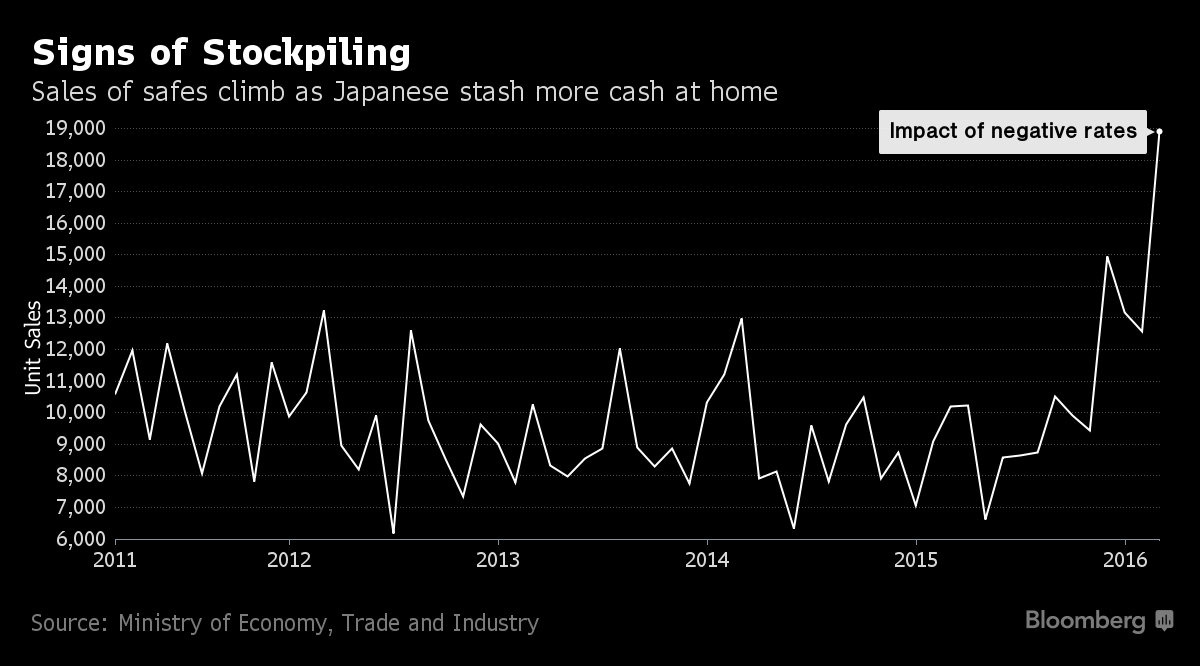
Savers are scared. Sales of safes to be installed at home have soared. There have been no structural reforms to speak of. Japan Inc. has benefited enormously, through various tax benefits and special stimulus packages, including foreign aid that is channeled back to Japanese companies. Government deficits are gigantic, providing additional stimulus for Japan Inc. And yet, the economy is languishing.

So Abenomics is facing its voters again. Few people on earth are as cynical about their elected officials as Japanese voters. Any remaining illusions have been wrung out of them years ago. In polls, voters have explained that they have not benefited from Abenomics. Yet, Prime Minister’s Shinzo Abe’s position remains strong, mainly because the opposition is so flimsy.

His conservative Liberal Democratic Party (LDP) has been in power since its beginning in 1955, except for an 11-month stint in 1993/94, and from 2009 to 2012. At the end of 2012, Abenomics was installed.

But there’s something that makes the Japanese nervous: how politicians handle their pensions. Particularly older voters. They make up a big part of the electorate. So the government decided not to rub the effects of Abenomics in their faces and rile them unnecessarily just before an election.

In April, it announced that it would delay the publication of the annual results of the $1.36 trillion Government Pension Investment Fund (GPIF), from the usual date in early July, to July 29. At the time, the election date hadn’t been set yet, but it would have to be before July 25. So July 29 was a safe bet.

The election “has absolutely nothing to do with it,” explained GPIF spokesman Shinichirou Mori at the time. His excuse was that the fund would be reviewing the results of the past 10 years and needs a little extra time to put the report together.

But like so many things of Abenomics, it too flopped: after rumors of huge losses had been swirling for months, the results were leaked.

“A person with direct knowledge of the matter,” and “speaking on condition of anonymity,” told Reuters that in fiscal 2015, which ended on March 31, the GPIF lost between ¥5 trillion and ¥5.5 trillion (between $49 billion and $53 billion).

This was the fund’s first annual loss since the Financial Crisis. All asset classes got hit, except – with hues of a bitter irony – Japanese Government Bonds (JGBs).

To continue reading: LEAKED: Japan’s Mega-Pension Fund Plows into Stocks, Eats $50Bn Loss, Tries to Hide it till after Election

Deflation Is Blowing In On An Eastern Trade Wind, by Raúl Ilargi Meijer

A deflationary winter is coming, according to SLL (see Debtonomics Archive), and Raúl Ilargi Meijer. If you read this article, you’ll have a pretty good idea what’s coming, and you can save yourself a lot of time by not reading the tremendous amount of garbage that’s out there on economics and the global economy. From Miejer at theautomaticearth.com:

Brexit is nowhere near the biggest challenge to western economies. And not just because it has devolved into a two-bit theater piece. Though we should not forget the value of that development: it lays bare the real Albion and the power hunger of its supposed leaders. From xenophobia and racism on the streets, to back-stabbing in dimly lit smoky backrooms, there’s not a states(wo)man in sight, and none will be forthcoming. Only sell-outs need apply.

The only person with an ounce of integrity left is Jeremy Corbyn, but his Labour party is dead, which is why he must fight off an entire horde of zombies. Unless Corbyn leaves labour and starts Podemos UK, he’s gone too. The current infighting on both the left and right means there is a unique window for something new, but Brits love what they think are their traditions, plus Corbyn has been Labour all his life, and he just won’t see it.

The main threat inside the EU isn’t Brexit either. It’s Italy. Whose banks sit on over 30% of all eurozone non-performing loans, while its GDP is about 10% of EU GDP. How they would defend it I don’t know, they’re probably counting on not having to, but Juncker and Tusk’s European Commission has apparently approved a scheme worth €150 billion that will allow these banks to issue quasi-sovereign bonds when they come under attack. An attack that is now even more guaranteed to occcur than before.

Still, none of Europe’s internal affairs have anything on what’s coming in from the east. Reading between the lines of Japan’s Tankan survey numbers there is only one possible conclusion: the ongoing and ever more costly utter failure of Abenomics continues unabated.

It’s developing in pretty much the exact way I said it would when Shinzo Abe first announced the policies in late 2012. Not that it was such a brilliant insight, all you had to know is that Abe and his central bank head Kuroda don’t understand what their mastodont problem, deflation, actually is, and that means they are powerless to solve it.

That Abe said somewhere along the way that all that was needed was his people’s confidence to make Abenomics work, says more than enough. The multiple flip-flops over a sales-tax increase say the rest. People don’t become more confident just because someone tells them to; that has the opposite effect. Deflation results from reduced spending, which in turn comes from not only decreasing confidence as well as a decrease in money people have available to spend.

That modern economics sees everything not spent as ‘savings’ adds significantly to the failure -on the part of Abe, Kuroda and just about everyone else- to understand what happened in Japan over the past 2-3 decades. To repeat once again, inflation/deflation is the velocity of money multiplied by money- and credit supply. The latter factor has in general gone through the roof, but that means zilch if the former -velocity- tanks.

That this velocity is -still- tanking, in Japan as well as in the western world, is due to, more than anything else, an unparalleled surge in debt. At some point, that will catch up with any economy and society. Even if they are growing, which our economies are not. Growth has been replaced with credit, and credit is debt. It’s safe to say that money velocity cannot possibly ‘recover’ until large swaths of debt have been cancelled, one way or another.

To continue reading: Deflation Is Blowing In On An Eastern Trade Wind


Japan’s Debt Burden Is Quietly Falling the Most in the World, by Enda Curran and James Mayger

Here’s the solution to all the world’s economic problems. Have governments issue debt, have central banks buy it, and then have the governments repudiate it. What could go wrong? From Enda Curran and James Mayger at bloomberg.com:

Japan for years has been renowned for having the world’s largest government debt load. No longer.

That’s if you consider how the effective public borrowing burden is plunging — by one estimate as much as the equivalent of 15 percentage points of gross domestic product a year, putting it on track toward a more manageable level.
Accounting for the Bank of Japan’s unprecedented government bond buying from private investors, which some economists call “monetization” of the debt, alters the picture. Though the bond liabilities remain on the government’s balance sheet, because they aren’t held by the private sector any more they’re effectively irrelevant, according to a number of analysts looking at the shift.

While Japan’s estimated gross government debt is now over twice the size of the economy, according to Schulz’s calculations using BOJ data, the shuffle of holdings from private actors like banks and households to the central bank is having a big impact. It means debt in private hands will fall to about 100 percent of GDP in two to three years, from 177 percent just before Prime Minister Shinzo Abe took power in late 2012, he estimates.

Sales Tax

It’s not like Japan is slowing down on borrowing. Abe’s administration is now laying the groundwork for another burst of fiscal stimulus, which could be funded by selling bonds. He also announced Wednesday a delay to a sales tax hike planned for April 2017, rebuffing fiscal hawks who argued it was vital to raise revenue. Finance Minister Taro Aso explained Tuesday that “the biggest problem is that private consumption hasn’t risen,” making now not a good time to raise the levy.

Helping improve household sentiment could be one reason for making it explicit that at least some of the government bonds in the BOJ’s holdings will be written off. If Japanese consumers understand they’re not on the hook for all the gross debt outstanding, their mood could potentially perk up.

‘Permanently Monetized’

“I do not believe that there is any credible scenario in which Japanese government debt can be repaid in the normal sense of the word repay,” said Adair Turner, chairman of the Institute for New Economic Thinking and a former head of Britain’s financial regulator. “It would therefore be useful to make clear to the Japanese people that the public debt does not all have to be repaid, since some of it can be permanently monetized by the Bank of Japan.”
Another option touted by some economists is to have the BOJ convert a portion of its holdings into perpetual zero-interest government bonds. Japanese authorities already have embraced other unorthodox moves, including negative interest rates, central bank purchases of stocks and real-estate investment trusts and a welter of programs to bolster lending.

For now, there’s no sign from policy makers that they are willing to take a step closer to full-bore debt monetization. As a veteran of the fiscal-discipline focused Ministry of Finance, BOJ Governor Haruhiko Kuroda would probably never endorse such a plan, according to Masaaki Kanno, chief Japan economist at JPMorgan Chase & Co. Kuroda has a little less than two years left in his current term.

To continue reading: Japan’s Debt Burden Is Quietly Falling the Most in the World

Escaping Nipponese NIRP—-8% Of GDP Has Been Stuffed Into Futons, by Kevin Buckland, Shigeki Nozawa, and Kazumi Miura

When low or no interest rates are paid on deposits, with negative rates perhaps to come, there is no advantage to holding one’s money in banks rather than in cash, except for safety. With the worldwide discussion of bank “bail-ins,” that last advantage may be ephemeral. Japan offers a case study, where the public is ruining the best laid plans of mice and central bankers. From Kevin Buckland, shigeki Nozasa and Kazumi Miura at bloomberg.com:

When the Bank of Japan unexpectedly announced negative interest-rate policies in January, the first thing Tomomi Sato did was withdraw a 10th of the money in her bank account and stash it at home.

“It made me think of bank runs and shutdowns like I’ve heard there were in the past,” said the 30-something assistant to manga comic artists, who commutes for two hours from a small apartment in Tokyo’s suburbs. “Eventually, I feel like they’ll start charging me to keep my money there. When I think about that, I begin to worry.”

Sato is emblematic of a challenge facing the central bank that rates below zero only deepened: average Japanese aren’t feeling the benefits of more than three years of extraordinary monetary stimulus, and cash withdrawals suggest they are losing faith. About 40 trillion yen ($360 billion) has piled up in homes across Japan, according to a Dai-ichi Life Research Institute estimate — equivalent to about 8 percent of gross domestic product. That’s money banks could be lending on or using to buy bonds.

Mattress Money

“So long as Japan has what can broadly be categorized as a zero interest-rate policy, the amount will continue to grow,” said Hideo Kumano, the Tokyo-based chief economist at Dai-ichi Life and a former BOJ official. “What it means for 40 trillion yen to be sleeping under mattresses is that the deflationary mindset is deeply rooted, and Japanese have become hyper-sensitive to risk.”

https://assets.bwbx.io/images/users/iqjWHBFdfxIU/ibwm3jzGTHHM/v2/-1x-1.png

Both BOJ Governor Haruhiko Kuroda and Prime Minister Shinzo Abe have highlighted the need to reinvigorate inflation expectations to spur consumption and investment. Meeting those goals has been complicated by an almost 20 percent plunge in Japanese stocks over the past year. Negative yields on Japanese government bonds maturing in up to a decade have also spurred the Ministry of Finance to cancel a string of sales aimed at retail investors.

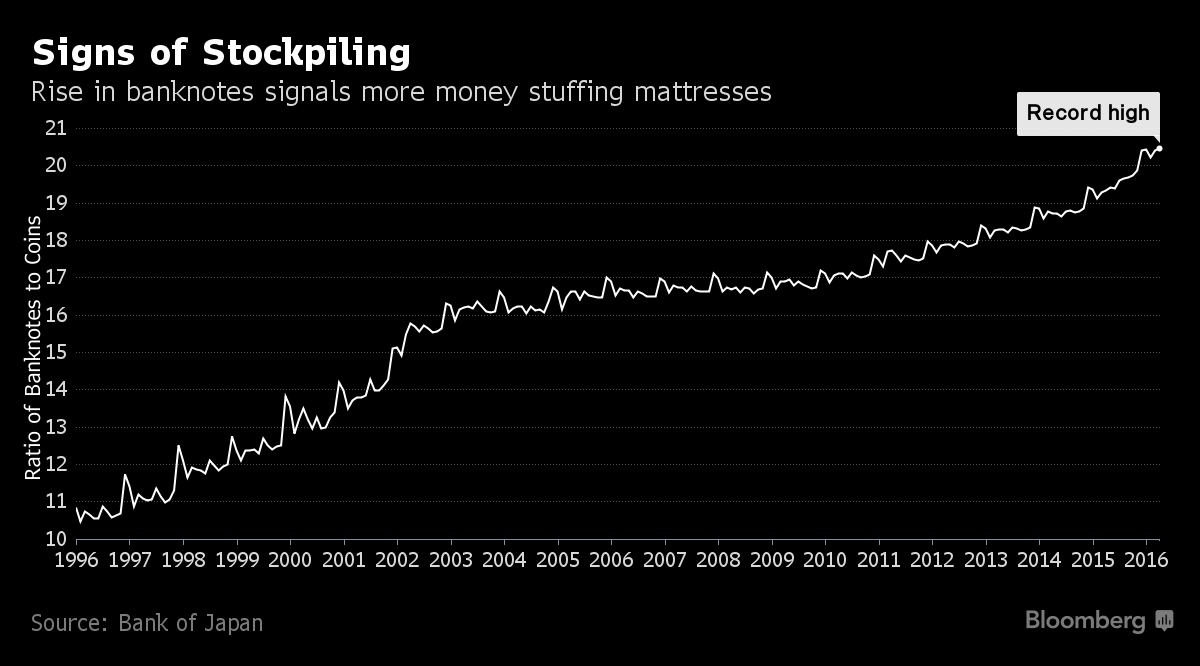
Financially, there’s little that separates the futon from a savings account that pays 0.001 percent annual interest. And perceptions that a negative deposit rate could become a tax on savers has exacerbated the migration of funds. Sales of safes in March were the highest in government data going back five years, and paper money exceeded coins in circulation by the most last month in BOJ figures to 1970.

https://assets.bwbx.io/images/users/iqjWHBFdfxIU/i5ZZB6MH9n3o/v2/-1x-1.png

To continue reading: Escaping Nipponese NIRP—-8% Of GDP Has Been Stuffed Into Futons

Japan’s Abenomics ‘dead in the water’ after US currency warnings, by Ambrose Evans-Pritchard

Twenty-five years of policy makers beating themselves in the heads with Keynesian hammers has made Japan’s once proud economy into a basket case. From Ambrose Evans-Pritchard at telegraph.co.uk:

The Bank of Japan has been forced to retreat from further emergency stimulus after a blizzard of criticism at home and abroad, and warnings that extreme measures may now be doing more harm than good.

The climb-down by the world’s most radical central bank is the latest sign that the monetary experiments since Lehman crisis may have run their course. The authorities have not exhausted their ammunition but are hitting political and legal constraints.

The yen surged 3pc against the US dollar in the biggest one-day move in eight months and equities skidded across Asia after the Bank of Japan (BoJ) failed to take fresh action to stave off deepening deflation, catching markets badly off guard.

Governor Haruhiko Kuroda dashed hopes for ‘helicopter money’, warning that direct monetary financing of spending would be “illegal”.

Mr Kuroda insisted that the BoJ still has plenty of firepower and can at any time push interest rates even deeper into negative territory or boost bond purchases beyond the current $74bn a month. “If additional easing is needed, we will do so promptly,” he said.

The reality is that negative rates (NIRP) have backfired badly on every front. They have prompted bitter protests from banks and money market funds caught in a squeeze.

The yen has appreciated by 10pc since the BoJ first embarked on the policy in January, the exact opposite of what was intended. The rising yen – ‘endaka’ – is pushing Japan deeper into a deflation trap and undercutting the whole purpose of ‘Abenomics’.

Core inflation has fallen to minus 0.3pc. The Nikkei index of equities in Tokyo has dropped 13pc this year, with contractionary wealth effects that make the BoJ’s task even harder. “Negative rates have completely failed,” said David Bloom from HSBC.

Washington will not tolerate the use of NIRP in any case, deeming it a disguised attempt to drive down exchange rates and export problems to the rest of the world.

Jacob Lew, the US Treasury Secretary, warned Japan and the eurozone at the G20 in Shanghai in February that the Obama administration is losing patience with use of beggar-thy-neighbour tactics by countries already running a current account surplus. They are in effect shifting their excess capacity abroad. Germany in particular is coming into the US cross-hairs.

Richard Koo from Nomura said the US is now on the warpath against currency manipulators. Mr Lew’s threat effectively renders Abenomics “dead in the water”.

To continue reading: Japan’s Abenomics ‘dead in the water’ after US currency warnings

Lessons from Japan: Decades of Decay, Unavoidable Collapse, by Charles Hugh Smith

In the long run, as John Maynard Keynes so infamously observed, we are indeed all dead. And in the long run, moronic economics, like those promoted by Mr. Keynes (with apologies to morons, not that any read SLL), lead to collapse. From Charles Hugh Smith at oftwominds.com:

Japan has proven that decay can be stretched into decades, but it has yet to prove that gravity can be revoked by central bank monetary games.

Japan’s fiscal and monetary extremes are in the news again: this time it’s the Bank of Japan’s extraordinarily large ownership of Japanese stocks, a policy intended to boost “investor sentiment” and prop up sagging equity valuations:

The Tokyo Whale Is Quietly Buying Up Huge Stakes in Japan Inc.

The core failure of Japan’s central bank and state is they have attempted to substitute monetary games for desperately needed social, political and economic reforms. This is the Keynesian ideology and project in a single sentence:
Keynesian policy holds that expansionary monetary and fiscal policy can be substituted for structural social, political and economic reforms, enabling the status quo to retain its power and privileges without disruption.

In effect, Japan has pursued a vast monetization campaign for 26 years. The Bank of Japan creates money out of thin air and uses the free money to buy government bonds, funding the state’s enormous fiscal deficits (also known as monetizing government debt). The BoJ has extended this monetization to corporate bonds and the stock market– effectively propping up government debt, corporate debt and the stock market with newly created money.

That these were once private-sector markets has been set aside, as the only thing that matters now is keeping them propped up, regardless of the cost. As I note in my new book Why Our Status Quo Failed and Is Beyond Reform, when emergency measures become permanent policies, you know the status quo is on life support.

To continue reading: Lessons from Japan: Decades of Decay, Unavoidable Collapse


How Central Planners Crippled Japan’s Economy, by Yonathan Amselem

The blogosphere is filled with articles about how this, that, and the other thing will end badly, and a favorite is Japan’s economic policies. The one thing wrong with such articles is they implicitly assume that financial markets have to validate the dire projections before they can be realized. There is no “will” in Japan; it is in bad shape now and getting worse every day, regardless of what the twits in government and central bank do to manipulate its stock and bond markets. From Yonathan Anselem at mises.org:

The greatest tragedy of the 2008–2009 financial meltdown was not that it happened. The collapse of asset prices was the necessary result of near zero interest rates. No, the most devastating aspect of the financial meltdown is that central planning alchemy lost no credibility. Policymakers around the world are still turning to Keynesian and socialist interventionism to address problems caused by Keynesians and socialists. The twin sledgehammers of central banking and almost unlimited state power have so distorted global markets (again) that some economies are now terminal. The latest victim of the interventionists and micromanagers is the nation of Japan. A once genuinely productive and innovative nation has, over the years, slowly succumbed to the cancerous rot of interventionism.

Japan’s World War II defeat left behind a barren rocky island whose industrial capacity, infrastructure, and labor force were devastated by Allied bombs. Japan’s flattened cities and smoldering factories may have painted a gloomy future but Japan had the thing that mattered most — a population largely free to organize and rebuild. The American military and remnants of central Japanese authority tried to lead the rebuilding of Japan through the political process but lines of communication and the transportation infrastructure were so damaged that many population centers away from Tokyo were left relatively free to rebuild. The resulting Japanese economic boom catapulted Japan’s living standards to a level on par with most Westernized nations. This explosive growth, described as a “miracle,” was no such thing. Japan’s new-found prosperity was simply what happens when markets are allowed to function. Unfortunately, the central planners in banking and government couldn’t resist the statist urge of heavy-handed interventionism. If there’s anything the political elite hate, its free people making voluntary decisions without their forceful input.

Central Planning Has Turned Japanese Corporations into Welfare Queens

The central planners imposed a number of zany anti-market schemes on the Japanese economy that have never been substantively reformed to this day. Legislators shielded Japan’s massive industrial base from foreign competition through protectionist tariffs and even subsidized some overseas exports. On the domestic front, nascent Japanese companies were heavily burdened by onerous regulations and very high taxes — this made it nearly impossible for start-ups to get off the ground and challenge the corporate establishment’s market share. As if this was not enough, exporters were further coddled by the Bank of Japan (BOJ). The BOJ has been fervently trying to turn the yen into toilet paper for the last thirty years. A cheap currency means artificially high profits for companies that export goods and artificially high costs for companies that import goods. After all, no government scheme could rightfully call itself a government scheme if it didn’t enrich somebody at the direct expense of others. The destructive effects of these policies have massively eroded Japanese productivity in the twentieth and twenty-first centuries.

To continue reading: How Central Planners Crippled Japan’s Economy

On The Impossibility Of A Soft Landing, by David Stockman

There is no better numbers guy than David Stockman, and he makes an airtight case that the numbers don’t add up for anything but a massive economic and financial crash. From Stockman at davidstockmanscontracorner.com:

While the robo-traders play tag with the chart points, it is worth considering how it will all end. After all, at today’s close the broad market (S&P 500) was valued at 24.3X LTM earnings per share. That is, valuations are in the nosebleed section of history, but financial history has tumbled into the sub-basement of future possibilities.

Stated differently, every first year spread-sheet jockey knows that what drives LBO models and NPV calculations is the assumed terminal year growth rate. Get imaginative enough about the possibilities out there, and you can come up with a swell return on today’s investment even if the next few years look a little rocky—-or even alot so.

So never mind that earnings have fallen five straight quarters and at $86.53 per share are now down 18.5% from their September 2014 LTM peak. Also ignore the fact that this quarter will be down 10% and that there is no rational basis for a rebound any time soon.

But somewhere behind the robo-machines which line the casino there is a corporals guard of carbon units buying what Wall Street is dumping. And whether they know it or not, at 24.3X they are betting on one whopping big terminal growth rate on the far side of the deflationary turmoil now afflicting the global economy.

Here’s the thing, however. The current deflationary wave is not a one-time detour which will pass in due course. Per the above analogy, we do not have merely two years of bad numbers in a 10-year LBO model with a robust terminal value at the end.

What we have, instead, is merely the initial shock waves from the actions of central banks which are trashing the joint. Lurking on the other side, therefore, is unfathomable risk, not extraordinary growth.

In a word, the stock market is not worth even 15X its current earnings or 1300. At length, the carbon units out there catching today’s bouncing dead cats will thank their lucky stars if their losses are only 40% from here.

The historical dead-end ahead is dramatically evident in the case of the BOJ and its lunatic detour into NIRP. And Japan is only following central bank policies recommended by Keynesians from the West and which are being followed, except for small nuances of degree, by the ECB and the Fed as well.

The very last place on earth that can afford negative interest rates, however, is Japan. It’s an old age colony lapsing toward fiscal bankruptcy. In hardly a few years it will desperately need buyers for its government bonds who don’t count their wealth in yen.

To continue reading: On The Impossibility Of A Soft Landing