The U.S. celebrates an arrest warrant for Vladimir Putin from a court whose jurisdiction it won’t recognize. From Good Citizen at thegoodcitizen.substack.com:
As the Empire of Lies celebrates the International Criminal Court issuing an arrest warrant for Vladimir Putin, let’s revisit who the ICC really works for.
Watch war criminal John Bolton threaten to arrest ICC judges and go after their finances if they or any organization or company assist the ICC in taking any action against American war criminals:
I asked ChatGPT about the war crimes of American leaders and the following is what it returned…
Henry Kissinger
Henry Kissinger, a former U.S. Secretary of State, has been accused of being involved in several war crimes during his time in office. Here are some of the main allegations against him:
The bombing of Cambodia: Kissinger played a key role in the secret bombing campaign in Cambodia during the Vietnam War, which led to the deaths of thousands of civilians. The bombing was carried out without the knowledge or approval of Congress or the American public.
The U.S. claims the imperial right to be wherever it wants to be. From The Strategic Culture Editorial Board at strategic-culture.org:
A $32 million drone buried unceremoniously at sea says a lot about a failing empire.
A U.S. spy drone operating 8,000 kilometers from Washington on Russia’s borders, helping a Nazi regime at war against Russia, crashes into the Black Sea – and yet, insanely, Moscow is arraigned for taking defensive action?
One has to be amazed by the total dissonance among American politicians and media over the incident this week when an unmanned U.S. military aircraft crashed into the Black Sea near Russian territory. The righteous indignation speaks of ineffable double-think and hypocrisy.
Russia was condemned for “reckless” and “unlawful” conduct after two of its fighter jets intercepted an MQ-9 Reaper unmanned aerial vehicle (UAV). The Reaper is deployed both as a surveillance aircraft and as an attack weapon capable of firing missiles. This drone was detected approaching airspace that Moscow has designated off-limits in connection with its special military operation in Ukraine.
The Pentagon claimed that one of the Russian Su-27 jets collided with the drone causing damage to one of its propellers. The U.S. Air Force says its operators brought down the Reaper which crashed in international waters. Why was a $32 million UAV so readily ditched?
For its part, Russia claims that its fighter jets buzzed the American drone causing it to make sharp maneuvers whereupon the UAV lost aeronautical control and crashed into the sea. Moscow has put the blame on the United States for creating a provocation and called on the U.S. to halt hostile flights near its borders. An effort to recover the drone debris is underway by Russia. Sensitive flight data may show what kind of mission the UAV was really undertaking. Was it gathering offensive targeting coordinates, as many such American UAVs have been doing over the past year to enable the Kiev regime?
What we need is more sanity, but we’re not getting that. From Ryan McMaken at mises.org:
Republicans and Democrats may quibble over how federal tax dollars might be spent on various social welfare programs like Medicaid and food stamps. But alongside Social Security, there is one area of federal spending that everyone can apparently agree on: military spending. Last year, the Biden administration requested one of the largest peacetime budgets ever, at $813 billion. Congress wanted even more spending and ended up approving a budget of $858 billion. In inflation-adjusted terms, that was well in excess of the military spending we saw during the Cold War under Ronald Reagan. This year, Joe Biden is asking for even more money, with a new budget request that starts at $886 billion. Included in that gargantuan amount—which doesn’t even include veterans spending—is billions for new missile systems for deploying nuclear arms, plus other programs for “modernizing” the United States’ nuclear arsenal.
Indeed, over the past year, the memo has gone out among the usual advocates of endless military spending that the US needs to spend much more on nuclear arms. This is a perennial position at the Heritage Foundation, of course, which has never met a military pork program it didn’t like. Moreover, in recent months, the Wall Street Journal has run several articles demanding more nuclear arms. The New York Post was pushing the same line late last year. Much of the rhetoric centers on the idea that Beijing is increasing its own spending on nuclear arms and thus the United States must “keep up.” For instance, last month, Patty-Jane Geller insisted that the US is in an “arms race” with China. Meanwhile, writers at the foreign-policy site 1945claimed Congress must “save” the American nuclear arsenal.
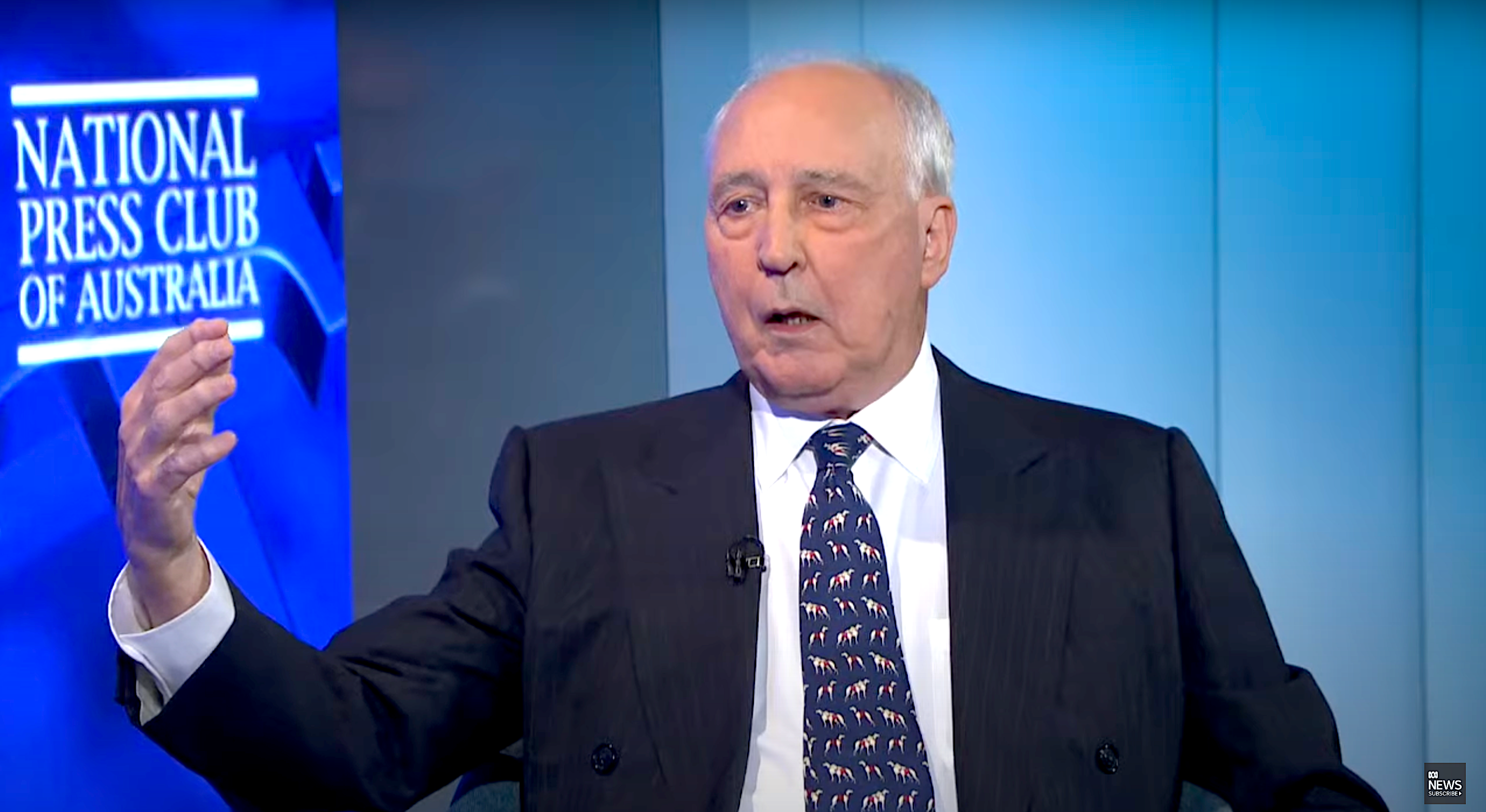
Australia desperately needs its former Prime Minister, Paul Keating, back in office. This is the most honest (and funny at times) series of public utterances that I’ve ever seen from a politician, or former politician. From Joe Lauria at consortiumnews.com:
Former Australian Prime Minister Paul Keating at the National Press Club in Canberra on Wednesday. (ABC screenshot)
Paul Keating, a former prime minister of Australia, has boldly contested the establishment consensus that Australia needs to spend A$368 billion to buy nuclear submarines as protection against a China Keating bluntly says is not a threat.
The former Labor premier has defied the conventional wisdom, saying the U.S. opposes China only because Beijing has committed “the high sin in internationalism – it has grown as large as the United States,” a fact the “exceptional state” can’t accept. By subordinating itself, Australia is forfeiting its sovereignty to rely on Britain, which abandoned its former colony years ago, to build nuclear submarines that serve U.S. — and not Australian — interests.
“China does not present and cannot present as an orthodox threat to the United States. By orthodox, I mean an invasive threat,” Keating said in a speech to the Australian National Press Club on Wednesday. He said:
“The United States is protected by two vast oceans, with friendly neighbours north and south, in Canada and Mexico. And the United States possesses the greatest arsenal in all human history. There is no way the Chinese have ever intended to attack the United States and it is not capable of doing so even had it contemplated it. So, why does the United States and its Congress insist that China is a ‘threat’?
The US Defence department’s own annual report to Congress in late 2022 said ‘the PRC aims to restrict the United States from having a presence on China’s periphery’. In other words, China aims to keep US navy ships off its coast. Shocking.
Imagine how the US would react if China’s blue water navy did its sightseeing off the coast of California. The US would be in a state of apoplexy.”
Keating said China is integrated into the international system as a member of the World Trade Organization, the IMF, the World Bank, the G20 and other organizations and has a “vested interest in globalization.”
The EU (and the U.S., too) have a set of sanctions called the Boomerang sanctions. From Natasha Wright at strategic-culture.org:
The Collective West on their steep downward civilization trend are doing their best to get their nanny state-addicted, complacent populations slowly used to the new age of a dysfunctional society.
EU (and the USA) have repeatedly tried bulldozing anti-Russia sanctions in the past year but all the attempts at reducing the Russian ruble to rubble have made a Baerbockean 360 degrees twist and turn with Vladimir Putin and Xi Jinping not even raising an eyebrow.
Those who run the EU either overtly or behind the diplomatic curtains seem to have had one more indecent intention to score yet another more or less meaningless, financially political point, just like all the others they have made to date, in that they will adopt their tenth jubilee set of anti-Russian sanctions. And alas, there lies their ill-fated symbolism which regrettably far too often likens the antics of Mr Bean. The EU and the NATO jackals alike tend to prefer the voodoo symbolism of dates, numbers etc: These were supposed to be voted on and passed on the 24th of February on the one-year anniversary of the beginning of the Russian special military operation in Ukraine. With this utterly empty gesture they wanted to show how much they cared about their ‘mutual fight’ ‘for the greater good’ (please, excuse my sarcasm) against Russia. But sadly their decision came one day only too late because they did not manage to agree on all the clauses and exemptions that tenth package was supposed to contain. Even more importantly, they found it hard to agree on what was supposed to be exempt from the sanctions so as to avoid the damage done being far more detrimental than the worth of it all at the end of their bureaucratic Brussels’ day for those EU member states strong and powerful enough to relentlessly and shamelessly lobby for ‘their cause’, such as Belgium for instance in the case of its Russian diamonds.
There’s more similarities than differences between America’s involvement in Iraq and its involvement in Ukraine. The biggest difference is that U.S. troops have not”officially” entered Ukraine . . . yet. From Medea Benjamin and Nicolas J. S. Davies at antiwar.com:
March 19th marks the 20th anniversary of the U.S. and British invasion of Iraq. This seminal event in the short history of the 21st century not only continues to plague Iraqi society to this day, but it also looms large over the current crisis in Ukraine, making it impossible for most of the Global South to see the war in Ukraine through the same prism as US and Western politicians.
While the US was able to strong-arm 49 countries, including many in the Global South, to join its “coalition of the willing” to support invading the sovereign nation of Iraq, only the U.K., Australia, Denmark and Poland actually contributed troops to the invasion force, and the past 20 years of disastrous interventions have taught many nations not to hitch their wagons to the faltering US empire.
Today, nations in the Global South have overwhelmingly refused US entreaties to send weapons to Ukraine and are reluctant to comply with Western sanctions on Russia. Instead, they are urgently calling for diplomacy to end the war before it escalates into a full-scale conflict between Russia and the United States, with the existential danger of a world-ending nuclear war.
The architects of the US invasion of Iraq were the neoconservative founders of the Project for a New American Century (PNAC), who believed that the United States could use the unchallenged military superiority that it achieved at the end of the Cold War to perpetuate American global power into the 21st century.
The mainstream is trying to acknowledge without actually having to admit that Ukraine is losing the war it was doomed to lose from the start. From Moon of Alabama at moonofalabama.org:
Finally some truth about the real state of the Ukrainian military is sneaking into main stream media. It is as bad, still not fully disclosed, as we have described it again and again.
I’ll leave out the propaganda bits and go for the factual beef. The quotes are long but needed to grasp the depth of horrible situation.
The opening paragraph:
The quality of Ukraine’s military force, once considered a substantial advantage over Russia, has been degraded by a year of casualties that have taken many of the most experienced fighters off the battlefield, leading some Ukrainian officials to question Kyiv’s readiness to mount a much-anticipated spring offensive.
That spring offensive is as likely to happen as the announced relief campaign to unblock Bakhmut. The later is bogged down.
The spring campaign will be made up of green recruits which will use a wild mix of weapons they are not familiar with. Unless there are some ‘western’ surprises I see no way how it can overwhelm the well prepared Russian defense lines.
It’s not easy putting together monetary arrangements that will be accepted by nations comprising over half the world’s population. (SLL maintains that it will be impossible.) From Pepe Escobar at thecradle.co:
In an exclusive interview with The Cradle, Russia’s top macroeconomics strategist criticizes Moscow’s slow pace of financial reform and warns there will be no new global currency without Beijing.
The headquarters of the Eurasian Economic Commission (EEC) in Moscow, linked to the Eurasia Economic Union (EAEU) is arguably one of the most crucial nodes of the emerging multipolar world.
That’s where I was received by Minister of Integration and Macroeconomics Sergey Glazyev – who was previously interviewed in detail by The Cradle – for an exclusive, expanded discussion on the geoeconomics of multipolarity.
Glazyev was joined by his top economic advisor Dmitry Mityaev, who is also the secretary of the Eurasian Economic Commission’s (EEC) science and technology council. The EAEU and EEC are formed by Russia, Belarus, Kazakhstan, Kyrgyzstan, and Armenia. The group is currently engaged in establishing a series of free trade agreements with nations from West Asia to Southeast Asia.
Our conversation was unscripted, free flowing and straight to the point. I had initially proposed some talking points revolving around discussions between the EAEU and China on designing a new gold/commodities-based currency bypassing the US dollar, and how it would be realistically possible to have the EAEU, the Shanghai Cooperation Organization (SCO), and BRICS+ to adopt the same currency design.
Glazyev and Mityaev were completely frank and also asked questions on the Global South. As much as extremely sensitive political issues should remain off the record, what they said about the road towards multipolarity was quite sobering – in fact realpolitik-based.
Saudi Arabia will use the agreement as a wedge in its dealing with the U.S. From Ted Snider at libertarianinstitute.org:
Until it happened, it was unthinkable. The United States has for decades guarded its role as the sole negotiator in the Middle East. It has insisted on being the chief arbiter of agreements and the architect and decider of partnerships. But on March 10, China emerged as the broker of a transformative agreement between Iran and Saudi Arabia while Washington was sidelined and left out of the room. The most important recent realignment of the Middle East was shaped by Beijing.
The story is so critical that it is too big to be contained in one story. It is two stories: the shifting of regional alignments and the shifting of global alignments.
Iran and Saudi Arabia have been exploring improving relations for the past few years. The feelers began with talks in 2020 and grew into several meetings in Iraq and Oman. In 2021, the two announced that Iran had resumed exports to Saudi Arabia, and Iran broached the idea of reopening consulates in each other’s countries and re-establishing diplomatic ties.
Both the Iranian and Saudi statements following their new agreement acknowledged those talks and thanked Iraq and Oman for their efforts and for hosting them. But it was China that brought them to the table, enabled the breakthrough and accomplished the agreement. “The two sides,” the Saudi statement said, “expressed their appreciation and gratitude to the leadership and government of the People’s Republic of China for hosting and sponsoring the talks, and the efforts it placed towards its success.” Iran’s statement expressed similar gratitude.
Douglas Macgregor has committed two unforgivable sins among U.S. analysts of the Ukraine war. He knows what he’s talking about, and he’s been consistently right. From Macgregor at theamericanconservative.com:
America’s self-inflicted trouble in Ukraine aggravates our dangerous trouble at home.
The crisis of American national power has begun. America’s economy is tipping over, and Western financial markets are quietly panicking. Imperiled by rising interest rates, mortgage-backed securities and U.S. Treasuries are losing their value. The market’s proverbial “vibes”—feelings, emotions, beliefs, and psychological penchants—suggest a dark turn is underway inside the American economy.
American national power is measured as much by American military capability as by economic potential and performance. The growing realization that American and European military-industrial capacity cannot keep up with Ukrainian demands for ammunition and equipment is an ominous signal to send during a proxy war that Washington insists its Ukrainian surrogate is winning.
Russian economy-of-force operations in southern Ukraine appear to have successfully ground down attacking Ukrainian forces with the minimal expenditure of Russian lives and resources. While Russia’s implementation of attrition warfare worked brilliantly, Russia mobilized its reserves of men and equipment to field a force that is several magnitudes larger and significantly more lethal than it was a year ago.
Russia’s massive arsenal of artillery systems including rockets, missiles, and drones linked to overhead surveillance platforms converted Ukrainian soldiers fighting to retain the northern edge of the Donbas into pop-up targets. How many Ukrainian soldiers have died is unknown, but one recent estimate wagers between 150,000-200,000 Ukrainians have been killed in action since the war began, while another estimates about 250,000.