
Category Archives: Other Views

The Wrong War for Central Banking, by Stephen S. Roach

From Stephen S. Roach, former Chairman of Morgan Stanley Asia and the firm’s chief economist, senior fellow at Yale University’s Jackson Institute of Global Affairs, and a senior lecturer at Yale’s School of Management. Notwithstanding the mainstream credentials, Roach has often swum against the tide on his economic calls, and he’s been right more often than wrong. His only mistake here is not mentioning debt as the overriding factor in deflation, but the rest of the article is pretty good. From Roach, at project-syndicate.org:

BEIJING – Fixated on inflation targeting in a world without inflation, central banks have lost their way. With benchmark interest rates stuck at the dreaded zero bound, monetary policy has been transformed from an agent of price stability into an engine of financial instability. A new approach is desperately needed.

The US Federal Reserve exemplifies this policy dilemma. After the Federal Open Market Committee decided in September to defer yet again the start of its long-awaited normalization of monetary policy, its inflation doves are openly campaigning for another delay.
Support Project Syndicate’s mission

For the inflation-targeting purists, the argument seems impeccable. The headline consumer-price index (CPI) is near zero, and “core” or underlying inflation – the Fed’s favorite indicator – remains significantly below the seemingly sacrosanct 2% target. With a long-anemic recovery looking shaky again, the doves contend that there is no reason to rush ahead with interest-rate hikes.

Of course, there is more to it than that. Because monetary policy operates with lags, central banks must avoid fixating on the here and now, and instead use imperfect forecasts to anticipate the future effects of their decisions. In the Fed’s case, the presumption that the US will soon approach full employment has caused the so-called dual mandate to collapse into one target: getting inflation back to 2%.

Here, the Fed is making a fatal mistake, as it relies heavily on a timeworn inflation-forecasting methodology that filters out the “special factors” driving the often volatile prices of goods like food and energy. The logic is that the price fluctuations will eventually subside, and headline price indicators will converge on the core rate of inflation.

This approach failed spectacularly when it was adopted in the 1970s, causing the Fed to underestimate virulent inflation. And it is failing today, leading the Fed consistently to overestimate underlying inflation. Indeed, with oil prices having plunged by 50% over the past year, the Fed stubbornly maintains that faster price growth – and the precious inflation rate of 2% – is just around the corner.

Missing from this logic is an appreciation of the new and powerful global forces that are bearing down on inflation. According to the International Monetary Fund’s latest outlook, the price deflator for all advanced economies should increase by just 1.5% annually, on average, from now to 2020 – not much higher than the crisis-depressed 1.1% pace of the last six years. Moreover, most wholesale prices around the world remain in outright deflation.

But, rather than recognize the likely drivers of these developments – namely, a seemingly chronic shortfall of global aggregate demand amid a supply glut and a deflationary profusion of technological innovations and new supply chains – the Fed continues to minimize the deflationary impact of global forces. It would rather attribute low inflation to successful inflation targeting, and the Great Moderation that it presumably spawned.

To continue reading: The Wrong War for Central Banking
FuhrerPrinzip, by Eric Peters

A dictatorship requires not just a dictator, but willing dictatees. From Eric Peters on a guest post at theburningplatform.com:

Free people don’t look for “leadership.” But that’s what every candidate for the presidency – regardless of partei – is offering to give them.leadership lead

Such people deserve what they will get.

They have, after all asked for it.

Most Americans do not know what the German word, fuhrer means.

It does not mean “Hitler.”

It means, leader.

Hitler was Der Fuhrer; the leader.

The Germans of the Hitler era loved having a leader. Being led.

And leading, too.

They even had an expression for it: fuhrerprinzip, the leadership principle. You obeyed your superiors and your subordinates obeyed you in turn – with the leader (Der Fuhrer) at the apex of the pyramid.

Americans today are like the Germans were.

Ready for a leader.Great Dictator image

And to be led.

The one requires the other.

This sickness in man was – is – not unique to Germans. It is a canker humanity picked up somewhere from ape to now that itches and comes to the surface regularly, pustulating and red. Germans (Prussians, to be precise about it) were particularly afflicted but the disease is easily spread.

To continue reading: FuhrerPrinzip

The Midwife to Chaos and Her Perjury, by Andrew P. Napolitano

Benghazi is only part of the story of Hillary Clinton’s depredations in Libya. Now that she’s been coronated by both parties (see “The Fix Is In,” SLL, 10/21/15), here’s a knowledgeable account of those depredations before they disappear down the memory hole, which they will. From Andrew Napolitano at antiwar.com:

The New York Times’ Maureen Dowd captured the moment last weekend when she referred to former Secretary of State Hillary Clinton as “the midwife to chaos” in Libya. Dowd apparently came to that conclusion after watching Clinton bobbing and weaving and admitting and denying as she was confronted with the partial record of her failures and obfuscations as secretary of state, particularly with respect to Libya.

The public record is fairly well-known. In March 2011, President Barack Obama declared war on Libya. He did this at the urging of Clinton, who wanted to overthrow Libyan strongman Col. Moammar Gadhafi so she could boast of having brought “democracy” to the region.

She and Obama conspired to do this even though former President George W. Bush and former British Prime Minister Tony Blair had publicly praised Gadhafi as an ally in the war against terrorist groups and even though the U.S. was giving the Gadhafi government more than $100 million a year in foreign aid.

Obama did his best to avoid constitutional norms. He deployed American intelligence agents on the ground, not troops, so he could plausibly deny he had put “boots” on the ground. He did not seek an American national consensus for war because Libya presented no threat whatsoever to the U.S. He did not obtain a congressional declaration of war as the Constitution requires because he couldn’t get one. And he did not seek United Nations permission, which is required to attack a fellow U.N. member.

He did obtain a U.N. embargo of the shipment of weapons into Libya, and he secured a NATO-enforced no-fly zone over portions of Libya. In order to enforce the no-fly zone, NATO sent jet fighters over the skies of Libya. The jets were guided and directed by American intelligence agents on the ground to bomb Libyan planes on the ground, which had been paid for by American taxpayers.

To pursue her goal of a “democratic” government there, Clinton, along with Obama and a dozen or so members of Congress from both houses and both political parties, decided she should break the law by permitting U.S. arms dealers to violate the U.N. arms embargo and arm Libyan rebels whom she hoped would one day run the new government. So she exercised her authority as secretary of state to authorize the shipment of American-made arms to Qatar, a country beholden to the Muslim Brotherhood and friendly to the Libyan rebels and a country the U.S. had no business arming – unless the purpose of doing so was for the arms to be transferred to the rebels.

Once this plot was hatched, Clinton and her fellow conspirators realized that some of these rebel groups were manned by al-Qaida operatives; and selling or providing arms to them is a felony – hence the reason for months’ worth of missing and destroyed Clinton emails. How could someone running for president possibly justify providing material assistance to terrorist organizations in the present international climate?

To continue reading: The Midwife to Chaos and her Perjury

Detroit Public Schools: 93% Not Proficient in Reading; 96% Not Proficient in Math, by Terence P. Jeffrey

Kids in Detroit can’t read or do math, and don’t think it’s because not enough money is being spent in that fiscally challenged city. Take note of the per student spending numbers in the article. The national numbers are better, but are still a disgrace. From Terence P. Jeffrey from cnsnews.com:

In the Detroit public school district, 96 percent of eighth graders are not proficient in mathematics and 93 percent are not proficient in reading.

That is according to the results of the 2015 National Assessment of Educational Progress tests published by the Department of Education’s National Center for Educational Statistics.

Only 4 percent of Detroit public school eighth graders are proficient or better in math and only 7 percent in reading. This is despite the fact that in the 2011-2012 school year—the latest for which the Department of Education has reported the financial data—the Detroit public schools had “total expenditures” of $18,361 per student and “current expenditures” of $13,330 per student.

According to data published by the Detroit Public Schools, the school district’s operating expenses in the fiscal year that ended on June 30, 2014 amounted to approximately $14,743 per student.

Nationwide, only 33 percent of public-school eighth graders scored proficient or better in reading in 2015 and only 32 percent scored proficient or better in mathematics.

To continue reading: Detroit Kids Can’t Read or Do Math

Inflation By Decade, by The Burning Platform

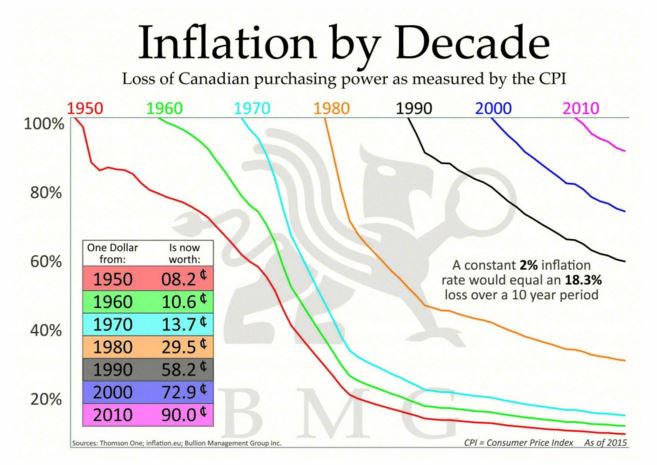
Even the Fed achieves its 2 percent per annum inflation goal, you get screwed. Those 2 percents add up, or, more properly, subtract down from your purchasing power. From theburningplatform.com:

Remember the GOAL of the Federal Reserve is to ACHIEVE 2% inflation over time. So, their goal is to decrease your purchasing power by 18.3% every ten years. Even using their fake under-reported CPI, they have managed to decrease the dollar’s purchasing power by 91.8% since 1950. And you are wondering why you can’t get ahead?

http://www.theburningplatform.com/2015/10/28/inflation-by-decade/

Cummins Sinks After Trimming Annual Forecast, Earnings Miss, by Mike Clothier

Sales and profits are falling like flies in the US industrial economy. The latest: Cummins, which among other things makes engines for big rigs. From Mark Clothier at bloomberg.com:

Company to cut 2,000 jobs to save as much as $200 million
Sales in key markets of China and Brazil at multiyear lows

Cummins Inc. fell the most in more than three years after third-quarter profit trailed analysts’ estimates and the company reduced its annual sales forecast because of weakening demand for its heavy-duty engines.

The company also said it’s cutting 2,000 jobs as part of a plan to save as much as $200 million a year. And Chief Financial Officer Pat Ward said on a conference call that Cummins will resume share buybacks this quarter. Its board authorized a $1 billion repurchase program in July 2014.

Cummins reported quarterly earnings of $2.14 a share on revenue of $4.62 billion, trailing the average estimates of $2.60 and $4.91 billion compiled by Bloomberg. Orders in China and Brazil are at multiyear lows with no sign of improvement soon, the Columbus, Indiana-based company said in a statement. Revenue in North America rose 4 percent, compared with an 18 percent decline in international markets.

“We are taking difficult but necessary actions to lower costs in the face of weak demand in many of our markets,” Chief Executive Officer Tom Linebarger said in the statement. “Global off-highway and power generation markets have been weak for some time and are worsening.”

Cummins said revenue this year will be little changed to down 2 percent from 2014, after an earlier forecast of an increase of 2 percent to 4 percent. The company said it will record pretax costs of $70 million to $90 million this quarter related to the job cuts.

The shares dropped 8.7 percent to $102.35 at the close in New York, their biggest one-day slide since July 2012. They have declined 29 percent this year.

“While we anticipated revenue weakness from off-highway markets, the magnitude of declines from on-highway were more aggressive than expected,” David Leiker, an analyst at Robert W. Baird & Co. in Milwaukee, wrote in a research note. He has a buy rating on the shares.

http://www.bloomberg.com/news/articles/2015-10-27/cummins-falls-after-trimming-annual-forecast-miss-on-earnings

Tourists of Empire America’s Peculiar Brand of Global Imperialism, by William Astore

The US comes, sees, stays a long time, tries to conquer, doesn’t do so, and gets out. From William Astore  at TomDispatch via antiwar.com:

The United States is a peculiar sort of empire. As a start, Americans have been in what might be called imperial denial since the Spanish-American War of 1898, if not before. Empire – us? We denied its existence even while our soldiers were administering “water cures” (aka waterboarding) to recalcitrant Filipinos more than a century ago. Heck, we even told ourselves we were liberating those same Filipinos, which leads to a second point: the U.S. not only denies its imperial ambitions, but shrouds them in a curiously American brand of Christianized liberation theology. In it, American troops are never seen as conquerors or oppressors, always as liberators and freedom-bringers, or at least helpers and trainers. There’s just enough substance to this myth (World War II and the Marshall Plan, for example) to hide uglier imperial realities.

Denying that we’re an empire while cloaking its ugly side in missionary-speak are two enduring aspects of the American brand of imperialism, and there’s a third as well, even if it’s seldom noted. As the U.S. military garrisons the planet and its special operations forces alone visit more than 140 countries a year, American troops have effectively become the imperial equivalent of globetrotting tourists. Overloaded with technical gear and gadgets (deadly weapons, intrusive sensors), largely ignorant of foreign cultures, they arrive eager to help and spoiling for action, but never (individually) staying long. Think of them as the twenty-first-century version of the ugly American of Vietnam-era fame.

The ugliest of Americans these days may no longer be the meddling CIA operative of yesteryear; “he” may not even be human but a “made in America” drone. Think of such drones as especially unwelcome American tourists, cruising the exotic and picturesque backlands of the planet loaded with cameras and weaponry, ready to intervene in deadly ways in matters its operators, possibly thousands of miles away, don’t fully understand. Like normal flesh-and-blood tourists, the drone “sees” the local terrain, “senses” local activity, “detects” patterns among the inhabitants that appear threatening, and then blasts away. The drone and its operators, of course, don’t live in the land or grasp the nuances of local life, just as real tourists don’t. They are literally above it all, detached from it all, and even as they kill, often wrongfully, they’re winging their way back home to safety.

Imperial Tourism Syndrome

Call it Imperial Tourist Syndrome, a bizarre American affliction that creates its own self-sustaining dynamic. To a local, it might look something like this: U.S. forces come to your country, shoot some stuff up (liberation!), take some selfies, and then, if you’re lucky, leave (at least for a while). If you’re unlucky, they overstay their “welcome,” surge around a bit and generate chaos until, sooner or later (in places like Iraq and Afghanistan, much, much later), they exit, not always gracefully (witness Saigon 1975 or Iraq 2011).

And here’s the weirdest thing about this distinctly American version of the imperial: a persistent short-time mentality seems only to feed its opposite, wars that persist without end. In those wars, many of the country’s heavily armed imperial tourists find themselves sent back again and again for one abbreviated tour of duty after another, until it seems less like an adventure and more like a jail sentence.

The paradox of short-timers prosecuting such long-term wars is irresolvable because, as has been repeatedly demonstrated in the twenty-first century, those wars can’t be won. Military experts criticize the Obama administration for lacking an overall strategy, whether in Syria, Iraq, Afghanistan, or elsewhere. They miss the point. Imperial tourists don’t have a strategy: they have an itinerary. If it’s Tuesday, this must be Yemen; if it’s Wednesday, Libya; if it’s Thursday, Iraq.

To continue reading: Tourists of Empire

And Now Trucking Is Suddenly Slowing Down, by Wolf Richter

Here’s another debt contraction alert. From Wolf Richter at wolfstreet.com:

This comes at the totally wrong time. Trucking had been booming. 2014 had been a banner year. Capacity was squeezed, and rates were rising, so trucking companies went on a buying binge, ordering everything in the book in preparation for red-hot demand in 2015 and more banner years down the road. But then came 2015.

Among businesses, over-ordering and tepid sales caused inventories to rise and the inventory-to-sales ratio to spike to Financial Crisis proportions. And now businesses are trying to bring them down by trimming orders because they’re having trouble selling more to the middle class, the over-indebted modern proletariat whose stagnant incomes are being eaten up by skyrocketing costs of housing, healthcare, college, and the like – and they simply can’t spend that much on shippable items.

And now this is ricocheting through the industry.

Monday after hours, the largest US truckload carrier, Swift, announced earnings. And on Tuesday, it clarified the debacle. It’s suffering from indigestion. The high costs from its red-hot capacity increase – average truck count jumped by 831 trucks in the third quarter from a year earlier – are now slamming into swooning freight demand.

Operating revenue declined 1%, which Swift blamed on the disappearing fuel surcharge, though it didn’t explain why it is getting away with still charging $109 million in fuel surcharges when diesel prices have plunged to rock-bottom.

So it’s cutting back. In its previous disclosure, it announced that its average truck count for 2015 would grow by 700-1,100 trucks. Now it cut the growth down to 500-600 trucks, “given that the freight environment is softer than we originally expected, and peak volumes have not yet materialized as in years past,” it said.

To continue reading: And Now Trucking Is Suddenly Slowing Down

Washington’s Syria “Strategy” In Complete Disarray As “Ally” Turkey Bombs US-Armed Rebels, by Tyler Durden

FUBAR is the appropriate acronym for US policy in Syria. From Tyler Durden at zerohedge.com:

A little over a week ago in “Full Metal Retard: US Launches ‘Performance-Based’ Ammo Paradrop Program For Make-Believe ‘Syrian Arabs’” we outlined what is perhaps the most hilarious Pentagon scheme designed to arm rebels in Syria to date (and that’s saying something).

Following the comical demise of the latest “train and equip” program, the US is out of options for supporting the opposition in Syria and so Washington decided to go back to Old Faithful: the Kurds.

But that presents a problem.

The US is now flying sorties from Incirlik and Turkish autocrat President Recep Tayyip Erdogan hates the Kurds and has gone out of his way to make it clear that Ankara doesn’t distinguish between the PKK and the YPG. For the uninitiated, here’s the problem broken down in bullet points:

• The US is flying from a Turkish airbase

• Access to that airbase came with NATO’s tacit approval of Erdogan’s move to crack down on the Kurdish PKK operating in Turkey (that crackdown is designed to bolster support for the government ahead of elections next month)

• Both the US and Turkey designate PKK as a “terrorist” group

BUT while Ankara equates the PKK with the Kurdish rebels battling ISIS in Syria, Washington actually supports those same rebels, setting up a conflict of interest

Now clearly, this is beyond absurd. That is, Turkey only got NATOs support for the politically motivated crackdown on the PKK because Ankara agreed to bundle said crackdown with a military campaign against ISIS. But the Syrian Kurds are the most effective ground force of them all when it comes to combating Islamic State. Because those Syrian Kurds are aligned with the PKK, Turkey is effectively trying to say its army is fighting ISIS, the PKK, and YPG all at once even as both the PKK and the YPG are also fighting ISIS.

And so, in an unbelievably silly attempt to keep from angering Erdogan, the US effectively created a fictional group of “Syrain Arabs” and then claimed that YPG had formed an alliance with the made-up army. Next, Washington dropped 50 tons of ammo into the desert (literally) and claimed that the “Syrian Arab Coalition” had retrieved it. Of course it was the Kurds who actually picked it up, the Pentagon just needed a cover story to feed to Ankara in case Erdogan lost his mind. Which he did.

As noted above, all of this comes in the context of what is supposed to be a cooperative effort between the US and Turkey to fight ISIS.

To continue reading: Washington’s Syria “Strategy” In Complete Disarray

IBM Discloses SEC Investigation, Plunges to Worst Level since 2010, Even Share Buybacks Don’t Work Anymore, by Wolf Richter

This doesn’t pass the smell test: using a corporation’s credit to borrow money buy back the corporation’s shares or pay dividends to support the share price and not coincidentally “enhance” the value of employee stock options. As IBM is proving, such tactics can redound to the corporations long-term detriment. From Wolf Richter at wolfstreet.com:

Financial Engineering bites back.

When IBM announced earnings last week, it talked about all the great things it was accomplishing to compensate for the fact that revenues had plunged 14% from a year ago to $19.28 billion, and that even “revenues from continuing operations,” after accounting for operations it had shed, dropped 1%. It was the 14th quarterly revenue decline in a row. Three-and-a-half years!

It’s not the only American tech company with declining revenues. There are a whole slew of them, mired in the great American revenue recession, including Microsoft, whose revenues plunged 12%. So they – big tech – are in this together.

But turns out, IBM’s revenues, as bad as they have been, might have been subject a little more financial engineering than normally allowed.

Today, IBM disclosed that the Securities and Exchange Commission is investigating how it has accounted for these lousy revenues. The one-sentence disclosure was tucked away in a footnote on page 45 of its SEC Form 10-Q, which it filed today:

In August 2015, IBM learned that the SEC is conducting an investigation relating to revenue recognition with respect to the accounting treatment of certain transactions in the U.S., U.K. and Ireland. The company is cooperating with the SEC in this matter.

“A company spokesperson wasn’t immediately available to elaborate on the probe,” according to the Wall Street Journal.

As I’m writing this, IBM is down 4% to $138, a new 52-week low:

To continue reading: IBM Discloses SEC Investigation, Shares Plunge