Big tech’s battle against free speech keeps getting more pitched. From Tom Luongo at tomluongo.me:
Google and YouTube’s war on free speech has just escalated again. And it won’t stop, folks. The latest incident involving hard-left Vox writer Carlos Maza whining to YouTube about Steven Crowder making fun of him is not only chilling but pathetic.
Carlos Maza is an activist who makes a living in the public forum. He is openly gay. Uses the twitter handle @gaywonk and regularly spews nothing but thinly-veiled violent rhetoric at anyone slightly to the right of Berthold Brecht.
Crowder’s crime is describing Maza in terms that Maza uses himself but does so derisively. And for that Maza believes Crowder shouldn’t have a platform on which to make a living.
This is now considered harrassment by emotionally-stunted man-babies.
And I’m not talking about Maza, here.
I’m talking about YouTube.
Because after YouTube refused to punish Crowder on behalf of Maza, YouTube then changed its Terms of Service to allow them to… guess what? Punish Crowder.
And it was done in the most under-handed and sniveling way possible. No phone calls. No official letters or emails. Just a text to Crowder’s Merchandise phone number and a public tweet to Crowder’s Half-Asian Lawyer informing him of what was coming.
Everything government touches turns to crap. Ringo Starr
Social media companies, search engines, and payments platforms are excising conservative, libertarian, and assorted anti-government voices. SLL argued in “The Friendly Faces of Fascism” that the largest and best known of these companies were essentially arms of the government. They are mechanisms for conveying information, opinions, and commerce between billions of people. Given their reach, importance, and ties to the government, should these ostensibly private companies be subject to the First Amendment’s prohibition of government restriction of free speech and the free press?
The First Amendment states that: Congress shall make no law respecting an establishment of religion, or prohibiting the free exercise thereof; or abridging the freedom of speech, or of the press; or the right of the people peaceably to assemble, and to petition the Government for a redress of grievances. By its terms, the amendment applies to one institution, Congress. By necessary implication, freedom of speech and the press must also be the freedom to choose what not to speak or publish.
The EU is doing its best to stifle the internet, ostensibly to protect copyrights, but actually to limit free expression. From Neil Clark at rt.com:
It’s basically a battle between billionaires Axel Springer SE and Google. But it is ordinary internet users who will fall victim to the EU’s new copyright law, which urgently needs modification.
It’s good to share. But the European Parliament clearly doesn’t think so. Its new copyright legislation, passed last week, clamps down quite severely on sharing things online. The dynamism of the internet is at threat. When Tim Berners-Lee, the creator of the World Wide Web, warns us of the dangers the new law poses, we should all sit up straight and pay attention.
For a start, the legislation shifts the responsibility for the uploading of copyright material to the internet platforms themselves. Beforehand it was the job of the companies who thought their copyright was infringed to do this. Many don’t bother, and are happy to see their material uploaded to sites like YouTube as they know it promotes an artist’s work and boosts sales. But all that is likely to change.
If people who don’t toe the liberal line think they’re going to catch a break from social media, they ought to think again. From Tyler Durden at zerohedge.com:
YouTube has blamed “newer members” of it’s 10,000 person fleet of content moderators for a virtual bloodbath of video takedowns, strikes, and account restrictions taking place across a large cross-section of conservative channels.
The Google division announced the new moderators in December, tasked with spotting said fake news, along with misleading or extreme content in the wake of a raging debate over the effect of propaganda and inaccurate reporting after Hillary Clinton’s 2016 election loss.
Google essentially responded to the crackdown on conservatives with “our bad,” after news of the mass censorship began to spread.
“As we work to hire rapidly and ramp up our policy enforcement teams throughout 2018, newer members may misapply some of our policies resulting in mistaken removals,” wrote a YouTube spokesman in an email. “We’re continuing to enforce our existing policies regarding harmful and dangerous content, they have not changed. We’ll reinstate any videos that were removed in error.”
Those who were issued strikes, partial bans, or temporary suspensions include According to Joe, Blackstone Intelligence, BakedAlaska, InfoWars, Jerome Corsi, Military Arms Channel, and MrLTavern, among many others. –The Outline
Over the last week, The Alex Jones channel was issued two strikes – however the second one was mysteriously removed hours later, maybe due to on overzealous “newer member” who disagreed with Infowars’ politics.
And last August, politically incorrect University of Toronto professor Jordan B. Peterson found himself locked out of his YouTube account with no explanation before regaining access.
Considering that there probably aren’t a ton of red MAGA hats proudly displayed on top of cubicle cabinets in YouTube’s San Bruno, CA headquarters or wherever their moderators decide the fate of content producers, it stands to reason that their fleet of eager new morality police – perhaps some of them having emitted primal screams upon Hillary’s loss, simply went on a rampage against mean words and scary guns.
Technically, and it’s an important point, Google is exercising its right to free speech by not providing a platform for views it doesn’t like. The right to free speech encompasses not promulgating—f9r any reason at all—others’ speech. Many people speak as if they have a constitutional right to use private platforms for their views. They don’t; the First Amendment only applies to the government. However, given how pervasive Google has become, it’s important to note what it does to restrict speech on its platform. From Zaida Green at lewrockwell.com:
Google is escalating its campaign of internet censorship, announcing that it will expand its workforce of human censors to over 10,000, the internet giant announced on December 4. The censors’ primary focus will be videos and other content on YouTube, its video-sharing platform, but will work across Google to censor content and train its automated systems, which remove videos at a rate four times faster than its human employees.
Human censors have already reviewed over 2 million videos since June. YouTube has already removed over 150,000 videos, 50 percent of which were removed within two hours of upload. The company is working to accelerate the rate of takedown through machine-learning from manual censorship, according to YouTube CEO Susan Wojcicki in an official blog post.
The hiring drive by Google is yet another advance in the campaign against any expression of political opposition. Other social media giants have implemented measures against “fake news”; Facebook has altered its algorithms to reduce the visibility of certain news stories, and Twitter has banned the Russian-funded media outlets RT and Sputnik from advertising on the platform.
While railing against “extremist content,” “child exploitation” and “hoaxes” in the interest of “public safety,” the ultimate goal of this campaign is the suppression of left-wing, anti-war sentiment.
Any censorship on YouTube will undoubtedly have an immense impact on online political discourse. According to a white paper by technology conglomerate Cisco, video will account for 69 percent of all consumer-based internet traffic in 2017; this is expected to rise to 80 percent by 2019.
YouTube essentially operates a monopoly on prerecorded video sharing and general video monetization, with some 1.5 billion viewers who watch 1 billion hours of video each day on the platform; in 2015, Google policy manager Verity Harding informed the European Parliament, which was then pressuring YouTube to censor “terror-related” content, that 300 hours of video were being uploaded to the platform every minute.
YouTube began removing photographic and video documentation of war crimes in Syria in August, terminating some 180 accounts and removing countless videos from other channels, including footage uploaded by Airwars of coalition air raids that have killed civilians, according to Hadi al-Khatib, the founder of Syrian Archive. YouTube later stated that it would work to “quickly reinstate” any videos and channels that it “removed mistakenly.”
Ron Paul videos are “not suitable” for people who have no brain. From Tyler Durden at Zero Hedge, via theburningplatform.com:
Former US Congressman Ron Paul has joined a growing list of independent political journalists and commentators who’re being economically punished by YouTube despite producing videos that routinely receive hundreds of thousands of views.
In a tweet published Saturday, Wikileaks founder Julian Assange tweeted a screenshot of Paul’s “Liberty Report” page showing that his videos had been labeled “not suitable” for all advertisers by YouTube’s content arbiters.
YouTube economically censors former presidential candidate @RonPaul for criticizing U.S. foreign policy on Afghanistan and WikiLeaks. pic.twitter.com/AnC88rZkhO
Assange claims that Paul was being punished for speaking out about President Donald Trump’s decision to increase the number of US troops in Afghanistan, after Paul published a video on the subject earlier this week.
The notion that YouTube would want to economically punish a former US Congressman for sharing his views on US foreign policy – a topic that he is unequivocally qualified to speak about – is absurd. Furthermore, the “review requested” marking on one of Paul’s videos reveals that they were initially flagged by users before YouTube’s moderators confirmed that the videos were unsuitable for a broad audience.
Other political commentators who’ve been censored by YouTube include Paul Joseph Watson and Tim Black – both ostensibly for sharing political views that differ from the mainstream neo-liberal ideology favored by the Silicon Valley elite.
Last week, Google – another Alphabet Inc. company – briefly banned Salil Mehta, an adjunct professor at Columbia and Georgetown who teaches probability and data science, from using its service, freezing his accounts without providing an explanation. He was later allowed to return to the service.
If it is not already, social media will soon be a bona fide member of the mainstream media-government axis of corruption. From Tyler Durden at zerohedge.com:
Late last night YouTube blocked the channel of the influential conservative politics and law website, “Legal Insurrection,” citing copyright infringement claims. The creator of the website, Cornell University Law Professor William Jacobson, told Fox News he was given no warning of the action and no opportunity to defend himself, saying “it’s very frustrating, it’s very scary, to have 8 years of content removed without a chance to defend yourself.”
Without notice, YouTube replaced Legal Insurrection’s channel with the following notice:
While the infringement notice from YouTube cited “multiple third-party claims”, earlier this morning, Legal Insurrection posted the following update to their website noting the complaint came solely from the Modern Language Association and was based on a couple of short excerpts borrowed from a 2-hour video from MLA that were “well-within fair use.”
UPDATE 1-13-2017 9:50 a.m. — I just received notice from YouTube that the copyright claims were filed by the Modern Language Association based on excerpts of audio of pro- and anti-Israel speakers at the MLA Annual Meeting we reported on in this post, Massive DEFEAT for BDS at Modern Language Association.
We intend to fight this both at the YouTube and legal level. It is highly questionable that MLA owns the copyright for oral presentations at the Annual Meeting, and even if it did, the limited excerpts we used from the nearly 2-hour video posted by MLA on YouTube are well-within fair use. What I think is really going on here is that anti-Israel activists at MLA complained to MLA that MLA had posted the audio on YouTube. MLA took down its own 2-hour video and now seeks to silence our reporting.
Which, of course, led Jacobson to the logical conclusion that YouTube’s decision was seemingly nothing more than the latest attempt of Silicon Valley’s liberal elitists to censor conservative media outlets, saying “clearly this was a politically motivated move…these were perfectly legitimate fair use excerpts with great news value.”
You can still put up your videos on YouTube, but YouTube won’t necessarily sell ads on them and let you monetize your content. From Paul Joseph Watson at infowars.com:
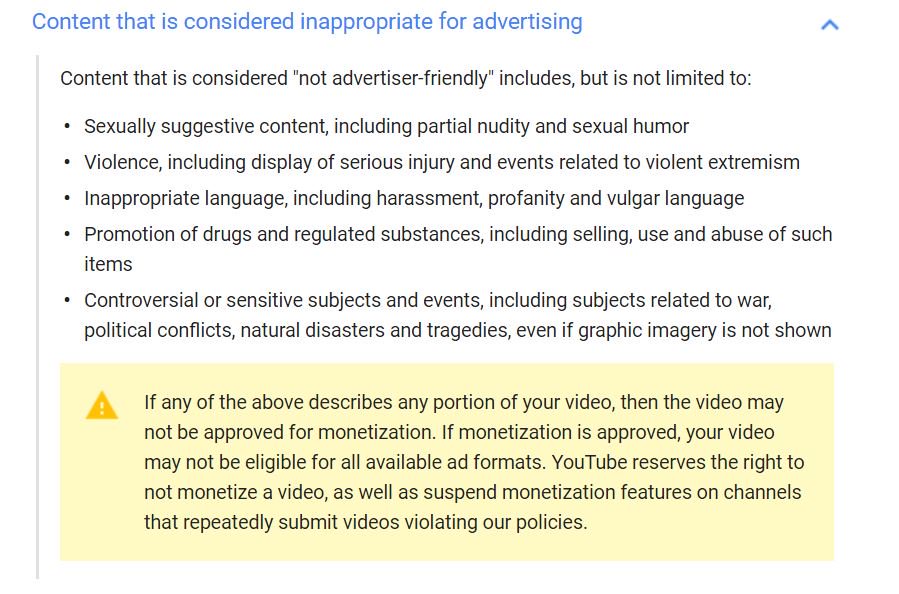
A new “advertiser friendly” policy introduced by YouTube will punish those who express politically incorrect opinions or dare to offend viewers by de-monetizing their content.
The new rules have sparked an outcry from the YouTube community because they are so incredibly restrictive.
YouTube will now retain the right to demonetize any videos that contain, “Controversial or sensitive subjects and events, including subjects related to war, political conflicts, natural disasters and tragedies, even if graphic imagery is not shown.”
“Inappropriate language, including harassment, profanity and vulgar language,” is also being demonetized.
Paul Joseph Watson @PrisonPlanet Sep 1
This is the end game of allowing all your content to be swallowed up by social media ghettos. #YouTubeIsOverParty
YouTube’s new policy will completely disincentivize YouTubers from discussing politically incorrect topics or expressing controversial opinions because they know they will be punished for doing so. Many YouTubers make a living off their channel and will therefore be walking on eggshells to avoid the company’s stringent new rules.
The new policy bears some hallmarks of the Communist Chinese government’s “social credit score system,” whereby Internet users are punished by private companies and their peers for expressing unpopular views on social media.
The move is primarily designed to scare away YouTubers from making anti-establishment political content, but prominent YouTubers are already reporting that videos on everything from acne solutions to tips on combating depression are being demonetized because they are not “advertiser friendly”.
“The channels that self-identify as vulnerable by these advertising guidelines seem to be news channels covering sensitive real-world topics,”reports Kotaku. Prominent YouTuber Philip DeFranco responded to the controversy by vowing, “I’m not going to censor myself,” despite the fact that dozens of his videos have already been demonetized.
Google-owned YouTube is of course a private company and can enforce any rules it likes, but with the advent of such corporations becoming so large (more powerful than countries in some cases), in addition to them insisting on being treated as a public utility, the move is a massive stab in the back for the content creators who helped build the platform in the first place.
As Matt Drudge warned about when he appeared on the Alex Jones Show nearly a year ago, creators allowing their content to be swallowed up by social media ghettos was always going to lead to this outcome.
“I don’t know why they’ve been successful in pushing everybody into these little ghettos, these Facebooks, these Tweets, these Instagrams,” Drudge told Jones. “This is ghetto, this is corporate; they’re taking your energy and you’re getting nothing in return.”
The video below sums up the impact the new rules will have on YouTube unless they are reversed.