Category Archives: Geopolitics

No More Ukraines, by David Stockman

If you’re a country with a GDP the size of Vermont’s, why wouldn’t you want to park under the U.S. defense umbrella? What’s in it for the U.S.? Nothing, but that’s how things roll in Biden’s America Last foreign policy. From David Stockman at lewrockwell.com:

Joe Biden must think that he’s the world’s Rich Uncle. In a meeting with the so-called Bucharest Nine today he promised these former Warsaw Pact nations—which should never have been admitted to NATO in the first place—unlimited economic and military support.

Nine more Ukraines if need be.

Biden conveyed reassurances that the United States is prepared to speed to their defense if they come under offensive action by Moscow. These nations include Bulgaria, the Czech Republic, Estonia, Hungary, Latvia, Lithuania, Poland, Romania and Slovakia.

For want of doubt, here’s the just-in-case-you-missed-the-message amplification from NSC spokesman John Kirby. Said the Deep State’s favorite shill, who is apparently serving the national security complex in endless rotation, having moved from State to DOD and then to the National Security Council during the last decade, with a stop in between at CNN:

“These are largely the group of eastern flank NATO allies who are basically and, quite frankly, literally on the front lines of our collective defense right now,” National Security Council spokesman John Kirby had previewed. 

He said the president’s purpose in the meeting is to “reaffirm the United States’ unwavering support for the security of that alliance and trans-Atlantic unity.” It’s also meant to send a message to Putin that his country can’t intimidate these democracies, some of them relatively new and fragile.

Well, let’s see. Where is it documented that Putin has ever threatened Bulgaria or Hungary or  Slovakia or Lithuania or any of the others for that matter? As it transpired, Hungary’s leader even refused to attend this pointless Biden photo op.

Continue reading

From special operation to full-scale war, by Alexander Dugin

Russia is rejecting the West and the notion that there can be peaceful coexistence. From Alexander Dugin at english.almayadeen.net:

Russia has changed its paradigm from realism to the Theory of a Multipolar World, has directly rejected liberalism in all its forms, and has directly challenged modern Western civilization, openly denying it the right to be universal.

A year has passed since the start of Russian Special Military Operation in Ukraine. It began precisely as a Special Military Operation, it is clear today that Russia has found itself in a full-fledged and difficult war. The war not so much with Ukraine – as a regime, not with a people (hence the demand for political denazification was put forward initially), but first of all with the “collective West”, that is, in fact, with the NATO bloc (except for the special position of Turkey and Hungary, seeking to remain neutral in the conflict – the remaining NATO countries take part in the war on the side of Ukraine one way or another).

This year of war shattered many illusions that all sides of the conflict had.

The West was wrong in its calculations

The West, hoping for the effectiveness of an avalanche of sanctions against Russia and its almost complete cut-off from the part of the world economy, politics, and diplomacy controlled by the United States and its allies, did not succeed. The Russian economy has held its own, there have been no internal protests, and Putin’s position has not only not wavered, but has only grown stronger. Russia could not be coerced into stopping military operations, attacking Ukraine’s military-technical infrastructure, or withdrawing decisions to annex new entities. There was no uprising of the oligarchs, whose assets were seized in the West, either. Russia survived, even though the West seriously believed that it would fall.

Continue reading

What the America got wrong, by Observer R

A comprehensive analysis of America’s many mistakes. There’s nothing wrong with a little self-examination. From Observer R at thesaker.is:

BACKGROUND

A quick search of the internet for the term “What Russia Got Wrong” yields a lot of entries. However, a quick search for the term “What America Got Wrong” yields a rather sparse list. This is understandable since the narrative in the West has been that Russia is losing in international relations. Also, the United States (US) think tanks and government studies are oriented toward analyzing Russia, as a competitor country, and not so much toward what the situation in the US is like. There are exceptions, but these are often couched in terms of the need for more money for various US military programs. It may be useful, therefore, to look at a few topics and see how the US fares.

WHAT AMERICA GOT WRONG: MILITARY

Going forward it seems past time to consider some significant deficiencies that have become evident in the American quest to remain a great or the greatest military power. Many of these elements have been brought forward recently in pubic discussions and are important considerations in terms of weapons and military force.

The US has continued to procure weapons that many critics perceive as not suited for the modern age, or that are simply obsolete. These weapons are generally very expensive and prevent funds from being shifted to better uses. The usual examples are aircraft carriers, stealth fighter planes, littoral combat ships, and so forth. Instead, the US should have switched funding and effort into hypersonic missiles, electronic warfare, air defense systems, and perhaps more advanced submarines. Thus, the US really does have a “missile gap” to contend with. The bad name that air defense got with the “Star Wars” episode under President Reagan delayed work in that area for many years. Now it appears that at least one foreign country, Russia, is considerably ahead of the US in air defense equipment.

In addition, long ago the US set up approximately 800 military bases around the world. These bases were useful in the days of gunboat diplomacy and when US hegemony required extensive preparation for military action anywhere around the globe. Then and now these bases require a lot of manpower and funding to operate, but it is not clear that they serve an essential purpose in this age. Other countries have taken up the chore of fighting pirates and bombing terrorist dens. The US effort could be greatly scaled back.

Continue reading

For the First Anniversary: 24 February 2023, by Batiushka

Sadly, The Saker website is going offline. Hopefully Batiushka will find some place else to post. He’d be welcome here at Straight Line Logic. From Batiushka at thesaker.is:

Tell everyone that the evil that is in the world will grow even stronger,
but that it is not evil that will triumph, but love.
Tsar Nicholas II

Foreword

A published author for 35 years on Church and cultural matters, I wrote a first article for the Saker that was published on 29 March 2022. It seems strange now that it took so long for me to offer to write here, as Andrei and I have the same spiritual background. The SMO in the Ukraine was the turning-point. This article, for 24th February 2023, is the last for Andrei’s blog. Appropriately for the Orwellian-minded, it is the 84th article in those 330 odd days, one every four days. Thank you, Andrei. As for future writings on geopolitical and cultural themes, I will be talking to Pepe Escobar.

Old Russia and Old Europe

I am an Old Russian who lives in Old Europe. I have lived in several European countries, not only in Russia. But just as I never recognised the New Russia, nor do I recognise the New Europe. Just as I recognised neither the Soviet Union with its post-Sovietism, nor do I recognise the European Union with its post-Europeanism. The latter Union was born just a few days after the funeral of the former Union, as the demons that had haunted the USSR for exactly 75 years from December 1916 to December 1991 crossed westwards and found another corrupted and rotting corpse to infest and consume. I believe that we are now at a millennial parting of the ways in world history with the clear and abject failure of the Western world. Although those of nominal faith are riven by nationalist politics, compromised by money-oriented careerism, strangled by bureaucratic centralism and reduced by superstitious ritualism, we follow another way. For the King is coming and we must be ready to meet Him.

Continue reading

Western Leaders Privately Say Ukraine Can’t Win the War, by Joe Lauria

Maybe spending over $100 billion in Ukraine wasn’t such a good idea after all. From Joe Lauria at consortiumnews.com:

The German and French leaders have told Ukraine they must seek peace with Russia in exchange for a post-war defense pact, according to a report in The Wall Street Journal. 

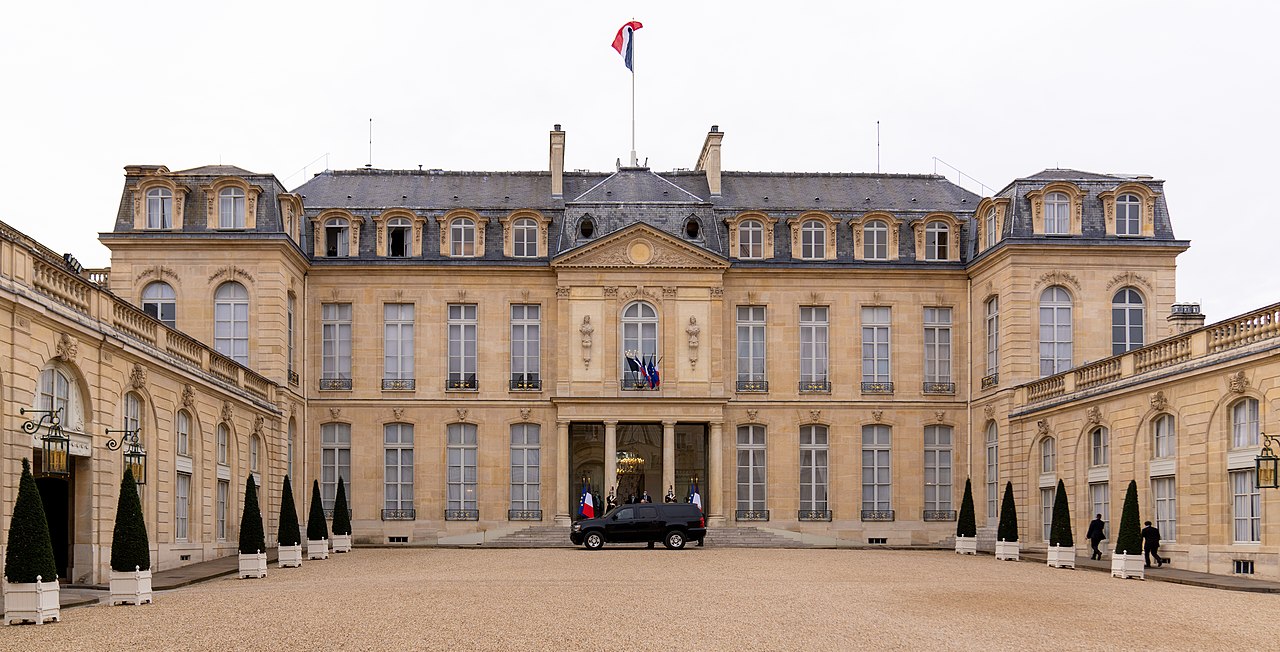
Élysée Palace where Macron and Scholz told Zelensky to seek peace. (U.S. State Dept.)

Western leaders privately told Ukrainian President Volodymyr Zelensky that Ukraine can not win the war against Russia and that it should begin peace talks with Moscow this year in exchange for closer ties with NATO. 

The private communications are at odds with public statements from Western leaders who routinely say they will continue to support Ukraine for as long as it takes until it achieves victory on the battlefield. 

The Wall Street Journal, which reported on the private remarks to Zelenksy, said:

“The public rhetoric masks deepening private doubts among politicians in the U.K., France and Germany that Ukraine will be able to expel the Russians from eastern Ukraine and Crimea, which Russia has controlled since 2014, and a belief that the West can only help sustain the war effort for so long, especially if the conflict settles into a stalemate, officials from the three countries say.

‘We keep repeating that Russia mustn’t win, but what does that mean? If the war goes on for long enough with this intensity, Ukraine’s losses will become unbearable,’ a senior French official said. ‘And no one believes they will be able to retrieve Crimea.’

French President Emmanuel Macron and German Chancellor Olaf Scholz told Zelensky at an Élysée Palace dinner earlier this month that he must consider peace talks with Moscow, the Journal reported.

According to its source, the newspaper quoted Macron as telling Zelensky that “even mortal enemies like France and Germany had to make peace after World War II.”

Macron told Zelensky “he had been a great war leader, but that he would eventually have to shift into political statesmanship and make difficult decisions,” the newspaper reported.   

Continue reading

Media Bewildered As Russian Economy Projected To Grow In 2023 Despite NATO Sanctions, by Tyler Durden

By now, the Russian economy was supposed to be in a depression and Vladimir Putin was supposed to be out of office. That was the Biden strategy, but it hasn’t worked out. From Tyler Durden at zerohedge.com:

After a smaller than expected GDP loss in 2022 of -2.1%, Russia has slipped through the NATO sanctions net and is projected by the IMF to see growth of 0.3% in 2023.  Western media proponents, shocked by this development, are wondering how this could be? (Report starts at 15:43)

Only months ago, political leaders and mainstream economists were expecting the complete fiscal destruction of Russia, leaving the nation in economic ruins and ending any chance of a continued military presence in Ukraine.  Joe Biden pledged to “crater” Russia’s economy, stating that Vladimir Putin “had no idea what was coming.”  French Finance Minister Bruno Le Maire predicted Russian collapse after the first wave of Western sanctions.  Politico lauded the “benefits” of the coming disintegration of the Russian Federation.  The propaganda has obscured certain economic realities that should have been obvious. 

The development of Russian economic resilience is not a surprise to those in the alternative media, who pointed out a year ago that Russia’s primary trading partners including China, India and Brazil make up a third of the world’s population and around 24% of global GDP.  They are also production based countries which manufacture a large portion of the world’s goods.  Russia is rich in raw commodities and resources including oil and natural gas, allowing for profitable trading opportunities for nations willing to ignore western sanctions.

Far from severing trade relations between the BRICS nations, US and NATO efforts to wage economic warfare over the Ukraine conflict have instead brought the countries closer together.  The BRICS are now engaged in bilateral trade which cuts out the US dollar as the world reserve currency and China is pursuing stronger military ties to Russia on top of its increased purchases of Russian commodities.

Continue reading

Glenn Diesen: One Year On… Why the Ukraine War Spells Doom For U.S. Hegemony and the NATO Alliance, by Finian Cunningham

The war hasn’t met the military or economic expectations of the U.S. and its proxy Ukraine. From Finian Cunningham at strategic-culture.org:

Russia is not backing down, but it can’t be said for the U.S. and its allies who are increasingly looking at a weakened geopolitical position.

After one year of war in Ukraine, Russia has not collapsed in the dramatic way that the United States and its European NATO allies were confidently predicting.

U.S. President Joe Biden in visits to Ukraine and Poland this week hailed the “unity” of NATO and the transatlantic alliance.

The reality is the Western transatlantic alliance is showing signs of fragmenting because of the immense strain on Europe’s economy due to European governments following Washington’s hostile policy towards Russia.

Street protests across Europe are growing against NATO and governing elites seen to be servile to American policy. This is not just about the war in Ukraine. The whole Western capitalist order is shaking at its foundation, largely because of American hegemonic ambitions. The Ukraine war is merely a manifestation of underlying geopolitics.

Contrary to Western great expectations, the Russian economy is holding up strongly and its military operations in Ukraine seem to be gaining the upper hand. This is in spite of the U.S.-led NATO bloc “throwing everything they can” at Russia to defeat it, from endless supplies of weaponry to support the Kiev regime, to endless rounds of economic sanctions in an attempt to collapse the Russian economy.

Glenn Diesen is a Professor at the University of South-Eastern Norway. He is an expert in international politics and Russian foreign relations.

Diesen explains that Russia has long been preparing for confrontation with the United States and its European allies. Ever since the U.S.-backed coup in Kiev in 2014 and the Western betrayal of the 2014 and 2015 Minsk peace agreements, Moscow quietly realized that it would have to reinforce its economy to withstand the anticipated Western showdown.

Continue reading

Russia Has No Strategy for Winning This War, by Rolo Slavskiy

It may be a very long war. From Rolo Slavskiy at unz.com:

If you look at and analyze the Not-War on the strategic level, well, you can’t help but come to the conclusions and talking points presented by the pessimists. If you’re honest, that is.

But the narrative has now shifted and the discussion is being framed on the tactical level. That is, the events around Bakhmut are what the Russian news and the commentators are talking about now. But the action around Bakhmut is a tactical one. There are three levels to military operations, at least in the Russian school.

Tactical

Operational

Strategic

And if you were hoping for a quick conclusion to the Bakhmut offensive, well. I’ve got more bad, but totally predictable, news for you.

URA:

The founder of Wagner PMC Yevgeny Prigozhin denied the information about the encirclement of 1.5 thousand Ukrainian soldiers near Bakhmut (Artemovsk). His comment is published by Prigozhin’s press service in the official telegram channel. He noted that the Ukrainians are putting up strong resistance and Bakhmut (Artemovsk) will not be taken in the near future.

“In all directions, the enemy is becoming more active, pulling up more and more new reserves. Every day, from 300 to 500 new fighters approach Bakhmut in all directions. Artillery fire intensifies every day,” said Yevgeny Prigozhin. He drew attention to the inappropriateness of positive promises that will not come true in the near future.

At the moment, fierce battles are being fought near Bakhmut (Artemovsk). Serious losses of the Armed Forces of Ukraine near Bakhmut were reported by the American media, 360 TV channel reports . Yevgeny Prigozhin said that the capture of Bakhmut would be the key to Russia’s victory in the Ukrainian conflict, the National News Service reports . Acting head of the DPR Denis Pushilin said that the Russian military surrounded 1.5 thousand Ukrainian soldiers near Bakhmut .

Continue reading

NATO Members Float Plan For Negotiations Amid “Growing Doubts” Ukraine Can Retake Territory, by Tyler Durden

The U.S. and NATO are looking for a face saving way out. Good luck with that. From Tyler Durden at zerohedge.com:

Update(1525ET): NATO has “answered” China’s Ukraine peace proposal unveiled earlier in the day by previewing a peace plan that three major Western allies reportedly have in the works. The plan hinges on Ukraine forging a defense pact with NATO (though stopping short of formal membership), and in return Kyiv would enter talks with Moscow, likely with territorial concessions on the table.

It’s said to be motivated in part by Western leaders having “growing doubts” over Ukraine’s ability to reconquer territory – thus a more ‘realist’ and pragmatic perspective might be taking hold one year into the stalemated conflict. The Wall Street Journal broadly outlines the German, France, UK plan as follows

Germany, France and Britain see stronger ties between NATO and Ukraine as a way to encourage Kyiv to start peace talks with Russia later this year, officials from the three governments said, as some of Kyiv’s Western partners have growing doubts over its ability to reconquer all its territory.

U.K. Prime Minister Rishi Sunak last week laid out a blueprint for an agreement to give Ukraine much broader access to advanced military equipment, weapons and ammunition to defend itself once the war ends. He said the plan should be on the agenda for the North Atlantic Treaty Organization’s annual meeting in July.

But if the plan hinges on creating a ‘fortress Ukraine’ through ramped up arms deliveries, including tanks and possibly jets, then it’s unlikely to sit well with Moscow – especially if the plan falls short of making territorial concessions. WSJ continues: 

The officials were careful to say that any decision on when and under what conditions any peace talks start is entirely up to Ukraine. Sunak on Friday said the West should give Ukraine arms that would give it a “decisive advantage” on the battlefield, including warplanes.

Continue reading

The Geoeconomics of Modern Conflict, by James Rickards

China is probably not going to invade Taiwan, and it is nowhere near the threat it is made out to be. From James Rickards at dailyreckoning.com:

Geopolitics play a major role in the outlook for global economies. But more importantly, today, we must look at the world through the prism of geoeconomics.

What is “geoeconomics”? Obviously, it’s a portmanteau from the words geopolitics and economics. There’s nothing new about considering those disciplines in the same context.

Wars are geopolitical and are often won through industrial capacity, which is primarily economic. Economics and global strategy have always been entwined. What is new is the idea that economics are not just an adjunct of geopolitics, but are now the main event.

This does not mean that warfare is over or that military prowess no longer matters… It means that the major powers in a globalized age will base their calculations on economic gain and loss, and will use economic weapons not as ancillaries, but as primary weapons.

This change was described at the beginning of the new age of globalization by strategic thinker Edward N. Luttwak in a 1990 article titled“From Geopolitics to Geo-Economics: Logic of Conflict, Grammar of Commerce.”

Luttwak wrote that the end of the Cold War and the start of globalization meant that armed conflict was too costly and uncertain for great powers. Economic interests would now be the arena for great power conflict.

Luttwak wrote, “Everyone, it appears, now agrees that the methods of commerce are displacing military methods – with disposable capital in lieu of firepower, civilian innovation in lieu of military-technical advance and market penetration in lieu of garrisons and bases.”

Continue reading