Category Archives: Governments

AS`AD AbuKHALIL: Saudi-Iran Deal a Possible US ‘Suez Moment’

It looks the U.S.’s dominant power in the Middle East has reached its sell-by date. From As`ad AbuKhalil at consortium news.com:

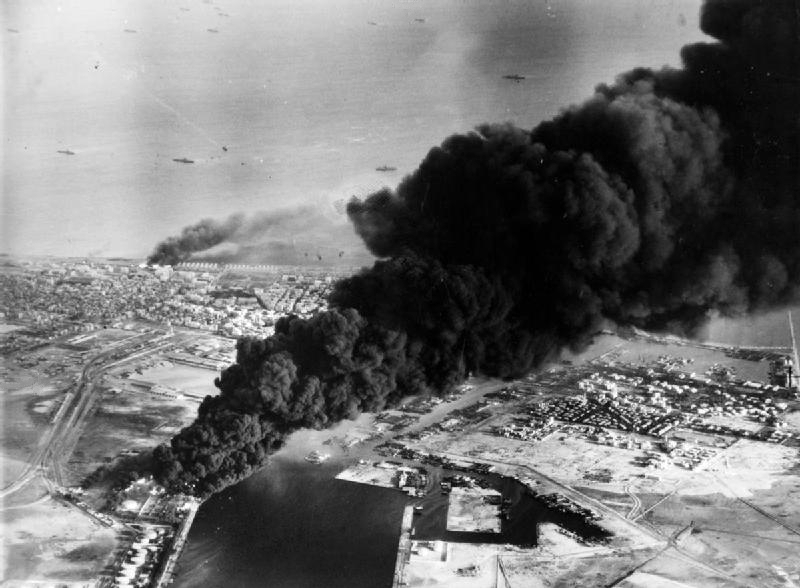
The U.S. does not want to experience what Britain experienced in Suez in 1956: a watershed moment signaling its global decline.

Smoke rises from oil tanks beside the Suez Canal hit during the initial Anglo-French assault on Port Said, Nov. 5, 1956. (Fleet Air Arm, Imperial War Museums, Wikimedia Commons)

The announcement in China on Friday of the resumption of relations between Saudi Arabia and Iran (after a 7-year freeze) caused a stir in Washington with U.S. mainstream media underlining the rise of China’s diplomatic role in the region at the expense of the U.S.

The U.S. has consistently aborted diplomatic initiatives of its allies and adversaries alike. China, on the other hand, emphasized that the cornerstone of its policies in the region is peace and diplomatic relations, in clear contrast to U.S. and Western roles in launching wars and instigating conflict.

Iran has been calling for the normalization of relations with Saudi Arabia for a few years, but Saudi Arabia snubbed all those initiatives. The Saudi government has been trying to win a brutal war in Yemen, which basically, and paradoxically, brought Iran closer to the Saudi border by virtue of Houthi reliance on Iranian assistance in the face of Saudi savagery.

The Iraqi government (through its Shiite component) has been mediating between Saudi Arabia and Iran for a few years. The Shiite political groupings in Iraq are fully aware that a rapprochement between the two countries would reflect favorably on the relations between Sunni and Shiite political grouping in the country.

Continue reading

Putin just changed EVERYTHING with this move and NATO can’t do anything

Scott Ritter explains Russian strategy in Ukraine and why Russia is winning.

Mediated By China Iran And Saudi Arabia Restore Ties – There Are Winners And Losers, by Moon of Alabama

In a world of ubiquitous hyperbole, this actually is, as Moon of Alabama says, “huge.” From Moon of Alabama at moonofalabama.org:

This is huge!

Regional rivals Iran and Saudi Arabia agree to restore ties after years of tensions
The deal, which will see the two countries reopen embassies in each other’s capitals, was sealed during a meeting in China and announced Friday in a joint communique.

Archrivals Iran and Saudi Arabia agreed Friday to restore diplomatic relations, a dramatic breakthrough brokered by China after years of soaring tensions between the regional rivals.

The deal, which will see the two countries reopen embassies in each other’s capitals, was sealed during a meeting in China — a boost to Beijing’s efforts to rival the United States as a broker on the global stage.

The agreement also may put a dampener Israel’s ongoing efforts to normalize relations with its Arab neighbors.

The talks were held because of a “shared desire to resolve the disagreements between them through dialogue and diplomacy, and in light of their brotherly ties,” according to a joint communique from Tehran, Riyadh and Beijing that was published by the Saudi Press Agency, the country’s official news agency.

The agreement followed intensive negotiations between Ali Shamkhani, a close adviser to Iran’s supreme leader Ayatollah Ali Khameni, and Saudi Arabia’s Minister of State Musaad bin Mohammed Al-Aiban, according to the statement.

It added that the foreign ministers from both countries would “meet to implement this, arrange for the return of their ambassadors, and discuss means of enhancing bilateral relations.”

Continue reading

Seismic Iran-Saudi Rapprochement Isolates US, by Joe Lauria

Seismic is exactly the right word for it. From Joe Lauria at consortiumnews.com:

The Chinese-brokered diplomatic deal between Saudi Arabia and Iran not only opens the way for resolution of region-wide conflicts, but foils U.S. Mideast designs based on Saudi-Iranian enmity, writes Joe Lauria.

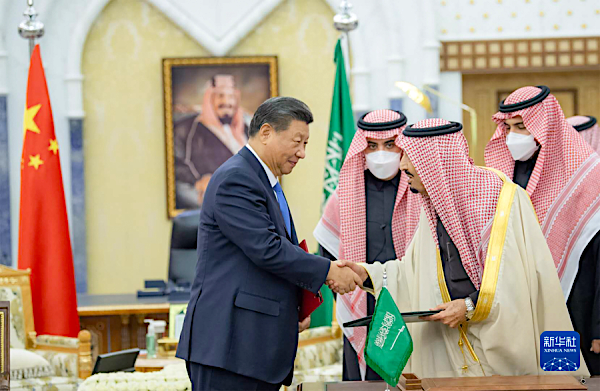
King Salman greets Chinese President Xi Jinping. (Chinese Foreign Ministry)

Ever since the 1979 Islamic Revolution that overthrew the U.S.-allied Shah of Iran, the rivalry between the two major Middle East powers — Iran and Saudi Arabia — has been at the heart of every conflict across the region.

The announcement on Friday that Iran and Saudi Arabia have normalized relations could have a seismic effect on all these conflicts and leave the U.S. on the outside looking in.  

In Lebanon, Iranian-backed Hezbollah and Saudi-backed parties might begin to resolve their differences, a unity that would worry Israel and lessen U.S. influence in the country.

In Syria, Hezbollah and Iranian militias have been battling Saudi-backed jihadists for more than a decade.  The Syrian war could now come to an end.

In Yemen, U.S.-backed Saudis have been fighting the Houthi, who have been driven into a closer alliance with Iran. Obstacles to a peace deal could now have been removed.

In Iraq, reconciliation between Sunni and Shia could make the U.S. presence and influence irrelevant and unwelcomed by all sides. 

In Bahrain, Iranian-backed Shi’ites no longer in conflict with the Saudi-aligned monarchy could sideline the presence of the U.S. Fifth Fleet in a region on the mend.

And in Saudi Arabia itself, the state’s tensions with Shi’tes in the eastern oil regions should lessen.  

Continue reading

When it comes to Nordstream and F-16s the U.S. Opts For Ham Handed Political Gestures, by Larry Johnson

The crew and passengers of the S.S. Minnow, the ill fated boat in Gilligan’s Island, blew up the Nordstream pipelines. From Larry Johnson at sonar21.com:

In theory, a covert operation is supposed to be elegant, sophisticated and smart. But that is not the case with the United States these days. Ham-fisted and clumsy are more apt descriptors.

Yesterday’s simultaneous release of a new account of who destroyed the Nordstream pipeline in the New York Times, Die Zeit and a London paper placing the blame on shadowy pro-Ukrainians was not a coincidence. This was a coordinated information operation and the media reaction to this news is quite telling. The same news outlets that strenuously ignored Sy Hersh’s explosive, detailed revelation that it was a U.S. operation with help from Norway stumbled over themselves to breathlessly report that an unidentified pro-Ukrainian group was the guilty party.

Die Zeit provided the most hilarity with their fantastic tale of six people on a private yacht carrying out the deed. Looks to me like Die Zeit was channeling a Gilligan’s Island episode. We had Ginger and Mary Ann, accompanied by the Professor, the Skipper, Thurston Howell and Gilligan. They set to sea with a 1000 pounds of high explosive and used their snorkel gear to plant the charge. I bet you it was Ginger and Mary Ann who planted the bomb, of course, was built by the crafty Professor.

Continue reading

India Takes A Leading Role In De-Dollarization, by Andrew Korybko

India is in an enviable position. Its population and economy are too large for either the West or the Eurasian alliance to ignore it. The country is basically free to pursue its own national interest. From Andrew Korybko at theautomaticearth.com:

Reuters reported on Wednesday that “India’s Oil Deals With Russia Dent Decades-Old Dollar Dominance”, which informed their audience that the growing trend of those two using national or third-party currencies like the UAE’s is something significant for everyone to pay attention to. To that outlet’s credit, it also reminded readers that IMF Deputy Managing Director Gita Gopinath foresaw in the month after Russia’s special operation began that the West’s sanctions “could erode the dollar’s dominance”.

Lo and behold, that’s precisely what happened, with India of all countries accelerating de-dollarization through its non-dollar-denominated energy deals with Russia. About them, Russia has since become India’s largest supplier over the past year and now provides a whopping 35% of that country’s needs, which is also the world’s third-largest oil importer and fifth-largest economy. Their new energy ties, and particularly the growing de-dollarization dimension of their deals, are thus globally important.

None of what was just described is driven by any anti-American animus on India’s part since everything is purely motivated by the pursuit of that country’s objective national interests. Delhi had no choice but to gradually diversify away from dollar-denominated energy deals with Moscow due to Washington’s illegal sanctions. Its multipolar leadership wasn’t going to let the world’s most populous country slip into an economic crisis just to please the US by eschewing the import of discounted oil from Russia.

Continue reading

New WHO Amendments Creating A Global Regime In The Name Of Health, by Dr. Sean Lin and Jacky Guan

After the stunning failures of the global Covid regime, it only makes sense to make WHO the powers of a global medical dictatorship. from Dr. Sean Lin and Jacky Guan at The Epoch Times via zerohedge.com:

Since its establishment, the World Health Organization (WHO) has assumed the role of an advisory entity in the international health domain. Since 2005, the WHO established International Health Regulations (IHR) as the main compliance tool to ensure that public health emergencies would be handled swiftly. The COVID pandemic perfectly illustrates how powerful the WHO already is.

However, a new set of amendments (pdf) proposed by state members of the WHO was published at the end of 2022, seeking to enhance the WHO’s power under the guise of the IHR. This, in addition to a newly proposed Intergovernmental Negotiating Body (INB) (pdf) and the addition of a pandemic prevention, preparedness, and response (WHO CA+) clause (pdf) in the INB, raises several red flags on the paradigm shift the WHO is undertaking, from playing the role of an international health advisory body to becoming a global regime acting in the name of health.

From Patient-Doctor Relationship to Powerful Health Conglomerate

Throughout history, people have relied on connections with friends, family, and neighbors to maintain a healthy social life. This is important not only for wellness but also for building the trust upon which the foundation of relationships lies. Just as it is vital in relationships with family and friends, in regard to health, trust is vital in patient-doctor relationships.

Doctors across many countries and diverse regions have a plethora of different methods to treat something as simple as a cold. Some may give you a flu shot, some may prescribe you some minor medication, and some might even tell you to drink hot soup and get lots of rest. There may also be an unfamiliar remedy from Latin America or Southeast Asia that works just as well as something you could pick up in a U.S. pharmacy. This is all to say that well-trained doctors know what they’re doing given the methods available to them.

The one-on-one patient-doctor relationship has traditionally been the tried-and-true way to establish a health system in any society. Even under evidence-based medicine, advice from the U.S. Centers for Disease Control and Prevention (CDC), U.S. Food and Drug Administration (FDA), or other health agencies serves as nonbinding recommendations to doctors that give them the right to make their own decisions based on their knowledge of the patient.

Continue reading

They Work So Hard To Manufacture Our Consent Because They Absolutely Require It, by Caitlin Johnstone

Remember, there are a lot more of us than there are of them. From Caitlin Johnstone at caitlinjohnstone.com:

Australian media are awash with reporting on the war-with-China propaganda series by The Sydney Morning Herald and The Age that I’ve been writing about for the last few days. Which is really quite extraordinary, because it’s not an actual news story.

It really isn’t. The Sydney Morning Herald and The Age just asked five warmongering China hawks what they think about war with China, wrote down their very predictable answers saying Australia must prepare for war with China within three years, and then passed it off as journalism. Obviously if you ask a bunch of China hawks if they think Australia should prepare for war with China they’re going to tell you yes; that’s not news, that’s just you reporting that five random warmongers think warmongery thoughts.

Yet SMH and The Age stretched this ridiculous non-story into a multi-part series titled “Red Alert” — all without ever noting the massive conflict of interest posed by the extensive ties its “panel” of “experts” have to US-aligned governments and the military industrial complex — and now it’s being covered like a real news story by the rest of Australian media. TV news segments have filled the airwaves reporting on the opinions of the most wildly biased people you could possibly find on this subject, the most appalling of which appeared on the Australian government’s ABC.

Continue reading

In Nord Stream attack, US officials use proxy media to blame proxy Ukraine, by Aaron Maté

It looks like the new “scoop” about the Nordstream sabotage will have a shelf life of less than a week. From Aaron Maté at mate.substack.com:

One month after Seymour Hersh reported that the US blew up the Nord Stream pipelines, US officials find a scapegoat in Ukraine and stenographers in the New York Times.

(Photo by Swedish Coast Guard via Getty Images)

Nearly six months after the Nord Stream pipelines exploded and one month after Seymour Hersh reported that the Biden administration was responsible, US officials have unveiled their defense. According to the New York Times, anonymous government sources claim that “newly collected intelligence” now “suggests” that the Nord Stream bomber was in fact a “pro-Ukrainian group.”

The only confirmed “intelligence” about this supposed “group” is that US officials have none to offer about them.

“U.S. officials said there was much they did not know about the perpetrators and their affiliations,” The Times reports. The supposed “newly collected” information “does not specify the members of the group, or who directed or paid for the operation.” Despite knowing nothing about them, the Times’ sources nonetheless speculate that “the saboteurs were most likely Ukrainian or Russian nationals, or some combination of the two.” They also leave open “the possibility that the operation might have been conducted off the books by a proxy force with connections to the Ukrainian government or its security services.” (emphasis added)

When no evidence is produced, anything is of course “possible.” But the Times’ sources are oddly certain on one critical matter: “U.S. officials said no American or British nationals were involved.” Also, there is “no evidence President Volodymyr Zelensky of Ukraine or his top lieutenants were involved in the operation, or that the perpetrators were acting at the direction of any Ukrainian government officials.”

Continue reading

Why credit needs a golden anchor, by Alasdair Macleod

Credit needs an anchor or you get what you have today: an enormously over-indebted global economy and financial system. From Alasdair Macleod at goldmoney.com:

This article examines the relationship between credit and its anchor in value. Today, that anchor is fiat currency, which is both parochial and unstable. Historically, and in law it has always been gold.

It is a common error to think of credit in a narrow sense, without realising that officially recorded credit in the form of banknotes and deposit accounts with the commercial banks are only a minor part of the total credit in an economy. This article takes a holistic view of credit.

The relationship between credit and whatever provides an anchor to its value is a far larger topic from that commonly discussed in economic journals. It involves an understanding of the relationships between currency credit and commercial bank credit, the consequences of which rarely occur to economic commentators.

There is evidence that changes in central bank credit have a greater impact on prices than an equivalent change in commercial bank credit ­— a new and important topic for our consideration.

This article draws on the history of law as it applies to banking, money, and credit. For both contemporary economists and the layman, it involves some concepts that may be novel to them. But given that they concern the very survival of contemporary currencies, they are worth making the effort to understand.

Continue reading