Tag Archives: Ukraine-Russia War

The Antiwar Movement Roars Back to Life, by Ron Paul

Of course the mainstream media ignored it, but there was a pretty substantial antiwar rally in Washington recently. From Ron Paul at ronpaulinstitute.org:

On February 19th, the National Mall in Washington, DC saw its largest antiwar rally in 20 years. The speakers list included four former US presidential candidates and a broad and diverse collection of antiwar activists from beyond the left and right.

The aptly-named “Rage Against War Machine” rally drew thousands of attendees, however many pro-war advocates eagerly pointed out that it did not match in size some of the larger rallies against the Iraq war 20 years ago.

To that I say, “who cares”? The US mainstream media engages in war propaganda non-stop, with the only exception being Fox News’ Tucker Carlson. So I think it’s a miracle anyone had the courage to travel to the heart of the war machine in Washington, DC to make their voices heard! We don’t need a majority to fight back – an educated and dedicated minority will do quite nicely. And we certainly had that at the rally!

As I sat in the green room waiting to speak, I had the opportunity to visit with former Democrat presidential candidates Tulsi Gabbard and Dennis Kucinich and former Green Party candidate Jill Stein. Political commentators Jimmy Dore and Chris Hedges were there, along with many leading and well—spoken libertarians. Everyone backstage carried the same message: we must put aside our differences to build a new, broad coalition against this war!

I believe the antiwar movement is starting to catch fire both at home and overseas. The DC rally was followed by much larger antiwar rallies in Paris, Berlin, London, and elsewhere.

Continue reading

The Last Lie Government Will Ever Tell, by George F. Smith

The possibility of the Ukraine-Russia war going nuclear is not trivial. From George F. Smith at lewrockwell.com:

The more powerful a government, the more likely it is to engage in war and conquest.  Case in point: US involvement in Ukraine.

In 2014 the US led a coup that displaced a “democratically-elected” president, Viktor Yanukovych.

In November 2013, . . . Yanukovych rejected a major economic deal he had been negotiating with the EU and decided to accept a $15 billion Russian counteroffer instead. That decision gave rise to antigovernment demonstrations that escalated over the following three months . . .

Instead of waiting around for the next election, Yanukovych fled to Russia on February 22, 2014.

The new government in Kiev was pro-Western and anti-Russian to the core, and it contained four high-ranking members who could legitimately be labeled neofascists. . . .

[It was] clear that Washington backed the coup. [U.S. assistant secretary of state Victoria] Nuland and Republican Senator John McCain participated in antigovernment demonstrations . . . As a leaked telephone recording revealed, Nuland had advocated regime change and wanted the Ukrainian politician Arseniy Yatsenyuk to become prime minister in the new government, which he did.

In 2019, comedian and actor Volodymyr Zelensky was elected president with 73.23 percent of the vote.  In spite of the media’s love affair with Zelensky, portraying him “as something equivalent to a reincarnation of Winston Churchill and Mother Teresa,” the Ukraine government remains one of the most corrupt on the planet.

Continue reading

Manichaeism and ‘An Ideology of Liberal Empire’ – Biden’s Forever Cosmic War Against Russian ‘Evil’, by Alastair Crooke

The U.S. sees itself as the perpetual good guy and Russia as the perpetual bad guy, which means the war in Ukraine may widen and last for a long time. From Alastair Crooke at strategic-culture.org:

When the U.S. begins its pivot away from Ukraine, and looks fully to Europeanise the war, the political class won’t be seen ‘for the dust’.

“Appetites of the autocrat cannot be appeased. They must be opposed. Autocrats only understand one word: “No.” “No.” “No.” (Applause.). “No, you will not take my country.” “No, you will not take my freedom.” “No, you will not take my future … A dictator bent on rebuilding an empire will never be able to ease [erase] the people’s love of liberty. Brutality will never grind down the will of the free. And Ukraine — Ukraine will never be a victory for Russia. Never”. (Applause.)

“Stand with us. We will stand with you. Let us move forward … with an abiding commitment to be allies not of darkness, but of light. Not of oppression, but of liberation. Not of captivity, but, yes, of freedom”.

Biden’s speech at Warsaw, complete with the lighting effects and dramatic backdrop reminiscent of his Liberty Hall speech in which he sought to portray his own domestic MAGA opposition as a grave security threat to America, again resorts to radical Manicheanism to depict (this time) Russia, (the external counterpoint to the related U.S. MAGA threat), as the foundation for the epic battle between light and the forces of darkness. The eternal struggle that persists – that must be fought endlessly and won crushingly.

Again, as with his Liberty Hall speech, Biden offered no concrete plan. Here in Warsaw, with the sands of time running out on his Ukraine ‘project’, and with U.S. ‘Realists’ and China ‘hawks’ gaining more traction at home, Biden elevated the struggle from the literal to the metaphysical plane.

Continue reading

Showdown in Ukraine, by Mike Whitney

Ukraine will be the scene of the U.S.’s biggest post World War II failure and the end of its empire. From Mike Whitney at unz.com:

The future of humanity will be decided on a battlefield in Ukraine. That’s no exaggeration. The conflict between the United States and Russia will determine whether global economic integration will expand within an evolving multi-polar system or if the “rules-based order” will succeed in crushing any opponent to its Western-centric model. This is what’s taking place in Ukraine today, in fact, all of the recent government-prepared documents related to national security identify Russia and China as the greatest threats to US hegemony. For example, take a look at this brief clip from the 2021 Congressional Research Service Report titled Renewed Great Power Competition: Implications for Defense—Issues for Congress:

The U.S. goal of preventing the emergence of regional hegemons in Eurasia… is a policy choice reflecting two judgments: (1) that given the amount of people, resources, and economic activity in Eurasia, a regional hegemon in Eurasia would represent a concentration of power large enough to be able to threaten vital U.S. interests….

From a U.S. perspective on grand strategy and geopolitics, it can be noted that most of the world’s people, resources, and economic activity are located not in the Western Hemisphere, but in the other hemisphere, particularly Eurasia. In response to this basic feature of world geography, U.S. policymakers for the last several decades have chosen to pursue, as a key element of U.S. national strategy, a goal of preventing the emergence of regional hegemons in Eurasia.” (“Renewed Great Power Competition: Implications for Defense—Issues for Congress”, US Congress)

Continue reading

5 Reasons Why Much Of Global South Isn’t Automatically Supporting The West In Ukraine – OpEd by Krishen Mehta

These are not the kind of problems that are going to go away with a U.S. presidential visit or a big check. They are long fermented and are deeply ingrained. From Krishen Mehta at eurasiareview.com:

In October 2022, about eight months after the war in Ukraine started, the University of Cambridge in the UK harmonized surveys conducted in 137 countries about their attitudes towards the West and towards Russia and China.

The findings in the study, while not free of a margin of error, are robust enough to take seriously.

These are:

  • For the 6.3 billion people who live outside of the West, 66 percent feel positively towards Russia and 70 percent feel positively towards China, and,
  • Among the 66 percent who feel positively about Russia the breakdown is 75 percent in South Asia, 68 percent in Francophone Africa, and 62 percent in Southeast Asia.
  • Public opinion of Russia remains positive in Saudi Arabia, Malaysia, India, Pakistan, and Vietnam.

Sentiments of this nature have caused some ire, surprise, and even anger in the West. It is difficult for them to believe that two-thirds of the world’s population is not siding with the West.

What are some of the reasons or causes for this? I believe there are five reasons as explained in this brief essay.

1. The Global South does not believe that the West understands or empathizes with their problems.

India’s foreign minister, S. Jaishankar, summed it up succinctly in a recent interview: “Europe has to grow out of the mindset that Europe’s problems are the world’s problems, but the world’s problems are not Europe’s problems.” He is referring to the many challenges that developing countries face whether they relate to the aftermath of the pandemic, the high cost of debt service, the climate crisis that is ravaging their lives, the pain of poverty, food shortages, droughts, and high energy prices. The West has barely given lip service to the Global South on many of these problems. Yet the West is insisting that the Global South join it in sanctioning Russia.

The Covid pandemic is a perfect example—despite the Global South’s repeated pleas to share intellectual property on the vaccines, with the goal of saving lives, no Western nation was willing to do so. Africa remains to this day the most unvaccinated continent in the world. Africa had the capability to make the vaccines but without the intellectual property they could not do it.

But help did come from Russia, China, and India. Algeria launched a vaccination program in January 2021 after it received its first batch of Russia’s Sputnik V vaccines. Egypt started vaccinations after it got China’s Sinopharm vaccine at about the same time. South Africa procured a million doses of AstraZeneca from the Serum Institute of India. In Argentina, Sputnik became the backbone of their vaccine program. All of this was happening while the West was using its financial resources to buy millions of doses in advance, and often destroying them when they became outdated. The message to the Global South was clear—your problems are your problems, they are not our problems.

Continue reading

China Compellingly Appears To Be Recalibrating, by Andrew Korybko

China has realized that it’s better to get involved in the Ukraine-Russia war as a peacemaker than as a participant. From Andrew Korybko at theautomaticearth.com:

State Of Affairs

China has hitherto done its utmost to remain completely away from the NATO-Russian proxy war that’s being waged between them in Ukraine, yet a fast-moving spree of developments over the past few days compellingly suggests that it’s recalibrating its approach to the New Cold War’s top conflict. The present analysis will begin by highlighting those aforesaid events before explaining the larger context in which they’re occurring, which should show the reader that something big is going on behind the scenes.

Diplomatic Developments In This Direction

Director of the Office of the Foreign Affairs Commission of the Communist Party of China (CPC) Central Committee Wang Yi met with Russian President Putin in the Kremlin last week after visiting several countries and participating in the Munich Security Conference. Their talks were significant since the Russian leader rarely meets with anyone who isn’t his counterpart, and he wouldn’t have made an exception to his informal rule simply to discuss the details of President Xi’s upcoming springtime visit.

China then unveiled its 12-point peace plan for resolving the Ukrainian Conflict on the one-year anniversary of Russia’s special operation. It was predictably praised by Russia, but what few expected is that it also piqued Zelensky’s interest – who said he’s eager to meet with President Xi to discuss it– despite Biden rubbishing it. On the same day, the Wall Street Journal (WSJ) then reported that France, Germany, and the UK are considering a NATO-like pact with Kiev to encourage it to resume peace talks.

Less than 24 hours afterwards on Saturday, it was announced that Belarusian President Lukashenko will be traveling to China from 28 February-2 March, following which French President Macron said that he plans to go there too sometime in early April. This fast-moving spree of developments proves that China is serious about negotiating at least a ceasefire to the Ukrainian Conflict, to which end President Xi will likely share his views on this with his two aforementioned counterparts during their visits.

Continue reading

There Has Never In History Been A Greater Need For A Large Anti-War Movement, by Caitlin Johnstone

We may be looking at the extinction of our species. We should be expressing our concerns. From Caitlin Johnstone at caitlinjohnstone.com:

Things are escalating more and more rapidly between the US-centralized power structure and the few remaining nations with the will and the means to stand against its demands for total obedience, namely China, Russia, and Iran. The world is becoming increasingly split between two groups of governments who are becoming increasingly hostile toward each other, and you don’t have to be a historian to know it’s probably a bad sign when that happens. Especially in the age of nuclear weapons.

The US State Department’s Victoria Nuland is now saying that the US is supporting Ukrainian strikes on Crimea, drawing sharp rebukes from Moscow with a stern reminder that the peninsula is a “red line” for the Kremlin which will result in escalations in the conflict if crossed. On Friday, Ukraine’s President Zelensky told the press that Kyiv is preparing a large offensive for the “de-occupation” of Crimea, which Moscow has considered a part of the Russian Federation since its annexation in 2014.

Continue reading

From special operation to full-scale war, by Alexander Dugin

Russia is rejecting the West and the notion that there can be peaceful coexistence. From Alexander Dugin at english.almayadeen.net:

Russia has changed its paradigm from realism to the Theory of a Multipolar World, has directly rejected liberalism in all its forms, and has directly challenged modern Western civilization, openly denying it the right to be universal.

A year has passed since the start of Russian Special Military Operation in Ukraine. It began precisely as a Special Military Operation, it is clear today that Russia has found itself in a full-fledged and difficult war. The war not so much with Ukraine – as a regime, not with a people (hence the demand for political denazification was put forward initially), but first of all with the “collective West”, that is, in fact, with the NATO bloc (except for the special position of Turkey and Hungary, seeking to remain neutral in the conflict – the remaining NATO countries take part in the war on the side of Ukraine one way or another).

This year of war shattered many illusions that all sides of the conflict had.

The West was wrong in its calculations

The West, hoping for the effectiveness of an avalanche of sanctions against Russia and its almost complete cut-off from the part of the world economy, politics, and diplomacy controlled by the United States and its allies, did not succeed. The Russian economy has held its own, there have been no internal protests, and Putin’s position has not only not wavered, but has only grown stronger. Russia could not be coerced into stopping military operations, attacking Ukraine’s military-technical infrastructure, or withdrawing decisions to annex new entities. There was no uprising of the oligarchs, whose assets were seized in the West, either. Russia survived, even though the West seriously believed that it would fall.

Continue reading

Western Leaders Privately Say Ukraine Can’t Win the War, by Joe Lauria

Maybe spending over $100 billion in Ukraine wasn’t such a good idea after all. From Joe Lauria at consortiumnews.com:

The German and French leaders have told Ukraine they must seek peace with Russia in exchange for a post-war defense pact, according to a report in The Wall Street Journal. 

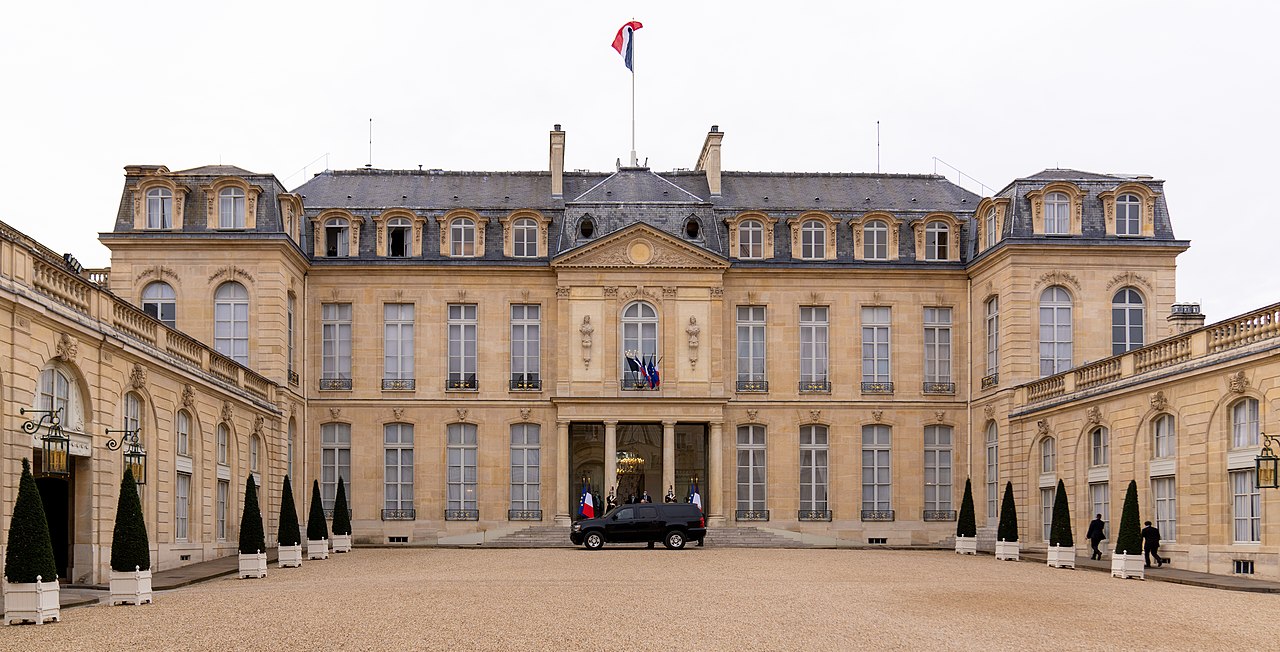
Élysée Palace where Macron and Scholz told Zelensky to seek peace. (U.S. State Dept.)

Western leaders privately told Ukrainian President Volodymyr Zelensky that Ukraine can not win the war against Russia and that it should begin peace talks with Moscow this year in exchange for closer ties with NATO. 

The private communications are at odds with public statements from Western leaders who routinely say they will continue to support Ukraine for as long as it takes until it achieves victory on the battlefield. 

The Wall Street Journal, which reported on the private remarks to Zelenksy, said:

“The public rhetoric masks deepening private doubts among politicians in the U.K., France and Germany that Ukraine will be able to expel the Russians from eastern Ukraine and Crimea, which Russia has controlled since 2014, and a belief that the West can only help sustain the war effort for so long, especially if the conflict settles into a stalemate, officials from the three countries say.

‘We keep repeating that Russia mustn’t win, but what does that mean? If the war goes on for long enough with this intensity, Ukraine’s losses will become unbearable,’ a senior French official said. ‘And no one believes they will be able to retrieve Crimea.’

French President Emmanuel Macron and German Chancellor Olaf Scholz told Zelensky at an Élysée Palace dinner earlier this month that he must consider peace talks with Moscow, the Journal reported.

According to its source, the newspaper quoted Macron as telling Zelensky that “even mortal enemies like France and Germany had to make peace after World War II.”

Macron told Zelensky “he had been a great war leader, but that he would eventually have to shift into political statesmanship and make difficult decisions,” the newspaper reported.   

Continue reading

Media Bewildered As Russian Economy Projected To Grow In 2023 Despite NATO Sanctions, by Tyler Durden

By now, the Russian economy was supposed to be in a depression and Vladimir Putin was supposed to be out of office. That was the Biden strategy, but it hasn’t worked out. From Tyler Durden at zerohedge.com:

After a smaller than expected GDP loss in 2022 of -2.1%, Russia has slipped through the NATO sanctions net and is projected by the IMF to see growth of 0.3% in 2023.  Western media proponents, shocked by this development, are wondering how this could be? (Report starts at 15:43)

Only months ago, political leaders and mainstream economists were expecting the complete fiscal destruction of Russia, leaving the nation in economic ruins and ending any chance of a continued military presence in Ukraine.  Joe Biden pledged to “crater” Russia’s economy, stating that Vladimir Putin “had no idea what was coming.”  French Finance Minister Bruno Le Maire predicted Russian collapse after the first wave of Western sanctions.  Politico lauded the “benefits” of the coming disintegration of the Russian Federation.  The propaganda has obscured certain economic realities that should have been obvious. 

The development of Russian economic resilience is not a surprise to those in the alternative media, who pointed out a year ago that Russia’s primary trading partners including China, India and Brazil make up a third of the world’s population and around 24% of global GDP.  They are also production based countries which manufacture a large portion of the world’s goods.  Russia is rich in raw commodities and resources including oil and natural gas, allowing for profitable trading opportunities for nations willing to ignore western sanctions.

Far from severing trade relations between the BRICS nations, US and NATO efforts to wage economic warfare over the Ukraine conflict have instead brought the countries closer together.  The BRICS are now engaged in bilateral trade which cuts out the US dollar as the world reserve currency and China is pursuing stronger military ties to Russia on top of its increased purchases of Russian commodities.

Continue reading