Category Archives: Governments

A Sane Voice Amidst the Madness, by Joe Lauria

Australia desperately needs its former Prime Minister, Paul Keating, back in office. This is the most honest (and funny at times) series of public utterances that I’ve ever seen from a politician, or former politician. From Joe Lauria at consortiumnews.com:

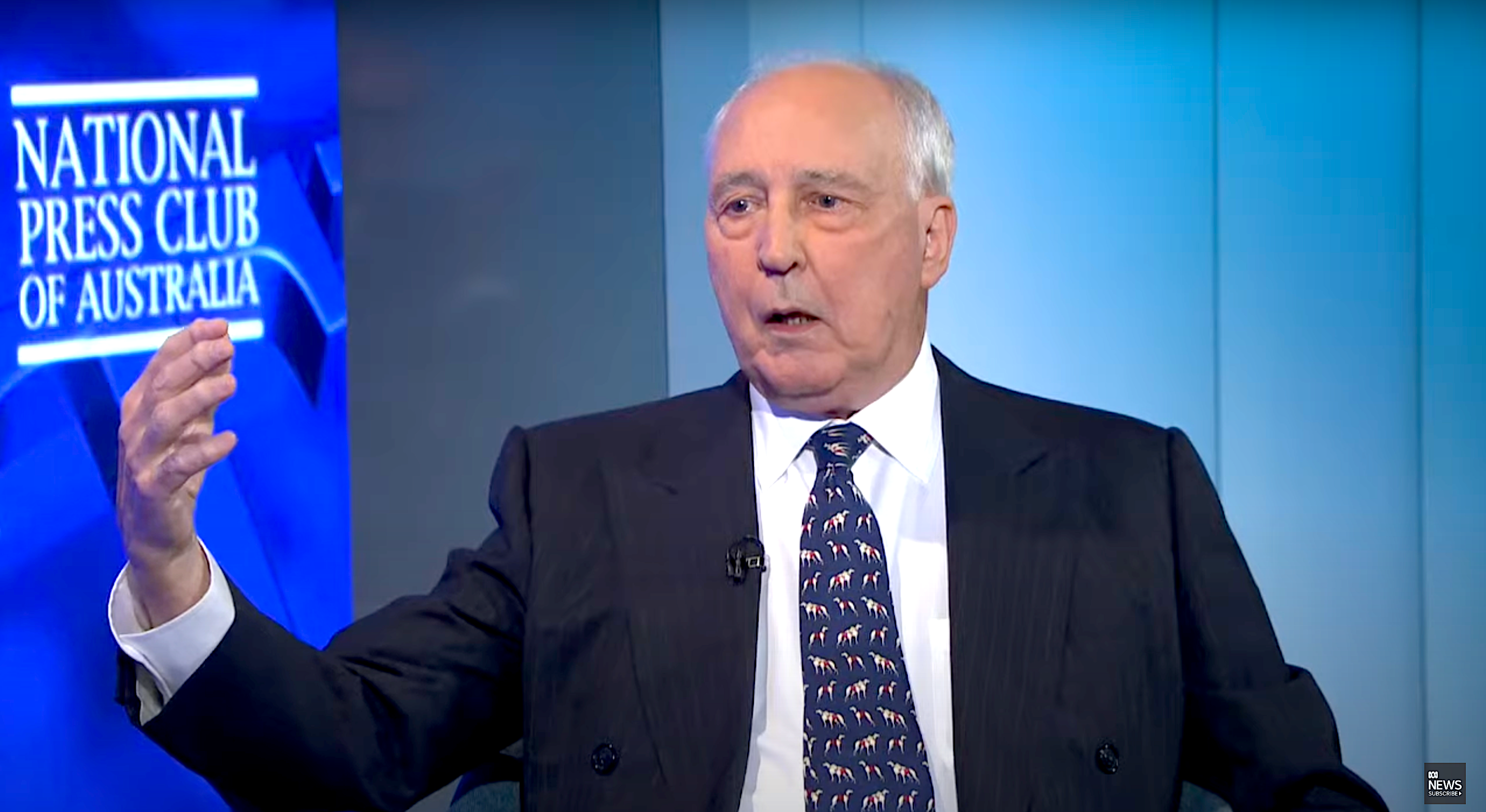
Former Australian Prime Minister Paul Keating at the National Press Club in Canberra on Wednesday. (ABC screenshot)

Paul Keating, a former prime minister of Australia, has boldly contested the establishment consensus that Australia needs to spend A$368 billion to buy nuclear submarines as protection against a China Keating bluntly says is not a threat.

The former Labor premier has defied the conventional wisdom, saying the U.S. opposes China only because Beijing has committed “the high sin in internationalism – it has grown as large as the United States,” a fact the “exceptional state” can’t accept.  By subordinating itself, Australia is forfeiting its sovereignty to rely on Britain, which abandoned its former colony years ago, to build nuclear submarines that serve U.S. — and not Australian — interests.

“China does not present and cannot present as an orthodox threat to the United States. By orthodox, I mean an invasive threat,” Keating said in a speech to the Australian National Press Club on Wednesday. He said:

“The United States is protected by two vast oceans, with friendly neighbours north and south, in Canada and Mexico. And the United States possesses the greatest arsenal in all human history. There is no way the Chinese have ever intended to attack the United States and it is not capable of doing so even had it contemplated it. So, why does the United States and its Congress insist that China is a ‘threat’?

The US Defence department’s own annual report to Congress in late 2022 said ‘the PRC aims to restrict the United States from having a presence on China’s periphery’. In other words, China aims to keep US navy ships off its coast. Shocking.

Imagine how the US would react if China’s blue water navy did its sightseeing off the coast of California. The US would be in a state of apoplexy.”

Keating said China is integrated into the international system as a member of the World Trade Organization, the IMF, the World Bank, the G20 and other organizations and has a “vested interest in globalization.”

Continue reading

EU Efforts to Reduce Russian Ruble to Rubble Have Made a Baerbock-ean 360 Degrees Twist, by Natasha Wright

The EU (and the U.S., too) have a set of sanctions called the Boomerang sanctions. From Natasha Wright at strategic-culture.org:

The Collective West on their steep downward civilization trend are doing their best to get their nanny state-addicted, complacent populations slowly used to the new age of a dysfunctional society.

EU (and the USA) have repeatedly tried bulldozing anti-Russia sanctions in the past year but all the attempts at reducing the Russian ruble to rubble have made a Baerbockean 360 degrees twist and turn with Vladimir Putin and Xi Jinping not even raising an eyebrow.

Those who run the EU either overtly or behind the diplomatic curtains seem to have had one more indecent intention to score yet another more or less meaningless, financially political point, just like all the others they have made to date, in that they will adopt their tenth jubilee set of anti-Russian sanctions. And alas, there lies their ill-fated symbolism which regrettably far too often likens the antics of Mr Bean. The EU and the NATO jackals alike tend to prefer the voodoo symbolism of dates, numbers etc: These were supposed to be voted on and passed on the 24th of February on the one-year anniversary of the beginning of the Russian special military operation in Ukraine. With this utterly empty gesture they wanted to show how much they cared about their ‘mutual fight’ ‘for the greater good’ (please, excuse my sarcasm) against Russia. But sadly their decision came one day only too late because they did not manage to agree on all the clauses and exemptions that tenth package was supposed to contain. Even more importantly, they found it hard to agree on what was supposed to be exempt from the sanctions so as to avoid the damage done being far more detrimental than the worth of it all at the end of their bureaucratic Brussels’ day for those EU member states strong and powerful enough to relentlessly and shamelessly lobby for ‘their cause’, such as Belgium for instance in the case of its Russian diamonds.

Continue reading

The Not-So-Winding Road From Iraq to Ukraine, by Medea Benjamin and Nicolas J. S. Davies

There’s more similarities than differences between America’s involvement in Iraq and its involvement in Ukraine. The biggest difference is that U.S. troops have not”officially” entered Ukraine . . . yet. From Medea Benjamin and Nicolas J. S. Davies at antiwar.com:

March 19th marks the 20th anniversary of the U.S. and British invasion of Iraq. This seminal event in the short history of the 21st century not only continues to plague Iraqi society to this day, but it also looms large over the current crisis in Ukraine, making it impossible for most of the Global South to see the war in Ukraine through the same prism as US and Western politicians.

While the US was able to strong-arm 49 countries, including many in the Global South, to join its “coalition of the willing” to support invading the sovereign nation of Iraq, only the U.K., Australia, Denmark and Poland actually contributed troops to the invasion force, and the past 20 years of disastrous interventions have taught many nations not to hitch their wagons to the faltering US empire.

Today, nations in the Global South have overwhelmingly refused US entreaties to send weapons to Ukraine and are reluctant to comply with Western sanctions on Russia. Instead, they are urgently calling for diplomacy to end the war before it escalates into a full-scale conflict between Russia and the United States, with the existential danger of a world-ending nuclear war.

The architects of the US invasion of Iraq were the neoconservative founders of the Project for a New American Century (PNAC), who believed that the United States could use the unchallenged military superiority that it achieved at the end of the Cold War to perpetuate American global power into the 21st century.

Continue reading

The SVB Collapse: How Financial Crisis Boosts The CBDC ‘Threat’, by Kit Knightly

Imagine tyranny that will make Covid totalitarianism look innocuous. From Kit Knightly at off-guardian.org:

Last Friday saw the total failure of the Silicon Valley Bank, the 16th biggest bank in the United States. The biggest bank failure since the 2008 financial crisis

By Sunday, the Silvergate Bank and Signature Bank had joined SVB in full collapse. All three are now safely under Federal Deposit Insurance Corporation (FDIC) control.

The FDIC has taken the unusual step of fully guaranteeing all deposits kept with the SVB – meaning the federal government will give taxpayer money out to compensate every SVB customer.

But the damage didn’t stop there. Naturally, this put pressure on other regional banks, with two more – First Republic Bank and PacWest Bank – coming close to collapsing themselves, following mini-runs.

The weekend saw Wall Street’s 4 biggest banks lose over 55 billion dollars in value. Bank stocks around the world are sliding in value.

As of this morning Credit Suisse’s stock is at an all-time low, sparking a sell-off of stocks all over the world.

In short, the financial situation is teetering on the edge of a major crisis. But is it accidental? And if not, what is the agenda behind it?

Well, firstly, no it’s not accidental. Let’s get that out of the way.

Does that mean the collapses were planned and engineered to the last detail? Maybe, maybe not.

Certainly, there was at least some warning for people in the know.

SVB’s CEO and CFO dumped a combined 4 million dollars of stock in the two weeks before the crash, and Peter Thiel’s Founders Fund withdrew all their funds from SVB the Thursday before the collapse.

That is despite the California Department of Financial Protection and Innovation finding that SVB was a “sound financial institution” as late as March 9th, and that it only entered insolvency after investors caused a run.

Continue reading

On ‘Prisoners of Conscience’ Who Fell Through the Cracks of EU Values, by Stephen Karganovic

The EU is just as hypocritical as the U.S. and Great Britain when it comes to freedom of the press. From Stephen Karganovic at strategic-culture.org:

A Spanish journalist has been rotting in a Polish prison for the past year. And nobody knew or cared, Stephen Karganovic writes.

Those who watched Duran associate Alex Christoforou’s podcast the other day [at 18 to 19:45 minutes] must have been as taken aback as I was by Alex’s revelation of the unsavoury fate of Spanish journalist Pablo Gonzales in European “values” stronghold Poland.

Gonzales, a Spanish (another “EU values” country) citizen, it turns out has been rotting in a Polish prison for the past year. Not a week, not a month or even a couple of months, but for just over a year. And nobody knew or cared. He is not being detained on any specific charges to which he could mount a legal defence. He is listed simply as “under investigation” for the somewhat vague offence of being an agent of Russia. If that is what indeed he is, so far it seems no judicially cognisable evidence to support such an allegation has been produced by the Polish authorities. After just over a year that Gonzales has been kept in prison, the Polish “investigation” has failed to turn up any incriminating facts that might form the basis for even a flimsy indictment. As a result, no charges have been filed and no trial is in prospect for Gonzales. As trite as that may sound, it is also disturbingly accurate: in the Europe that, with its gallant overseas allies, fights for democracy in Ukraine, European journalist Pablo Gonzales is languishing in a Kafkaesque predicament.

In his expose, Alex Christoforou asks the natural question, “Where is the Spanish government in all this?” [at 19:20 minutes]. The answer is bound to disillusion everyone who imagined that in situations such as this morality had any influence over political decisions. It all comes down to the odious principle of raison d’état. Spain has issues with Catalan and Basque troublemakers and is loath to create a precedent that would provide foreigners a pretext to meddle in the way it treats its prisoners. For Spain the convenient solution therefore is to downplay the incarceration in Poland of one of its own citizens and hope that no one will notice.

Continue reading

The Looming Quadrillion Dollar Derivatives Tsunami, by Ellen Brown

Ellen Brown’s analysis of derivatives is one of the most intelligent articles we’ve read about the financial system since banks started blowing up. She’s nailed the biggest risk. From Brown at unz.com:

On Friday, March 10, Silicon Valley Bank (SVB) collapsed and was taken over by federal regulators. SVB was the 16th largest bank in the country and its bankruptcy was the second largest in U.S. history, following Washington Mutual in 2008. Despite its size, SVB was not a “systemically important financial institution” (SIFI) as defined in the Dodd-Frank Act, which requires insolvent SIFIs to “bail in” the money of their creditors to recapitalize themselves.

Technically, the cutoff for SIFIs is $250 billion in assets. However, the reason they are called “systemically important” is not their asset size but the fact that their failure could bring down the whole financial system. That designation comes chiefly from their exposure to derivatives, the global casino that is so highly interconnected that it is a “house of cards.” Pull out one card and the whole house collapses. SVB held $27.7 billion in derivatives, no small sum, but it is only .05% of the $55,387 billion ($55.387 trillion) held by JPMorgan, the largest U.S. derivatives bank.

SVB could be the canary in the coal mine foreshadowing the fate of other over-extended banks, but its collapse is not the sort of “systemic risk” predicted to trigger “contagion.” As reported by CNN:

Despite initial panic on Wall Street, analysts said SVB’s collapse is unlikely to set off the kind of domino effect that gripped the banking industry during the financial crisis.

“The system is as well-​capitalized and liquid as it has ever been,” Moody’s chief economist Mark Zandi said. “The banks that are now in trouble are much too small to be a meaningful threat to the broader system.”

No later than Monday morning, all insured depositors will have full access to their insured deposits, according to the FDIC. It will pay uninsured depositors an “advance dividend within the next week.”

Continue reading

Sergey Glazyev: ‘The road to financial multipolarity will be long and rocky’, by Pepe Escobar

It’s not easy putting together monetary arrangements that will be accepted by nations comprising over half the world’s population. (SLL maintains that it will be impossible.) From Pepe Escobar at thecradle.co:

In an exclusive interview with The Cradle, Russia’s top macroeconomics strategist criticizes Moscow’s slow pace of financial reform and warns there will be no new global currency without Beijing.

The headquarters of the Eurasian Economic Commission (EEC) in Moscow, linked to the Eurasia Economic Union (EAEU) is arguably one of the most crucial nodes of the emerging multipolar world.

That’s where I was received by Minister of Integration and Macroeconomics Sergey Glazyev – who was previously interviewed in detail by The Cradle –  for an exclusive, expanded discussion on the geoeconomics of multipolarity.

Glazyev was joined by his top economic advisor Dmitry Mityaev, who is also the secretary of the Eurasian Economic Commission’s (EEC) science and technology council. The EAEU and EEC are formed by Russia, Belarus, Kazakhstan, Kyrgyzstan, and Armenia. The group is currently engaged in establishing a series of free trade agreements with nations from West Asia to Southeast Asia.

Our conversation was unscripted, free flowing and straight to the point. I had initially proposed some talking points revolving around discussions between the EAEU and China on designing a new gold/commodities-based currency bypassing the US dollar, and how it would be realistically possible to have the EAEU, the Shanghai Cooperation Organization (SCO), and BRICS+ to adopt the same currency design.

Glazyev and Mityaev were completely frank and also asked questions on the Global South. As much as extremely sensitive political issues should remain off the record, what they said about the road towards multipolarity was quite sobering – in fact realpolitik-based.

Continue reading

China Brokers Agreement Between Iran and Saudi Arabia, by Ted Snider

Saudi Arabia will use the agreement as a wedge in its dealing with the U.S. From Ted Snider at libertarianinstitute.org:

Until it happened, it was unthinkable. The United States has for decades guarded its role as the sole negotiator in the Middle East. It has insisted on being the chief arbiter of agreements and the architect and decider of partnerships. But on March 10, China emerged as the broker of a transformative agreement between Iran and Saudi Arabia while Washington was sidelined and left out of the room. The most important recent realignment of the Middle East was shaped by Beijing.

The story is so critical that it is too big to be contained in one story. It is two stories: the shifting of regional alignments and the shifting of global alignments.

Iran and Saudi Arabia have been exploring improving relations for the past few years. The feelers began with talks in 2020 and grew into several meetings in Iraq and Oman. In 2021, the two announced that Iran had resumed exports to Saudi Arabia, and Iran broached the idea of reopening consulates in each other’s countries and re-establishing diplomatic ties.

Both the Iranian and Saudi statements following their new agreement acknowledged those talks and thanked Iraq and Oman for their efforts and for hosting them. But it was China that brought them to the table, enabled the breakthrough and accomplished the agreement. “The two sides,” the Saudi statement said, “expressed their appreciation and gratitude to the leadership and government of the People’s Republic of China for hosting and sponsoring the talks, and the efforts it placed towards its success.” Iran’s statement expressed similar gratitude.

Continue reading

The Urbanity Of Evil: 20 Years After The US Invasion Of Iraq, by Norman Solomon

Senator Joe Biden was the chairman and Tony Blinken was chief of staff of the Senate Foreign Relations Committee that helped propagate the weapons of mass destruction deception and rubber-stamped the invasion of Iraq. They’re no less clueless today. From Norman Solomon at commondreams.org:

Former U.S. President George W. Bush

Former U.S. President George W. Bush speaks before signing the joint congressional resolution authorizing the US use of force against Iraq if needed 16 October, 2002 at the White House in Washington, DC. Secretary of Defense Donald Rumsfeld (R), House Speaker Dennis Hastert, R-IL (2nd R), and Secretary of State Colin Powell (C) look on during speech. (Photo: Luke Frazza/AFP via Getty Images)

Vast quantities of lies from top U.S. government officials led up to the Iraq invasion. Now, marking its 20th anniversary, the same media outlets that eagerly boosted those lies are offering retrospectives. Don’t expect them to shed light on the most difficult truths, including their own complicity in pushing for war.

What propelled the United States to start the war on Iraq in March 2003 were dynamics of media and politics that are still very much with us today.

Soon after 9/11, one of the rhetorical whips brandished by President George W. Bush was an unequivocal assertion while speaking to a joint session of Congress on Sept. 20, 2001: “Every nation, in every region, now has a decision to make. Either you are with us, or you are with the terrorists.” Thrown down, that gauntlet received adulation and scant criticism in the United States. Mainstream media and members of Congress were almost all enthralled with a Manichean worldview that has evolved and persisted.

Our current era is filled with echoes of such oratory from the current president. A few months before fist-bumping Saudi Arabia’s de facto ruler Mohammed bin Salman—who’s been in charge of a tyrannical regime making war on Yemen, causing several hundred thousand deaths since 2015 with U.S. government help—Joe Biden mounted a pulpit of supreme virtue during his 2022 State of the Union address.

Biden proclaimed “an unwavering resolve that freedom will always triumph over tyranny.” And he added that “in the battle between democracy and autocracies, democracies are rising to the moment.” Of course, there was no mention of his support for Saudi autocracy and war.

Continue reading

The Sea Gypsy Tribe Encyclopedia

Escaping the woes that beset humanity in a sailboat somewhere in the South Pacific doesn’t sound too bad. From Ray Jason at theseagypsyphilosopher.com:

For more than a decade I have been promoting a concept that I call The Sea Gypsy Tribe. The idea is that Humanity is living in an increasingly chaotic world with the possibility of extreme catastrophes looming just beyond the stormy horizon.

I firmly believe that the best way to escape from any type of emergency, is in a well-prepared, ocean-capable sailboat, along with a small group of like-minded sailors in their boats. During the last 10 years at my blog, in about a dozen essays, I have carefully described various disasters and then explained how sailing vessels can effectively respond to them.

My sincere hope is that none of us ever have to deal with such extreme situations. It would be terrific if none of us ever had to react to a currency collapse or a cyber attack or a balloon armed with an EMP! But a wise, old mariner once advised me to “Hope for the best, but prepare for the worst!”

Since I receive inquiries from cruisers all around the world, I decided to collate together the many reasons that I believe the sea gypsy life is ideal in shielding one from natural or human-caused disasters.

Therefore, I am creating this Sea Gypsy Tribe Encyclopedia. It will be spread out across a few essays. Initially, I will randomly choose the topics for discussion, but eventually, they will all be alphabetized like an encyclopedia. But don’t be alarmed – it will not be some massive tome. Instead, it will be a longish essay divided into a few segments. Let’s begin!

Continue reading