Category Archives: Academia

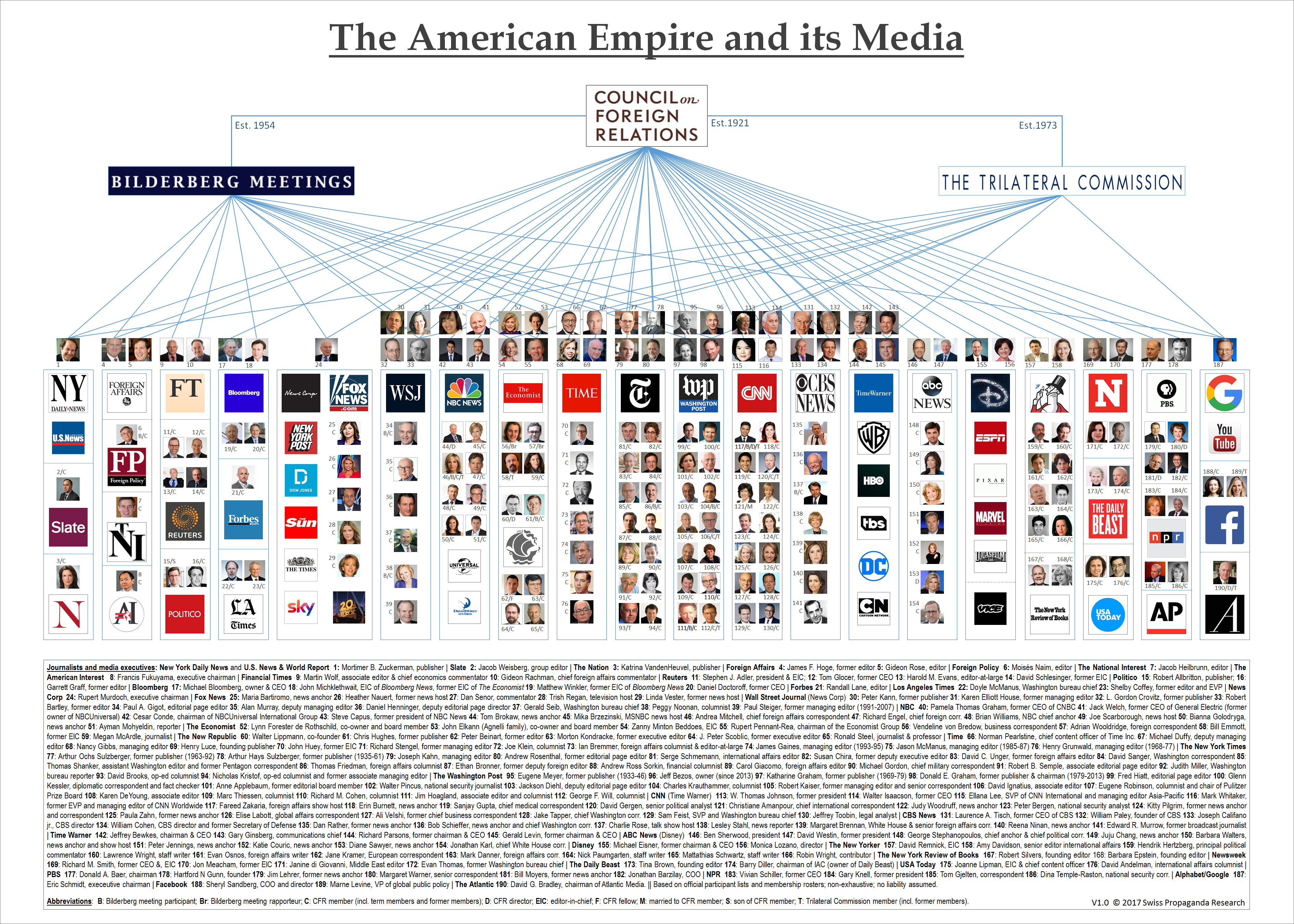
The American Empire and its Media, by Swiss Propaganda Research

Few people realize just how deeply imbued the Council on Foreign Relations (CFR) is into government, the media, business, and academia. From Swiss Propaganda Research at swprs.org:

Largely unbeknownst to the general public, executives and top journalists of almost all major US news outlets have long been members of the influential Council on Foreign Relations (CFR).

Established in 1921 as a private, bipartisan organization to “awaken America to its worldwide responsibilities”, the CFR and its close to 5000 elite members have for decades shaped U.S. foreign policy and public discourse about it. As a well-known Council member once explained, the goal has indeed been to establish a global Empire, albeit a “benevolent” one.

Based on official membership rosters, the following illustration for the first time depicts the extensive media network of the CFR and its two main international affiliate organizations: the Bilderberg Group(covering mainly the U.S. and Europe) and the Trilateral Commission (covering North America, Europe and East Asia), both established by Council leaders to foster elite cooperation at the international level.

CFR Media Network

In a column entitled “Ruling Class Journalists”, former Washington Post senior editor and ombudsman Richard Harwood once described the Council and its members approvingly as “the nearest thing we have to a ruling establishment in the United States”.

Harwood continued: “The membership of these journalists in the Council, however they may think of themselves, is an acknowledgment of their active and important role in public affairs and of their ascension into the American ruling class. They do not merely analyze and interpret foreign policy for the United States; they help make it. () They are part of that establishment whether they like it or not, sharing most of its values and world views.”

However, media personalities constitute only about five percent of the overall CFR network. As the following illustration shows, key members of the private Council on Foreign Relations have included:

  • several U.S. Presidents and Vice Presidents of both parties;
  • almost all Secretaries of State, Defense, and the Treasury;
  • many high-ranking commanders of the U.S. military and NATO;
  • almost all National Security Advisors, CIA Directors, Ambassadors to the U.N., Chairs of the Federal Reserve, Presidents of the World Bank, and Directors of the National Economic Council;
  • some of the most influential Members of Congress (notably in foreign & security policy matters);
  • many top jounalists, media executives, and entertainment industry directors;
  • many prominent academics, especially in key fields such as Economics, International Relations, Political Science, History, and Journalism;
  • many top executives of Wall Street, policy think tanks, universities, and NGOs;
  • as well as the key members of both the 9/11 Commission and the Warren Commission (JFK)

To continue reading: The American Empire and its Media

Celebrity Experts, by The Zman

Politically motivated “experts” are often wrong because their predictions are a product of their ideology. From the Zman at theburningplatform.com:

A few years ago Greg Cochran pointed out that western economists had been very wrong about the economic condition of the Soviet block countries. Paul Krugman had claimed that the East German economy was 80% of the West German economy. When the wall fell, what was revealed was a backward economy with environmental devastation and low quality consumer goods. All of this was obvious from the outside. All you had to do was take a look at the cars, which were a joke compared to the cheapest western cars.

The reason western economists were so laughably wrong about the Soviet economy is that it was worth their while to be wrong. The Left side of the ruling class wanted to believe the commies were doing well. They owned the media and the academy, so it is not hard to figure out the rest. That, of course, calls into the question the integrity of the field, but in reality they just believed what was convenient. Even PhD’s can delude themselves if it has social value. You see that in this post by celebrity economist Tyler Cowen.

Will Ethiopia become “the China of Africa”? The question often comes up in an economic context: Ethiopia’s growth rate is expected to be 8.5 percent this year, topping China’s projected 6.5 percent. Over the past decade, Ethiopia has averaged about 10 percent growth. Behind those flashy numbers, however, is an undervalued common feature: Both countries feel secure about their pasts and have a definite vision for their futures. Both countries believe that they are destined to be great.

Consider China first. The nation-state, as we know it today, has existed for several thousand years with some form of basic continuity. Most Chinese identify with the historical kingdoms and dynasties they study in school, and the tomb of Confucius in Qufu is a leading tourist attraction. Visitors go there to pay homage to a founder of the China they know.

This early history meant China was well-positioned to quickly build a modern and effective nation-state, once the introduction of post-Mao reforms boosted gross domestic product. That led to rapid gains in infrastructure and education, and paved the way for China to become one of the world’s two biggest economies. Along the way, the Chinese held to a strong vision that it deserved to be a great nation once again.

To continue reading: Celebrity Experts

How Identity Politics Is Changing Universities, by William L. Anderson

The weird political belief system that sees the world entirely in terms of gender, race, and ethnicity have virtually taken over the academy. From William L. Anderson at mises.org:

Ours is a politicized age from the college campus to the corporate boardroom, a situation in which things that once were personal now are utterly political. The hard left now controls not only higher education, but also much of scientific research upon which the future of humanity as we know it depends. What began in 1969 as the establishment of a single course in Women’s Studies at Cornell University and similar courses elsewhere in what then were called Black Studies has metastasized into a monster that almost completely dominates higher education in the United States and Canada. Today, it is rare to find a college or university that does not have majors and programs in Identity Studies.

This long march of feminists and racialists from near-obscurity to absolute-dominance is compared to the rise of Snopes family created by author William Faulkner in his 1940 novel, The Hamlet. In Faulkner’s book, the Snopeses move into the Mississippi community of Frenchman’s Bend and slowly take over nearly all aspects of life. Even though the locals seem to understand what is taking place, they are seemingly helpless because they heard the rumor that people that made a Snopes unhappy would have their barns burned to the ground.

In campus politics, the activists did not threaten to burn only the barns but rather the entire college campus. Anyone in higher education that might allegedly say or write something that offends someone in a politically-protected group is likely to be the focus of the infamous Twitter Mob, and even a distinguished career and something as prestigious as a Nobel Prize offers no cover, as Tim Hunt found out. For that matter, truth itself is no defense, as we found out in the infamous Duke Lacrosse Case. All that matters is identity politics, and the Duke case demonstrates just how powerful – and destructive – such politics have become.

In March 2006 at Duke University, a black stripper falsely claimed that three members of the Duke men’s lacrosse team beat and raped her at a team party where she performed, and the Duke campus exploded in anger as the story spread throughout the country, dominating newscasts and the Internet. Shortly after the accusations surfaced, 88 Duke faculty members signed an advertisement in the Duke Chronicle, a student newspaper, condemning the lacrosse players and thanking demonstrators for not waiting to see if the charges were credible.

To continue reading: How Identity Politics Is Changing Universities

Pushback, by James Howard Kunstler

A University of Pennsylvania law professor publishes an article calling on people to act civilized, and of course gets crucified for it. From James Howard Kunstler at kunstler.com:

A very brave law professor at the University of Pennsylvania, named Amy Wax has published the astounding argument that human beings in America would benefit from adopting “bourgeois values” and behaving accordingly. Bourgeois (Boozh-wah, for the underspeeched) may be an unfortunate term-of-art, since it came to be used as a pejorative back in the old hippie days — something that Ms. Wax might remember, since she is a Baby Boomer — but what else might you call this bundle of traditional values: honesty, fidelity, thrift, temperance, punctuality, fortitude, gratitude, dedication, kindness, loyalty, et cetera?

A glance at Amy Wax’s credentials might induce a head-snap.

Amy Laura Wax received a B.S. summa cum laude in molecular biophysics and biochemistry from Yale in 1975. She was then a Marshall Scholar in Philosophy, Physiology, and Psychology at Somerville College at Oxford University. She earned an M.D. from Harvard Medical School in 1981, training as a neurologist, and received a J.D. from Columbia in 1987, where she was an editor of the Law Review. She was a Law Clerk to the Honorable Abner J. Mikva, U.S. Court of Appeals for the District of Columbia Circuit from 1987-88. From 1988-94, she served as Assistant to the Office of the Solicitor General in the U.S. Department of Justice, where she argued 15 cases before the United States Supreme Court. Wax was a member of the Legal Affairs Committee, American Academy of Neurology from 1986-1992. In 1994, she joined the faculty of UVA [U. of Virginia]. She taught courses in civil procedure, labor law, and poverty law and welfare policy. She became Class of 1948 Professor of Scholarly Research in Law from 2000-01. After becoming a visiting professor to Penn Law School in 2000, she joined its faculty in 2001.

By some miracle, she didn’t end up a professor of Intersectional Gender Justice. Of course, the Social Justice commissars around the country regard her as just another neo-Nazi punk committing violence-through-speech against the ethno-sexual minorities who seek to throw off the shackles of Cis-White Privilege oppression. In an op-ed essay in the Philadelphia Inquirer (co-authored with Larry Alexander of the University of San Diego School of Law) titled Paying the Price for Breakdown of the Country’s Bourgeois Culture, Wax argued that “the single-parent, anti-social habits, prevalent among some working-class whites, the anti ‘acting white’ rap culture of inner-city blacks” and the “anti-assimilation ideas gaining ground among some Hispanic immigrants” are not suited to a First-World 21st Century Environment.

To continue reading: Pushback

Harvard’s Cowardice on Chelsea Manning, by Robert Parry

Chelsea Manning exposed war crimes but Harvard withdraws a fellowship at the insistence of a war criminal. From Robert Parry at consortiumnews.com:

Exclusive: In an abject display of intellectual cowardice, Harvard’s Kennedy School withdrew a fellowship from Chelsea Manning after hearing protests from accomplices in the war crimes she exposed, reports Robert Parry.

Harvard University’s John F. Kennedy School of Government has shown that it is no profile in courage by withdrawing a visiting fellowship that had been awarded to Chelsea Manning, who served seven years in prison for revealing U.S. war crimes committed in Iraq and Afghanistan.

U.S. Army Pvt. Chelsea (formerly Bradley) Manning.

The Kennedy School caved in to pressure from people who shared in responsibility for those and other crimes, including former CIA Deputy Director Michael Morell, who resigned his own fellowship in protest and denounced Manning as “a convicted felon and leaker of classified information.”

Of course, it is also true that Martin Luther King Jr. was jailed for criminal violations pertaining to his protests against “legal” injustices — as was South Africa’s Nelson Mandela. Manning represented perhaps America’s quintessential prisoner of conscience of this decade, someone who was severely punished for exposing wrongdoing.

After serving in Iraq as an Army intelligence analyst and witnessing the often-cavalier attitude toward killing Afghans and Iraqis, Manning decided to release thousands of classified documents, including what WikiLeaks labeled the “Collateral Murder” video of a U.S. helicopter gunship mowing down Iraqis and two Reuters journalists on a Baghdad street. Manning’s decision was an act of moral courage at a time when American Officialdom was violating a host of international laws with impunity.

Indeed, what was almost as troubling as the war crimes themselves was that virtually no one from the presidencies of George W. Bush and Barack Obama was punished for their criminal actions, especially for committing what the Nuremberg Tribunals deemed the “supreme international crime,” the crime of “aggressive war.”

Bush was allowed to retire to a quiet life as an artist; many of his senior national officials have gone on to comfy jobs in the corporate and academic worlds; and Obama has already begun to hit the lucrative lecture circuit. But Manning served seven hard years in prison and has now been further humiliated by Harvard’s cowardice.

In the explanation of the hasty late-night decision to withdraw Manning’s fellowship, the school’s dean Douglas Elmendorf wrote, “I see more clearly now that many people view a visiting fellow title as an honorific, so we should weigh that consideration when offering invitations.”

To continue reading: Harvard’s Cowardice on Chelsea Manning

How Berkeley Birthed the Right, by Patrick J. Buchanan

Leftist radicals have helped some of the most unlikely people. From Patrick J. Buchanan at buchanan.org:

In December 1964, a Silver Age of American liberalism, to rival the Golden Age of FDR and the New Deal, seemed to be upon us.

Barry Goldwater had been crushed in a 44-state landslide and the GOP reduced to half the size of the Democratic Party, with but 140 seats in the House and 32 in the Senate.

The Supreme Court of Chief Justice Earl Warren, the most liberal in history, was on a roll, and LBJ was virtually unopposed as he went about ramming his Great Society through Congress.

The left had it all. But then they blew it, beginning at Berkeley.

Protests, sit-ins, the holding of cops hostage in patrol cars — went on for weeks to force the University of California, Berkeley, to grant “free speech,” and then “filthy speech” rights everywhere on campus.

Students postured as revolutionaries at the barricades, and the Academic Senate, consisting of all tenured faculty, voted 824-115 to support all Free Speech Movement demands, while cravenly declining to vote to condemn the tactics used.

Middle America saw the students differently — as overprivileged children engaged in a tantrum at the most prestigious school in the finest university system in the freest nation on earth.

Here is how their leader Mario Savio described the prison-like conditions his fellow students had to endure on the Berkeley campus in 1964:

“There is a time when the operation of the machine becomes so odious, makes you so sick at heart, that you can’t take part; you can’t even passively take part, and you’ve got to put your bodies upon the gears and upon the wheels, upon the levers, upon all the apparatus, and you’ve got to make it stop. And you’ve got to indicate to the people who run it, to the people who own it, that unless you’re free, the machine will be prevented from working at all!”

To borrow from Oscar Wilde, it takes a heart of stone to read Mario’s wailing — without laughing.

As I wondered in an editorial in the St. Louis Globe-Democrat that week, “If there is so much restriction of speech on the campus, how it is that a few yards from Sproul Hall there is a Young Socialist League poster complaining of ‘American Aggression in the Congo’ and calling on students to support ‘the Congolese rebels.’”

To continue reading: How Berkeley Birthed the Right

Universities Cave to Snowflakes, by Walter E. Williams

Institutions of higher education get loopier by the day. From Walter E. Williams at lewrockwell.com:

One wonders just how far spineless college administrators will go when it comes to caving in to the demands of campus snowflakes. For those unfamiliar with the term “snowflakes,” it is increasingly being used to characterize college students easily traumatized by criticism and politically incorrect phrases. They demand safe spaces and trigger warnings so as not to be upset by views that challenge their own. Snowflakes feel as though they must be protected against words, events and deeds that do not fully conform to their extremely limited, narrow-minded beliefs built on sheer delusion. This might explain their behavior in the wake of Donald Trump’s trouncing of Hillary Clinton.

Generosity demands that we forgive these precious snowflakes and hope that they grow up. The real problem is with people assumed to be grown-ups — college professors and administrators who tolerate and give aid and comfort to our aberrant youth. Let’s look at tiny samples of it.

To help avoid microaggressions, the University of North Carolina administration posted a notice urging staff and faculty members to avoid phrases such as “husband/boyfriend,” which they claim is heteronormative, and “Christmas vacation,” which “minimizes non-Christian spiritual rituals.”

This winter, the Oregon State University administration will treat its students to a new class that promises to teach them about how blacks have historically resisted white supremacists. Professor Dwaine Plaza, one of three instructors for the course, said the idea was inspired by Trump’s election, which he fears will take the country back to the 1960s.

The University of Maryland is hosting a series of postelection lectures on how a “commitment to white supremacy” gave Trump momentum and blaming “white America’s spiritual depravity” for his rise to power. One of the topics will be “Make America White Again? The Racial Reasoning of American Nationalism.”

To continue reading: Universities Cave to Snowflakes


We Love You, Morons, by Robert Gore

Are most people too stupid, ignorant, and benighted to comprehend truth in the sciences, appreciate beauty in the arts, and embrace wisdom in politics? That question captures the bedrock assumption guiding a sliver of the populace, a self-anointed elite who cover their disdain for everyone else with altruistic professions of humanitarian concern. They’re curiously contradictory posture: we despise common tastes, choices, and beliefs, but we stand four square for the common “folk” (one of President Obama’s favorite words). After over a century of such sententiousness, the “common folk” are beyond irritated. Before the charade blows up completely, however, this claim to intellectual, aesthetic, and moral superiority, its widespread acceptance and its devastating effects, must be dissected, analyzed, and understood.

Walk into any museum of modern art and you’ll soon come upon a work that, if you’re honest with yourself, you have no idea how or why it’s called art. Maybe its a few squiggly lines, or a geometric representation indistinguishable from the floor tiles in a restroom you once visited, or three blank, white canvases (these examples came from a simple Google search: modern art, images), but no matter what “masterpiece” first evokes it, the feeling grows that a fraud is being perpetrated. Visual art is chosen here because it’s the most obvious, but listening to the music from today’s supposed heirs to Beethoven, Chopin, and Rachmaninoff, or reading the precious gems that win contemporary literary prizes and awards will also produce that sinking sensation of intellectual and aesthetic victimization. You have, in fact, been had, and it’s vitally important to unravel this con game and what it accomplishes.

The decoupling of the “artistic” from the popular is a fairly recent development. The Renaissance geniuses were mostly recognized during their lifetimes. Shakespeare’s plays (whoever wrote them) filled the Globe theater. The serialized Crime and Punishment was devoured by Russian readers, the English eagerly awaited each Dickens’ installment, the French lionized Victor Hugo, and Mark Twain won enduring acclaim, notwithstanding some scathing criticism, after the publication of The Adventures of Huckleberry Finn (for a more contemporary scathing criticism, SLL has weighed in). However, by 1885, when Twain’s classic was published, storm clouds were already on the horizon.

For centuries the hereditary nobility, primarily the landed aristocracy, was the clearly demarcated economic and political elite of Europe. They had no need either to exaggerate their status or to differentiate themselves with incomprehensible artistic, intellectual, and moral standards. Their patronage of religion, education, and the arts was in part to ensure that their standards were promulgated and accepted throughout society, especially among the lower classes. That patronage created a second tier, the priests, scholars, and artists, dependent on their patrons and below them on the social scale, but above the “common folk.”

The Industrial Revolution upended the prevailing order. Fortunes larger than those of even the wealthiest of the European nobility went to the inventive, innovative, and ingenious. Wealth became a shifting, dynamic product of unfettered minds, not a virtually static sum based on land and rentier profits from low risk investments carefully shepherded from generation to generation, protected and augmented through political power. Heredity in the new order counted for next to nothing, except for whatever genetics had bestowed upon those who successfully navigated the ceaselessly roiling competitive landscape.

Undermining the basis of the old aristocracy, capitalism also knocked down the social status of the priests, scholars, and artists. The masses, as they disdainfully became known, certainly didn’t abandon religion, education, and art, but it was Rockefeller, Carnegie, Ford, and Edison, et al., that they admired and wanted to emulate, and some of them did. The devalued classes launched a counterattack that was, ironically enough, funded and supported in large measure by the new millionaires, their heirs, and their foundations.

It takes intellectual back handsprings to condemn as exploitive the first economic system in history that not only propelled countless rags-to-riches stories, but provided opportunity and raised standards of livings for millions of ordinary people who would have been previously consigned to poverty. In Karl Marx the devalued “intellectuals” found their man. Capitalism’s supposed internal contradictions would cause it to fail, replaced by a fully planned economy, and you-know-who would be doing the planning.

Only the resolutely masochistic can plow through Marx’s analytic gobbledygook and wildly errant predictions. What the intellectuals—the vast majority of whom did not actually read him—understood was that his planning and “scientific” socialism offered an avenue to restore them to primacy. They adopted two strategies. The first can only be called “baffle them with bullshit”: develop terminology, “specialized” modes of thought, and standards so abstruse and arcane—in politics, economics, the arts, and education—that the select few initiates would be seen as especially intelligent and expert. The second strategy was faux humanitarianism: the elect were not just exceptionally smart and capable, they were distinguished by their outsize concern for the wellbeing of the rest of humanity.

The presumed “exploited” didn’t have much use for a system where their ability doomed them to providing for the less industrious and competent, Marxist revolution came not from the proletariat in the industrially advanced nations as Marx had predicted, but in agrarian Russia, and demonstrated that the utopia had to be imposed at the point of a gun. Lenin and Stalin’s rivers of blood were bright light warnings of Marxism’s inherent flaws, but Western intellectuals continued to propound collectivism, undeterred, although they often called it something other than communism. The dictators derided the intellectuals as “useful idiots.” The intellectuals embraced the dictators, unveiling their true goal: power.

It is no coincidence that the century of the experts has been the bloodiest in human history. The mental chaos and intellectual abdication that have unleashed this unprecedented carnage are faithfully rendered in today’s awful art, literature, and music. However, an epochal change has begun. A growing number see the pretensions of the rulers and so-called thought leaders, the supposed brilliance, expertise, and humanitarianism, for the shams they are. A squiggly line is not the Mona Lisa, random noise is not Tchaikovsky, ten years from now nobody will be reading books hailed as today’s classics, and the “best and brightest” are just as prone to incompetence and corruption, if not more so, as anyone else; the governments they direct have run their countries into the ground.

One cannot be made to feel stupid without one’s consent. That consent, so long granted, is being withdrawn as common sense (known in some quarters as straight line logic), makes a comeback. The vaulting ambition of those exercising power always “o’erleaps itself” when those it seeks to rule rediscover that they run their own lives far better than the powerful do. The shrieking you hear is from those who have perpetrated fraud, recognizing that without their ill-gotten and undeserved power and status, they are nothing and have nothing to offer that anybody else would want. Don’t expect them to give it all up without a hellacious fight.

LITERATURE YOU CAN’T PUT DOWN

TGP_photo 2 FB

AMAZON

KINDLE

NOOK

You’ve Got To Read It to Believe It

Horrors! Pro-Donald Trump for president chalkings have been spotted on the campus of Emory University. One can understand the dismay of sensitive students to this apparently unapproved exercise of the First Amendment, although one wonders if Bernie Sanders chalkings would elicit the same dismay. By the way, tuition at this illustrious institution is $45,700 per annum. From Sam Budnyk at emorywheel.com, with all he has written so far about the by now infamous Trump chalkings:

UPDATE (3/22 at 9:49 p.m.) Scroll down for the original article:

The following day, University President James W. Wagner, as well as representatives from College Council (CC) and Student Government Association (SGA) sent emails to the Emory community to address student concerns and responses. In his University-wide email, Wagner wrote that he intends to implement “immediate refinements to certain policy and procedural deficiencies, regular and structured opportunities for difficult dialogues, a formal process to institutionalize identification, review and [the] addressing of social justice opportunities and issues and a commitment to an annual retreat to renew our efforts.” Wagner added in his email that the previous day’s chalkings represented “values regarding diversity and respect that clash with Emory’s own.”

In the joint email sent on behalf of CC and SGA, representatives wrote that they “remain unapologetically dedicated to inclusion, diversity and equity,” and that both institutions will stand in solidarity with any Emory students who have encountered a lack of safety and support. To provide Emory students an opportunity to discuss such support and inclusivity on Emory’s campus, SGA will hold office hours on Thursday, March 24 from 10 a.m. to 11 a.m. and CC will hold office hours on Thursday from 3:30 p.m. to 5 p.m.

According to the Dobbs University Center’s (DUC) Posting Policy, chalking must be reserved and approved through Emory’s campus reservation service, 25Live. The Posting Policy says that: chalk cannot be on columns or walls, it must be done on horizontal, ground surfaces and areas where rain can easily wash it away. Failure to comply with these policies results in a clean up fee. Chalking also may only remain for 48 hours. After this time, another group can chalk, if they reserve their chalking through 25Live.

The DUC’s Posting Policy also points out that the DUC is guided by the University’s policy on open expression, and any member of the Emory community who violates the open expression of others will be held in violation of said policy.

According to Emory University’s Open Expression Policy 8.14.5.8, “nonpersonal protests” such as chalking, should follow “all applicable flyer posting policies and banner reservation rules.” It also states that “no nonpersonal protests will be denied because of the content” of the display as long as they falls within the law, and that members of the community who “deface the open expression of others” are also violating this policy.

The article will be updated as information becomes available.

Students protested yesterday at the Emory Administration Building following a series of overnight, apparent pro-Donald Trump for president chalkings throughout campus.

Roughly 40 students gathered shortly after 4:30 p.m. in the outdoors space between the Administration Building and Goodrich C. White Hall; many students carried signs featuring slogans such as “Stop Trump” or “Stop Hate” and an antiphonal chant addressed to University administration, led by College sophomore Jonathan Peraza, resounded “You are not listening! Come speak to us, we are in pain!” throughout the Quad. Peraza opened the door to the Administration Building and students moved forward towards the door, shouting “It is our duty to fight for our freedom. It is our duty to win. We must love each other and support each other. We have nothing to lose but our chains.”

After approximately ten minutes outside from the start of the demonstration, the gathered students were ushered into the Quad-facing entrance to the Administration Building and quickly filled a staircase to continue their demonstration. Pausing in the staircase, a few students shared their initial, personal reactions to the chalkings.

“I’m supposed to feel comfortable and safe [here],” one student said. “But this man is being supported by students on our campus and our administration shows that they, by their silence, support it as well … I don’t deserve to feel afraid at my school,” she added.

To read more of this drivel: Emory Students Express Discontent With Administrative Response to Trump Chalkings

Bull Run, by James Howard Kuntsler

From James Kuntsler at kunstler.com:

The Twitter-incited mob that shut down last week’s Donald Trump rally at the University of Illinois’ Chicago pavilion was the first skirmish in what is shaping up to be a civil war between a political Left that has lost its mind and a political Right that has lost its mind and its soul. The tensions between these two camps are so contorted and dishonest that even trying to unpack the issues puts the un-packer in jeopardy of being branded as one kind of thought-criminal or another.

The Left has lost its mind in a climax of zealotry over the new religion of social justice, with its sacred “victims” (blacks, LBGTQs, etc), its sacred tenets (“diversity,” “inclusion”), and its endless charges of blasphemy (renamed “micro-aggressions”) against heretics (“racists,” “homophobes”) who object to absolutist thought policing. This was nicely described by Jonathan Haidt, social psychologist and Professor of Ethical Leadership at New York University in a recent podcast with author Sam Harris. (Skip to 1 hour 30 minutes in the long discussion.)

The religion got started on the campuses, where social science careerists ginned up an elaborate doctrine to justify the self-importance of their new departments in so-called race, gender, and privilege studies — the main point of which was to create new categories of sacred victims suffering spiritual torments (“traumas”) that could never be healed. These crypto-religious “studies” led to a multiplication of demons that had to be exorcized by an equal multiplication of diversity deans and committees aimed at punishing blasphemies — such as arguing against affirmative action (“racist”), or wearing a Mexican sombrero at a tequila party (“cultural appropriation” + “racist”), which happened recently at posh Bowdoin College.

To continue reading: Bull Run