Category Archives: Environment

Davos Billionaires Want to Save the Planet… Why Don’t Developing Countries Trust Them? By Matthew Ehret

Beware billionaires bearing global plans. From Matthew Ehret at strategic-culture.org:

For the time being, the world’s developing sector is generally not going to accept being sacrificed on the altar of a new Gaia cult managed by a priesthood of Davos billionaires.

A miracle appears to be happening, as the multibillionaires of the World Economic Forum (WEF) appear to have grown consciences.

As if by magic, it appears that these gold collar elites no longer yearn for profit and power as they once had. As COP26 closes up its 12 day annual ceremonies, leading WEF-connected figures like Prince Charles, Jeff Bezos, Mario Draghi, Mark Carney and Klaus Schwab have announced a new system of economics that is based on virtue over profit!

According to the COP26 website, “95 high profile companies from a range of sectors commit to being ‘Nature Positive,’ agreeing to work towards halting and reversing the decline of nature by 2030.”

Prince Charles has boasted that he has coordinated 300 companies representing over $60 trillion to get on board with a global green transition, and after meeting with the Prince on November 2, Jeff Bezos announced his new $2 billion Earth Fund to protect nature’s ecosystems with a focus on Africa. Even Prime Minister Mario Draghi has joined Mark Carney on this new green path, as both men have moved beyond their old Goldman Sachs money worshipping days and embraced a better destiny. At the Nov 1 G20 Summit, Draghi embraced Prince Charles’ Green Markets Initiative and threw Italy’s full support behind the de-carbonization initiative.

Continue reading→

Used Car Battery Problems Take Shine Off China’s “Green” New Energy Vehicles, by Shawn Li

A large-scale switch to electric cars faces the significant environmental problems of mining the rare earth elements for the batteries and then disposing of the batteries at the end of their useful lives. They’re already running into these problems in China. From Shawn Li at The Epoch Times via zerohedge.com:

In the last decade, China has rapidly expanded its “green” new energy vehicle (NEV) industry but recycling and disposing of hundreds of thousands of tons of used car batteries has become a pressing issue due to environmental concerns.

Growth in China’s NEV industry took off in 2014 when nearly 78,500 NEVs were produced and some 75,000 were sold. As of September of this year, China’s NEV registration reached 6.78 million, of which 5.52 million are fully electric vehicles.

The NEV industry predicts that its production and sales growth rate will remain above 40 percent in the next five years prompting the question of how to best manage the growing numbers of discarded lithium batteries from the NEVs.

Industry data shows that the service life of lithium batteries used in electric vehicles is generally 5 to 8 years, and the service life under warranty is 4 to 6 years. That means, tens of thousands of electric car batteries will soon need to be discarded or recycled, and millions more down the road.

According to the latest data from China Automotive Technology and Research Center, the cumulative decommissioning of China’s electric car batteries reached 200,000 tons in 2020 and the figure is estimated to climb to 780,000 tons by 2025.

Presently, most end-of-life batteries are traded in the unregulated black market, raising serious environmental concerns. If such batteries are not handled properly, they could cause soil, air, and water pollution.

“A 20-gram cell phone battery can pollute a water body equivalent to three standard swimming pools. If it is buried in the ground, it can pollute 1 square kilometer (247 acres) of land for about 50 years,” Wu Feng, a professor at Beijing Institute of Technology, once publicly stated.

Continue reading→

Biden’s Baffling Oil Policy Faces Backlash From All Sides, by Irina Slav

Why should Biden’s energy policies be any less baffling than any of his other policies? From Irina Slave at oilprice.com:

  • President Biden is in a tight spot when it comes to energy
  • The White House continues to face critique from both environmentalists and the oil and gas industry
  • If energy demand continues to grow at the current pace, switching from pragmatism to an all-out renewables agenda will be a huge challenge

President Joe Biden and his administration hardly planned for everything that happened this year. In fairness, no administration could have planned for it: soaring oil and gas demand, tight supply, rising prices fueling inflation that has quickly gone from nothing to worry about to the biggest worry for many.

Yet that’s not the worst of it for the Biden administration. The president came into office with the pledge to set the United States on a course towards a lower-carbon energy future. This would have been a challenging task even under the best of circumstances, the U.S. being one of the biggest polluters in the world. With the energy crunch, the task becomes almost impossible.

It is no wonder, then, that when Biden started calling on OPEC to boost crude oil production, nervous about rising gas prices at American filling stations, he instantly attracted accusations of hypocrisy. After all, he was pushing an energy transition agenda, he was clearly not in favor of boosting domestic oil production, and one of the first executive orders he signed was the one that killed the Keystone XL pipeline.

The White House’s climate envoy, John Kerry, got asked about Biden’s energy policy at the COP26 summit in Glasgow last week. How could the president urge OPEC to pump more oil while campaigning for the phase-out of fossil fuels, the media asked Kerry.

“He’s asking them to boost production in the immediate moment,” Kerry said in response, as quoted by the Wall Street Journal. “And as the transition cuts in, there won’t be that need as you deploy the solar panels, as you deploy the transmission lines, as you build out the grid.”

Kerry’s statement is in line with Biden’s own defense of his latest moves in the energy area.

Continue reading→

The Big Green Push to Get Rid of Coal Had the Opposite Effect, by Mike “Mish” Shedlock

Like so much of what the left does, what actually happens is the exact opposite of what they promised. From Mike “Mish” Shedlock at mishtalk.com:

An alleged big win to eliminate coal turned into a bust and then some.

Coal Consumption

Investors Pushing Mining Giants to Quit Coal is Backfiring

Bloomberg has an interesting story on how Environmentalists Pushing Mining Giants to Quit Coal has backfired.

It was supposed to be a big win for climate activists: another of the world’s most powerful mining companies had caved to investor demands that it stop digging up coal.

Instead, Anglo American Plc’s exit from coal has become a case study for unintended consequences, transforming mines that were scheduled for eventual closure into the engine room for a growth-hungry coal business.

And while it’s a particularly stark example, it’s not the only one. When rival BHP Group was struggling to sell an Australian colliery this year, the company surprised investors by applying to extend mining at the site by another two decades — an apparent attempt to sweeten its appeal to potential buyers.

Now, after years of lobbying blue-chip companies to stop mining the most-polluting fuel, there’s a growing unease among climate activists and some investors that the policy many of them championed could lead to more coal being produced for longer.

BHP may end up holding on to the Australian mine it was battling to sell, Bloomberg reported last week. Earlier this year, Glencore Plc sounded out a major climate investor group before announcing it would increase its ownership of a big Colombian coal mine, according to people familiar with the matter.

Continue reading→

The Means Are The End, by Robert Gore

nrm_1413211155-grandma

“God save us from those who would ‘save’ us.”
A Straight Line Logic reader’s dear, departed grandmother

Ignore the words and slogans associated with humanity’s periodic descents into death and destruction and what’s left? What’s on the other side of the rhetoric and ritualistic ends-justify-the-means rationalizations? More death and destruction. The means are the end, there’s nothing else. The dictators kill their way to the top and then keep on killing. Many of their victims believe the rhetoric. A few grasp during their last moments that their killers meant to kill them all along.

Humanity is once again confronted by a movement that once again claims our subjugation and its absolute power will lead to utopia. Along the way a few must be sacrificed for the greater good. If things go according to plan, few will mean billions, but the promised paradise will be worth it. Paradise for the homicidal psychopaths promoting and perpetrating these horrors is a world turned into a charnel house. The object of murder is murder.

One reason they employ the smear “extremist” is to divert people from reaching extreme conclusions, especially if they’re the correct ones. People who realize they’re going to be murdered will fight back, which is troublesome for the utopians. Is mass murder the object? Cast aside the propaganda and look at what’s actually happening.

The figurative representation of the SARS-CoV-2 virus is a sphere dotted with the coronal spike proteins that give coronaviruses their name. The novelty of the mRNA technology incorporated into the widely used Pfizer and Moderna vaccines is that they instruct cells to produce the same spike proteins. The assurances were that spike proteins produced by the vaccines would act locally, at the site of the shot, and that they would stimulate the immune system’s production of antibodies against the virus with no pathogenic effects.

The assurances were false. From the injection site the vaccine can travel via the bloodstream all over the recipient’s body to organs, tissues, glands, and systems, where cells are stimulated to produce the spike proteins. The spike proteins are pathogens even when detached from the virus. Often they disappear within a few days with no immediately apparent ill effects, but not always. In the vascular system, they can damage the endothelial tissue that lines blood vessels and the blood vessels themselves by binding to cells’ ACE2 receptors, leading to inflammation, bleeding, and blood clots. They can cross the blood-brain barrier and cause neurological damage. Spike proteins can damage cells throughout the body, accounting for the vaccines’ myriad reported adverse effects.

Amazon Paperback Link

Kindle Ebook Link

They apparently have an affinity for sexual organs. Menstrual problems and first-trimester miscarriages have been reported at far higher than normal rates among mRNA-vaccinated woman. For males, there have been reports of testicular damage, including swelling, and erectile dysfunction. We have no idea what these effects may have on fertility long-term, but it should have been exhaustively studied before a single shot was administered to children.

Continue reading

The Recognition, by James Howard Kunstler

James Howard Kunstler uncorks on those who would save us from ourselves. From Kunstler at kunstler.com:

The climate change agitation is based on a central grandiose fallacy of our wobbling technocratic age: the idea that if you can measure enough stuff, you can control it. The master-wish in this case is what, exactly? To control the weather? (Which we might define as the day-to-day expression of the planet’s climate?) That ain’t gonna happen. In case you haven’t noticed, the business model of industrial civilization is already broken, and many of its dazzling tricks with it. And, anyway, the earth’s climate is forever and always changing, as is the adaptive response to it by human populations over the centuries, sometimes slowly and sometimes fast.

So, the net result of this year’s Glasgow Climate Summit is to pledge gobs of money from the “rich” nations to protect the poor nations, while mandating the reduction of oil, natgas, and coal in all nations, i.e., the global economy. Apropos of those “rich” nations, guess what: all of our modern money rests on promises to deliver future volumes of energy (and products of value made from it) and those promises are without basis in reality, so the money itself is increasingly worthless. Thus, the cost of getting that future energy exceeds the promises embedded in the money based on the energy. How’s that for a paradox? We’re the proverbial snake eating its own tail and now we’ve bitten off more than we can swallow.

We’re going to use less energy whether Klaus Schwab (and the Persian cat in his lap) likes it or not because our money is increasingly no good, which translates into a general loss of mojo for this round of civilization. The massive matrix of mutually self-reinforcing activities is seizing up — the mining, making, harvesting, and transport of stuff. That’s exactly what the “supply chain” melodrama is about. Of course, the Glasgow Summit did allow a bunch of people to feel self-important, to bethink themselves morally superior, which is the status currency of our time — the brownie-point having more actual value than the dollar these days. It certifies the “good” people and validates their persecution of the “bad” people, which is the central political drama of our time. The reward is power for its own sake, which is — let’s face it — the essence of evil.

Continue reading→

Shut Down Joe, by Eric Peters

The agenda is clear: shut down as much as possible, regardless of the cost to the economy or in human life. From Eric Peters at ericpetersautos.com:

It appears that the Biden Thing is determined to do more than Jab the entire country. He also appears determined to freeze it.

And bankrupt it.

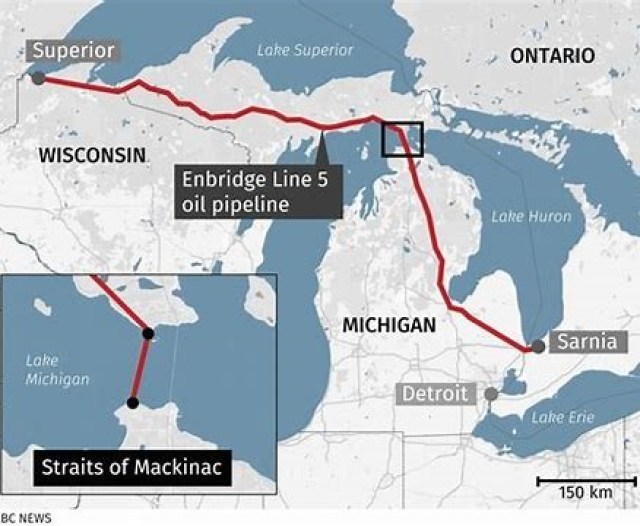
Word is out that – contrary to initial denials – the Biden Thing will issue another ukase (that is, a decree) shutting down the Line 5 pipeline that currently sends more than a half-million barrels’ worth of oil per day to the United States from Canada.

Of course, it’s phrased otherwise. The regime is merely “studying” it. You know, like it “studied” issuing a ukase that every American worker be threatened with loss of job and livelihood as the “incentive” to make them roll up their sleeves.

Shutting down Line 5 will have catastrophic practical and economic effects on the supply of oil – in the United States – because there is nothing on tap, so to speak, to make up for the impending loss. The Biden regime seems determined to close off the tap; which is to say the Biden regime is consciously trying to squeeze (and quite literally) freeze the people of the United States.

This will happen because of two things, one of them obvious. Less oil means less fuel. For cars as well as homes heat with oil. The effect will be especially harsh in the Midwest, where the freeze comes sooner, is harder – and lasts longer.

But everyone is going to pay more for gas – and oil – and everything else connected with  oil and gas.

Which is essentially everything – including food and not only because it will cost more to truck the food from where it grows and where it’s raised to where it’s bought. Oil fuels agriculture – via fertilizer – without which the amount of food currently grown cannot be sustained. Cows and chickens and pigs eat the produce of agriculture before we eat them. When they have less to eat, there are less of them for us to eat. When it costs more to feed them, it costs us more to eat.

That is just one of the cascading effects to expect as a result of the Biden ukase.

Which ukase is justified by the regime as being necessary for the “environment.” In fact, it is necessary for the agenda of this regime, which is determined to make the cost of living higher so as to make its forced electrification agenda seem less expensive. If it costs the same to heat your home using fuel oil as it does to use electricity, then – so the logic goes – people will not mind being forced to buy just electricity.

Continue reading→

David Stockman on the GreenMageddon… Part 5

The final article of David Stockman’s series thoroughly debunking green mythology. From Stockman at internationalman.com:

Editor’s Note: Right now, the global elite and world leaders are coming together at the UN Climate Change Conference in Glasgow to address the “problem” of climate change.

Washington, DC, insider David Stockman debunks the narrative and offers a comprehensive look at the climate change agenda, including what it means for you.

Below is the final part of David’s article series.


GreenMageddon is no hyperbole. It’s is the virtually certain outcome of attempting to purge CO2 emissions from a modern energy system and economy that literally breathes and exhales fossilized carbon.

Indeed, the very idea of converting today’s economy to an alternative energy respiratory system is so far beyond rational possibility as to defy common sense. Yet that is exactly where the COP26 powers that be and their megaphones in the MSM are leading us.

In the first place, it needs be understood that the climate change advocates essentially lie about how much “green energy” we now use and therefore the scope for energy supply system displacement of fossil fuels which would be required to get to net zero CO2 emissions by 2050.

For instance, it is commonly claimed that 12% of US primary energy consumption (2020) is accounted for by “renewables”, implying that we are off to a decent start in eliminating the fossil fuel dependency of the system.

Actually, no—not even close. That’s because “renewables” and green energy defined as solar and wind are not remotely the same thing.

According to DOE, the US consumed 11.6 quads (quadrillion BTUs) of renewables in 2020, but 7.3 quads or 63% of that was accounted for by old-style non-fossil fuels including:

  • Hydroelectric: 2.6 quads;
  • Wood: 2.5 quads;
  • Biofuels: 2.0 quads;
  • Geothermal: 0.2 quads

Of course, there is nothing wrong with these non-fossil fuels and in some cases they can be quite efficient. But they are not part of the “green solution” to displace some or all of the 73 quads of fossil fuels consumed in 2020 because most of these sources are tapped out or not desirable to expand.

Continue reading→

Why COP26 Refused to Address Planned Obsolescence, by Joaquin Flores

The world could conserve a hell of a lot of resources if things didn’t break after a year or two. From Joaquin Flores at strategic-culture.org:

The ugly truth about cap and trade and all similar schemes is that they do not really reduce carbon emissions, if most other factors remain the same, Joaquin Flores writes.

The failure of the UN’s COP26 conference in Glasgow was spectacle of hypocrisy befitting of a moribund ruling class. These kinds of antics harken back to the decline and fall of the Roman Empire, where its decadent ruling class was deadly out of touch with the causes of growing decentralization and dissatisfaction in the periphery. And so taking our historical analogy further, we may begin to unwrap an epochal catastrophe which today’s elite now faces.

The transition from the Roman imperial system, through the Carolingian period, into to the system of medieval Europe, saw a continual decentralization of power, and the evolution of slaves and serfs into land-owning peasants.


Boris Johnson arrives at COP26 by private jumbo jet ready to tackle other leaders on emissions

This economic decentralization was connected to localized power structures. Roman forts thereby formed the basis of the medieval system of castles, and the relative weakness of these lords and little kings correlated to an improvement in the rights and economic power of what became the small land-owning peasantry.

Continue reading→

Did Glasgow Deliver ‘Blah, Blah, Blah’? By Patrick J. Buchanan

When you cut through the copious crap surrounding confabs like the recent one in Glasgow, it boils down to demands for money. From Patrick J. Buchanan at buchanan.org:

At the end of the first week of the Glasgow climate summit, 100,000 protesters marched to denounce the attendees as phonies who will never honor their commitments to curb carbon emissions.

Despite pledges by 100 nations to reduce methane emissions by 30% by 2030, and by 20 nations, including the U.S., to end financing of new international fossil-fuel power plants, teenage climate superstar activist Greta Thunberg says the COP26 summit is a con:

“Two weeks of business as usual, blah, blah, blah!”

Thunberg has a point.

Commitments made in Scotland are not binding upon governments that, be they autocratic or democratic, do not subordinate their national interests to pledges ostentatiously made in global forums.

This Glasgow summit calls to mind the Kellogg-Briand Pact, which won a Nobel Peace Prize for Secretary of State Frank Kellogg,

On Aug. 27, 1928, 15 High Contracting Parties signed on to renounce war as an instrument of national policy. The signatories that day were the United States, Britain, Germany, Italy, Japan, France, Poland, Belgium, Czechoslovakia, Canada, South Africa, Australia, New Zealand, Ireland and India. Within 15 years, all 15 nations, Ireland alone excepted, were ensnared in the greatest war in history.

Continue reading→