Tag Archives: Federal Reserve

Since 9/11, the Government’s Answer to Every Problem Has Been More Government, by John Whitehead

It’s a cycle: problem→government→government makes problem worse→more government→and so on. From John Whitehead at rutherford.org:

“A government big enough to give you everything you want is a government big enough to take away everything that you have.”—Anonymous

Have you noticed that the government’s answer to every problem is more government—at taxpayer expense—and less individual liberty?

The Great Depression. The World Wars. The 9/11 terror attacks. The COVID-19 pandemic.

Every crisis—manufactured or otherwise—since the nation’s early beginnings has become a make-work opportunity for the government to expand its reach and its power at taxpayer expense while limiting our freedoms at every turn.

Indeed, the history of the United States is a testament to the old adage that liberty decreases as government (and government bureaucracy) grows. To put it another way, as government expands, liberty contracts.

To the police state, this COVID-19 pandemic has been a huge boon, like winning the biggest jackpot in the lottery. Certainly, it will prove to be a windfall for those who profit from government expenditures and expansions.

Given the rate at which the government has been devising new ways to spend our money and establish itself as the “solution” to all of our worldly problems, this current crisis will most likely end up ushering in the largest expansion of government power since the 9/11 terrorist attacks.

This is how the emergency state operates, after all.

From 9/11 to COVID-19, “we the people” have acted the part of the helpless, gullible victims desperately in need of the government to save us from whatever danger threatens. In turn, the government has been all too accommodating and eager while also expanding its power and authority in the so-called name of national security.

As chief correspondent Dan Balz asks for The Washington Post, “Government is everywhere now. Where does it go next?

When it comes to the power players that call the shots, there is no end to their voracious appetite for more: more money, more power, more control.

This expansion of government power is also increasing our federal debt in unprecedented leaps and bounds. Yet the government isn’t just borrowing outrageous amounts of money to keep the country afloat. It’s also borrowing indecent sums to pay for programs it can’t afford.

Continue reading

The Fed and the looming capital market meltdown, by Tuomas Malinen

Massive fiat debt issuance is just digging the hole deeper. From Tuomas Malinen at gnseconomics.com:

The Federal Reserve system made a future financial panic or currency panic impossible. It made stable for the first time in the history of the United States the credit system of the people of the United States. – Senate Documents, 64th Cong., 1st Sess., December 6, 1916

We have been watching the “shock-and-awe” bailout of the financial system by the Federal Reserve with astonishment.  Never before has a central bank tried single-handedly to rescue both the financial system and a large proportion of U.S. corporations. We were taken aback then by Fed actions and are now just as worried about what it has given birth to.

We are unfortunately now in a situation where we cannot speak of “markets” anymore. The Fed has nurtured a dangerous, centrally controlled financial system, á la the Soviet Union. Like its ‘role model’, monolithic systems always fail, as the complexity of financial interactions and the economy will eventually overwhelm the central planners.

Alas, we fear that we are approaching the breaking point of the modern financial order.

The Federal Reserve

After the collapse of banks of the families Peruzzi and Bardi in 1343 and 1346 (the first financial crisis of the Middle Ages), a discussion about a ‘liquidity back-stop’ of the banking system began. The idea of the modern central bank emerged.

For the same reasons, the ‘Panic of 1907’ was a game-changer in an attempt to create a central bank in the US. To put a stop to the bank runs, a coalition led by the illustrious banker J.P. Morgan repeatedly intervened to restore the solvency of several New York banks, which in turn gave more impetus to demands that the U.S. banking system required a permanent institutional source of liquidity.

However, the creation of the Federal Reserve system, in 1913, was beset by worries that it would lead to the “socialization” of the economy. To calm these fears, the authority of the Fed to issue legal tender (or “currency”) was restricted by both the ‘real bills doctrine’ and the distribution of financial power.

Continue reading→

The Empire Will Strike Back: Dollar Supremacy Is the Fed’s Imperial Mandate, by Charles Hugh Smith

At this point the dollar is a buy and bonds and precious metals are a sell. From Charles Hugh Smith at oftwominds.com:

Triffin’s Paradox demands painful trade-offs to issue a reserve currency, and it demands the issuing central bank serve two competing audiences and markets.

Judging by the headlines and pundit chatter, the U.S. dollar is about to slide directly to zero. This sense of certitude is interesting, given that no empire prospered by devaluing its currency. Rather, devaluing the currency is a sure path to dissolution and collapse of the empire. This dynamic–devaluation leads to decline and collapse–is not exactly a secret.

So what all those proclaiming the death of the USD are saying is the Imperial Project is consciously choosing suicide, all to boost the U.S. stock market which is now little more than a signaling mechanism and a means of accelerating wealth inequality, as the billionaire class and the billionaire wannabe’s in the top .01% are the primary winners as stocks reach new highs.

(Recall that the U.S. economy is best described as anything goes and winners take most.)

Taking it one step further, those predicting the collapse of the U.S. dollar are predicting that not only will the Empire choose suicide, so will the billionaires because what will their fortunes be worth if the USD goes to zero?

The USD-is-dead crowd (and it is a crowd) present the demise as ordained by some mysterious force, as if the Empire has no will or power to resist the inevitable slide to zero. The helpless giant can only watch as the Federal Reserve debauches the dollar to boost stocks and float the mountains of debt required to keep the U.S. economy from imploding.

The USD-is-dead crowd also seems to overlook the inconvenient fact that all the other issuers of fiat currency are busy debauching their currencies, too by the same mechanisms: the endless digital printing of new currency, distributed to already-insanely-wealthy financiers and corporations. (Debt-serfs can “save themselves” by borrowing more, heh.)

We get it: digitally printing trillions in excess of actual productivity eventually destroys the purchasing power of the over-issued currency. We also get the need to keep interest rates at near-zero so governments can fund endless trillions in stimulus and other giveaways–billions to the billionaires and a trickle of bread-and-circuses to the debt-serfs.

Continue reading

The Dollar Is Dying, by MN Gordon

Monetary debasement usually goes along with moral and intellectual debasement. From MN Gordon at economicprism.com:

This week, while perusing the Federal Reserve’s balance sheet figures, we came across a rather curious note.  We don’t know how long the Fed’s had this note posted to its website.  But we can’t recall ever seeing it.  The note reads as follows:

“The Federal Reserve’s balance sheet has expanded and contracted over time.  During the 2007-08 financial crisis and subsequent recession, total assets increased significantly from $870 billion in August 2007 to $4.5 trillion in early 2015.  Then, reflecting the FOMC’s balance sheet normalization program that took place between October 2017 and August 2019, total assets declined to under $3.8 trillion.  Beginning in September 2019, total assets started to increase.”

Directly below this note is the following chart:

Does this look like a balance sheet that expands and contracts over time?

Quite frankly, the Fed’s balance sheet chart, and the extreme dollar debasement that it illustrates, is a disgrace.  The fact that the Fed had to add this flagrantly false note as preface to its disgraceful chart is an insult.

This is a direct offense to anyone that’s built a modest savings account by exchanging their time for dollars.  The time and effort put to obtaining these dollars is being stolen by the insidious process of central bank engineered money supply inflation.  Year in and year out, these earned dollars will be worth less and less.

Continue reading→

#MacroView: Fed Wants Inflation But Their Actions Are Deflationary, by Lance Roberts

In a debt saturated world, central bank balance-sheet expansion is deflationary. From Lance Roberts at realinvestmentadvice.com:

A recent CNBC article states the Fed will make a major commitment to ramping up inflation. How is this different than the past decade of promises for higher inflation? More importantly, while the Fed may want inflation, their very actions continue to be deflationary.

The Fed Has A Plan

“In the next few months, the Federal Reserve will be solidifying a policy outline that would commit it to low rates for years as it pursues an agenda of higher inflation and a return to the full employment picture that vanished as the coronavirus pandemic hit. 

Recent statements from Fed officials and analysis from market veterans and economists point to a move to “average inflation” targeting in which inflation above the central bank’s usual 2% target would be tolerated and even desired. 

To achieve that goal, officials would pledge not to raise interest rates until both the inflation and employment targets are hit.” – CNBC

Such certainly sounds familiar.

“The Federal Reserve took the historic step on Wednesday of setting an inflation target that brings the Fed in line with many of the world’s other major central banks.

In its first-ever ‘longer-run goals and policy strategy’ statement, the U.S. central bank said an inflation rate of 2 percent best aligned with its congressionally mandated goals of price stability and full employment.”– Reuters Reporting On Ben Bernanke’s Fed Policy Statement January 26, 2012

The Unseen

Over the last decade, the Federal Reserve has engaged in never-ending “emergency measures” to support asset markets and the economy. The stated goal was, and remains, such actions would foster full employment and price stability. There has been little evidence of success.

The table and charts below show the Fed’s balance sheet’s expansion and its effective “return on investment” on various aspects of the economy. For example, since 2009, the Fed has expanded its balance sheet by 612%. During that time, the cumulative total growth in GDP (through Q2-2020) was just 34.83%. In effect, it required $17.58 for every $1 of economic growth. We have applied that same measure across various economic metrics.

Fed Inflation, #MacroView: Fed Wants Inflation But Their Actions Are Deflationary

Continue reading→

The new deal is a bad old deal, by Alasdair Macleod

The Internet’s best economist explains why the New Deal was a huge mistake, and why we’re about to repeat it, except this time only huger. From Alasdair Macleod at goldmoney.com:

So far, the current economic situation, together with the response by major governments, compares with the run-in to the depression of the 1930s. Yet to come in the repetitious credit cycle is the collapse in financial asset values and a banking crisis.

When the scale of the banking crisis is known the scale of monetary inflation involved will become more obvious. But in the politics of it, Trump is being set up as the equivalent of Herbert Hoover, and presumably Joe Biden, if he is well advised, will soon campaign as a latter-day Roosevelt. In Britain, Boris Johnson has already called for a modern “new deal”, and in his “Hundred Days” his Chancellor is delivering it.

In the thirties, prices fell, only offset by the dollar’s devaluation in January 1934. This time, monetary inflation knows no limit. The wealth destruction through monetary inflation will be an added burden to contend with compared with the situation ninety years ago.

Introduction

Boris Johnson recently compared his reconstruction plan with Franklin D Roosevelt’s New Deal. Such is the myth of FDR and his new deal that even libertarian Boris now invokes them. Unless he is just being political, he shows he knows little about the economic situation that led to the depression.

Continue reading

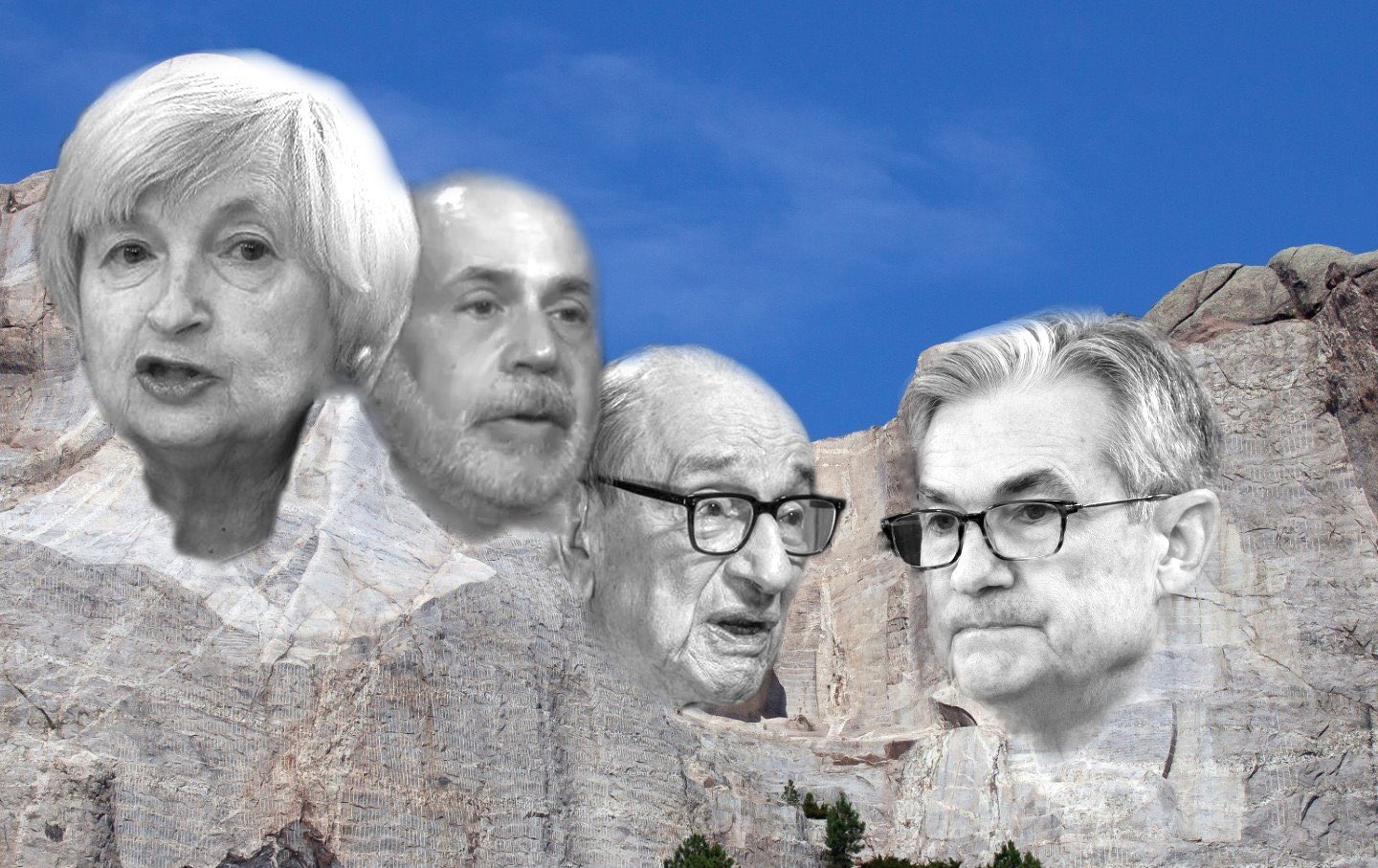
Mount Printmore, from The Burning Platform

https://www.theburningplatform.com/2020/07/04/mount-printmore/

Busted, by Sven Henrich

The Federal Reserve has distorted the economy and financial markets beyond recognition. From Sven Henrich at northmantrader.com:

First they dismiss you as a conspiracy theorist then they join you. The secret is out, the Fed is busted: Central banks have distorted asset prices far above the economy.
I’ve been harping about the market cap to GDP ratio for a while and even called the Fed’s asset price distortion operation a direct threat to the economy.

Now it appears the IMF agrees:

This disconnect between markets and the real economy raises the risk of another correction in risk asset prices should investor risk appetite fade, posing a threat to the recovery”

Posing a threat to the recovery. This was precisely my point on CNBC Fast Money last week:

https://twitter.com/NorthmanTrader/status/1273370977641140226?ref_src=twsrc%5Etfw%7Ctwcamp%5Etweetembed%7Ctwterm%5E1273370977641140226&ref_url=https%3A%2F%2Fnorthmantrader.com%2F2020%2F06%2F26%2Fbusted%2F

Continue reading→

MMT: Not Modern, Not Monetary, Not a Theory, by Jeff Deist

Jeff Deist spares SLL the trouble of debunking the Modern Monetary Theory fantasy. From Deist at mises.org:

Modern monetary theory (MMT) has a new champion, and a new bible. Stephanie Kelton, economics professor at SUNY Stony Brook, is the author of The Deficit Myth: Modern Monetary Theory and the Birth of the People’s Economy. Professor Kelton was an advisor to the Bernie Sanders presidential campaigns, and her ideas increasingly find purchase with left progressives. It is certainly possible that she has a future either in a Biden administration or even on the Federal Reserve Board, which is a testament to how quickly our political and cultural landscape has shifted toward left progressivism. And left progressivism requires a “New Economics” to provide intellectual cover for what is essentially a political argument for painless free stuff from government.

Kelton’s essential argument, first advanced by MMT guru Warren Mosler in the 1990s, is quite simple: federal spending is unconstrained by revenue. Taxes function only to regulate demand and hence inflation; federal borrowing functions only to regulate interest rates. Sovereign government treasuries can create and spend as much money as they like to stimulate growth, especially when the economy is underperforming. If inflation spikes, taxes can be imposed to take money out of the economy.

Continue reading

The Federal Reserve is Getting Desperate, by Ron Paul

It doesn’t matter how desperate the Fed gets, whatever they do won’t work. From Ron Paul at ronpaulinstitute.org:

In a sign that the Federal Reserve is growing increasingly desperate to jump-start the economy, the Fed’s Secondary Market Credit Facility has begun purchasing individual corporate bonds. The Secondary Market Credit Facility was created by Congress as part of a coronavirus stimulus bill to purchase as much as 750 billion dollars of corporate credit. Until last week, the Secondary Market Credit Facility had limited its purchases to exchange-traded funds, which are bundled groups of stocks or bonds.

The bond purchasing initiative, like all Fed initiatives, will fail to produce long-term prosperity. These purchases distort the economy by increasing the money supply and thus lowering interest rates, which are the price of money. In this case, the Fed’s purchase of individual corporate bonds enables select corporations to pursue projects for which they could not otherwise have obtained funding. This distorts signals sent by the market, making these companies seem like better investments than they actually are and thus allowing these companies to attract more private investment. This will cause these companies to experience a Fed-created bubble. Like all Fed-created bubbles, the corporate bond bubble will eventually burst, causing businesses to collapse, investors to lose their money (unless they receive a government bailout), and workers to lose their jobs.

Continue reading