Category Archives: Economy

China’s Turn, by Mike Whitney

The U.S. may go to war to prevent the Chinese economy’s emergence as the world’s largest. From Mike Whitney at unz.com:

Ukraine is the first flashpoint in a great power struggle between the United States and China. After years of shifting its industries to low-wage locations around the world, the US finds itself steadliy losing market-share to a faster-growing and more resourceful China. By most estimates, China’s economy will overtake the United States by 2035 at which point, Beijing will be in a much better position to shape international trade relations in a way that promotes its own interests. With growth, comes power, and that rule will certainly apply to China as well. China has emerged as an industrial powerhouse that sits at the very epicenter of the most populous and fastest growing region in the world. It is for that reason that the United States has initiated a series of provocations on the island of Taiwan and in the South China Sea. The US has abandoned all hope of prevailing over China through conventional free market competition. Instead, the US plans to engage China militarily in a desperate attempt to drain its resources, garner broader support for economic sanctions and isolate isolate China from its regional trading partners. It is a risky and disruptive plan that could backfire spectacularly, but Washington is moving forward regardless. US foreign policy mandarins and their globalist allies will not accept an outcome in which China is the world’s biggest and most powerful economy. This is from an article at China Macro Economy:

Although the pace of China’s economic rise has slowed in recent years, it appears on track to end the United States’ lengthy run as the world’s largest economy by around 2035, according to the latest projection by economists at Goldman Sachs.

The new estimate is 10 years later than the investment bank had predicted in 2011. But economists Kevin Daly and Tadas Gedminas said that potential growth in China still remains significantly higher than in the US.

“China has already closed most of the gap with US GDP,” they said in a report published on Tuesday, adding that China’s gross domestic product has risen from 12 per cent of the US’ in 2000 to a little under 80 per cent.

China’s annual economic growth will be around 4 per cent from 2024 to 2029, compared with 1.9 per cent in the US, according to the report, which projects what the global economy will look like through 2075….

The US dollar’s exceptional strength over the past 10 years is another reason for the 10-year revision in when China’s economy will become No 1, Daly added… But the US dollar’s strength versus the Chinese yuan is likely to diminish over the coming decade, providing more ground for China to overtake the US, according to the report.

The report also projected that the weight of global GDP will shift more towards Asia over the next 30 years, and that the world’s five largest economies in 2050 will be China, the United States, India, Indonesia and Germany.” (“China GDP to surpass US around 2035, years later than previously expected, Goldman Sachs predicts”, China Macro Economy)

Continue reading

The stage is set for Hybrid World War III, by Pepe Escobar

The Russians and Chinese see quite clearly that they stand in opposition to the U.S., and they are determined to build something different and what they regard as better than the American model. From Pepe Escobar at thesaker.is:

A powerful feeling rhythms your skin and drums up your soul as you’re immersed in a long walk under persistent snow flurries, pinpointed by selected stops and enlightening conversations, crystallizing disparate vectors one year after the start of the accelerated phase of the proxy war between US/NATO and Russia.

That’s how Moscow welcomes you: the undisputed capital of the 21st century multipolar world.

A long, walking meditation impregnates on us how President Putin’s address – rather, a civilizational speech – last week was a game-changer when it comes to the demarcation of the civilizational red lines we are all now facing. It acted like a powerful drill perforating the less than short, actually zero term memory of the Collective West. No wonder it exercised a somewhat sobering effect contrasting the non-stop Russophobia binge of the NATOstan space.

Alexey Dobrinin, Director of the Foreign Policy Planning Department of the Ministry of Foreign Affairs in Russia, has correctly described

Putin’s address as “a methodological basis for understanding, describing and constructing multipolarity.”

For years some of us have been showing how the emerging multipolar world is defined – but goes way beyond – high speed interconnectivity, physical and geoeconomic. Now, as we reach the next stage, it’s as if Putin and Xi Jinping, each in their own way, are conceptualizing the two key civilizational vectors of multipolarity. That’s the deeper meaning of the Russia-China comprehensive strategic partnership, invisible to the naked eye.

Continue reading

The Brain Standard, Part One, by Robert Gore

Illusion Of Mind - PowerThoughts Meditation Club

A society’s well being is directly calibrated to its adherence to the brain standard.

The world is moving towards multipolarity. One axis, the West, is led by the U.S., the other—Eurasia and the global south—by Russia and China. Ukraine currently serves as a cauldron of the military conflict between the two axes. Taiwan may become a second such cauldron.

Through sanctions, the West has made economic and financial warfare a part of the conflict. The longest arrow in the U.S.’s quiver is the dollar’s reserve currency status. Western economies are based on credit. Central banks serve as the focal point of fiat debt issuance and monetization, interest rate manipulation, and currency debasement. Russia, China, and their cohorts are exploring alternatives to the dollar’s role and the West’s fiat currency, debt, and financialization, discussing arrangements based on gold and commodities, and economic activity centered on agriculture, mining, petroleum, manufacturing, and trade.

It’s a common sense conclusion that these are a more durable economic foundation than fiat debt, whose value is wholly dependent on the ever-shifting whims of politicians and monetary functionaries. Several commentators have hailed the shift away from the West’s fiat currencies and credit to that which is tangible and real. Currently, however, Russia and China’s currencies and credit are just as fiat as the West’s.

Oil was as tangible and real in 1600 as it is now. Why was it regarded as a useless nuisance back then and now it trades at around $76 (or about 1/24th of an ounce of real money, or gold) per barrel? What made oil valuable, the linchpin of the global economy, for which countries have been invaded and wars fought? Somebody figured out how to unlock and control oil’s energy and use it to generate light and power, and to distill it to derive chemicals now used in everything from fertilizers and plastics to pharmaceuticals and cosmetics.

Direct barter is the means of exchange in primitive economies. Money is the intermediary agent that allows a producer to indirectly trade his or her production for someone else’s, to the benefit of both parties. Gold’s suitability as money has been recognized for millennia. Credit allows those who consume less than they produce to invest their surplus in economic activity that generates returns higher than the interest charged.

******

Do you like what you’re reading? SLL cuts through the reams of intellectual clutter, nonsense, and lies that bombard us daily. SLL is based on the premises that freedom is the foundation of human progress and happiness, truth is paramount, and inquiry and logic are the essential tools for realizing those objectives. What readers value the most are its clarity and understanding. Please consider compensating SLL for value received. The payment links are on the right or click the button below. Thank you.

******

There is no mystery what the best and brightest seek: freedom to think, express, and produce; protection of property and contract rights; security from crime and war. The conundrum is how few times those conditions have even come close to being fulfilled. They stand out like isolated lighthouses, beacons shining through history’s all-too-frequent darkness and tempest tossed seas. There are no such beacons today; the world shuns the brain standard.

It is the human mind and productive activity that imparts value to oil, gold, and credit. The mind is the fountainhead of human progress and wealth. The world has always run on the brain standard. A society’s well being is directly calibrated to its adherence to that standard. Its requirements are not conceptually complicated, but throughout history its sporadic implementation has proven problematic.

Continue reading

The Top 3 Reasons the US Has Entered the Inflation Death Spiral, by Nick Giambruno

Mostly because there are so many people out there who want something for nothing. From Nick Giambruno at internationalman.com:

Inflation Death Spiral

Rapidly rising food, housing, medical, and tuition prices are squeezing Americans, and many do not understand the real cause of their falling living standards.

That confusion opens the door for opportunistic politicians who promise supposed freebies to ease the pain of inflation. Many, unfortunately, succumb to this siren’s call.

Perverse as it is, the policies offered to people suffering from inflation create even more inflation. In other words, inflation has a way of perpetuating itself, much like a heroin addiction.

We are already seeing cockamamie schemes in the US, like “inflation relief checks,” which attempt to solve the problems of inflation by creating more inflation.

The political-inflation cycle follows a clear pattern:

Step #1: In a fiat currency system, the government will inevitably print an ever-increasing amount of currency to finance itself.

Step #2: This makes prices and living costs rise faster than wages.

Step #3: The average person feels the pain but doesn’t understand what’s happening.

Step #4: More people support politicians who promise freebies to relieve the pain inflation causes.

Continue reading

Sex, Drugs & Rock ‘n’ Roll, by Jeff Thomas

The party was never supposed to stop, except that it has. From Jeff Thomas at internationalman.com:

Sex, Drugs & Rock ‘n’ Roll

The baby-boomer generation were perhaps the most privileged generation that the US has ever spawned.

Their fathers returned from World War II, eager to get married, buy a house and start a family. The economy was booming, as, during the early years of the war, the US wisely stayed out, but provided tanks, helmets and even toothbrushes to those who were directly involved in the fray.

What’s more, they didn’t accept pound notes or francs; they accepted only gold. So, at the end of the war, when the manufacturing cities of Europe had been destroyed by bombs, the male populations decimated and the governments broke, the US was on a roll. They had most of the world’s gold and had first-rate manufacturing facilities that only had to switch from making jeeps and rifles to making cars and televisions.

That wave of wealth allowed the young married couples to spoil their children with whatever they wanted.

The boomer generation reached their teens in the 1960s, and having grown accustomed to receiving whatever they wanted in life, they were young adults and wanted to party. The phrase, “sex, drugs and rock ‘n’ roll” was coined and it was an apt one. Young Americans opted for plenty of all three.

Continue reading

What the America got wrong, by Observer R

A comprehensive analysis of America’s many mistakes. There’s nothing wrong with a little self-examination. From Observer R at thesaker.is:

BACKGROUND

A quick search of the internet for the term “What Russia Got Wrong” yields a lot of entries. However, a quick search for the term “What America Got Wrong” yields a rather sparse list. This is understandable since the narrative in the West has been that Russia is losing in international relations. Also, the United States (US) think tanks and government studies are oriented toward analyzing Russia, as a competitor country, and not so much toward what the situation in the US is like. There are exceptions, but these are often couched in terms of the need for more money for various US military programs. It may be useful, therefore, to look at a few topics and see how the US fares.

WHAT AMERICA GOT WRONG: MILITARY

Going forward it seems past time to consider some significant deficiencies that have become evident in the American quest to remain a great or the greatest military power. Many of these elements have been brought forward recently in pubic discussions and are important considerations in terms of weapons and military force.

The US has continued to procure weapons that many critics perceive as not suited for the modern age, or that are simply obsolete. These weapons are generally very expensive and prevent funds from being shifted to better uses. The usual examples are aircraft carriers, stealth fighter planes, littoral combat ships, and so forth. Instead, the US should have switched funding and effort into hypersonic missiles, electronic warfare, air defense systems, and perhaps more advanced submarines. Thus, the US really does have a “missile gap” to contend with. The bad name that air defense got with the “Star Wars” episode under President Reagan delayed work in that area for many years. Now it appears that at least one foreign country, Russia, is considerably ahead of the US in air defense equipment.

In addition, long ago the US set up approximately 800 military bases around the world. These bases were useful in the days of gunboat diplomacy and when US hegemony required extensive preparation for military action anywhere around the globe. Then and now these bases require a lot of manpower and funding to operate, but it is not clear that they serve an essential purpose in this age. Other countries have taken up the chore of fighting pirates and bombing terrorist dens. The US effort could be greatly scaled back.

Continue reading

Media Bewildered As Russian Economy Projected To Grow In 2023 Despite NATO Sanctions, by Tyler Durden

By now, the Russian economy was supposed to be in a depression and Vladimir Putin was supposed to be out of office. That was the Biden strategy, but it hasn’t worked out. From Tyler Durden at zerohedge.com:

After a smaller than expected GDP loss in 2022 of -2.1%, Russia has slipped through the NATO sanctions net and is projected by the IMF to see growth of 0.3% in 2023.  Western media proponents, shocked by this development, are wondering how this could be? (Report starts at 15:43)

Only months ago, political leaders and mainstream economists were expecting the complete fiscal destruction of Russia, leaving the nation in economic ruins and ending any chance of a continued military presence in Ukraine.  Joe Biden pledged to “crater” Russia’s economy, stating that Vladimir Putin “had no idea what was coming.”  French Finance Minister Bruno Le Maire predicted Russian collapse after the first wave of Western sanctions.  Politico lauded the “benefits” of the coming disintegration of the Russian Federation.  The propaganda has obscured certain economic realities that should have been obvious. 

The development of Russian economic resilience is not a surprise to those in the alternative media, who pointed out a year ago that Russia’s primary trading partners including China, India and Brazil make up a third of the world’s population and around 24% of global GDP.  They are also production based countries which manufacture a large portion of the world’s goods.  Russia is rich in raw commodities and resources including oil and natural gas, allowing for profitable trading opportunities for nations willing to ignore western sanctions.

Far from severing trade relations between the BRICS nations, US and NATO efforts to wage economic warfare over the Ukraine conflict have instead brought the countries closer together.  The BRICS are now engaged in bilateral trade which cuts out the US dollar as the world reserve currency and China is pursuing stronger military ties to Russia on top of its increased purchases of Russian commodities.

Continue reading

Deconstruction: Why Leftist Movements Cannot Coexist With People That Value Freedom, by Brandon Smith

The leftist mantra is: “I control, therefore I am.” That is why they cannot live and let live. From Brandon Smith at alt-market.us:

It should be clear to anyone paying attention during this current stage of instability in our modern era that something is very wrong in terms of American society. I’m not talking about ongoing issues of political corruption and economic mismanagement, I’m talking about something much more dangerous. I’m talking about the systematic derailment of our culture, heritage, principals, history and moral compass. I’m talking about the vicious devouring of the very sinews that hold our civilization together.

There is a cancer eating away at America, a concerted and organized effort to destabilize. For anyone who is familiar with the Conjuring movies, it’s a bit like a demonic invasion. As Ed Warren cautions, the three stages of attack are infestation, oppression and finally, possession. The little demon we are dealing with, though, comes with Antifa patches, rainbow flags and special pronouns.

This week I came across a statement by Georgia representative Marjorie Taylor Greene in which she called for a “national divorce”, a separation of conservative red states and far left blue states, a parting of ways due to our obvious irreconcilable differences. Leftists within the corporate media, of course, flipped out, accusing Greene of inciting treason and the destruction of the US.

While I don’t generally put much stock in the comments of politicians I think it’s important to address this particular sentiment because it echos the arguments made by the Liberty Movement and the alternative media for many years. It’s just surprising to hear a prominent public figure say what we have been saying for so long.

Continue reading

CBDCs — The good, the bad, the ugly, by Alasdair Macleod

The good is not all that good, the bad is very bad, and the ugly is extremely ugly. From Alasdair Macleod at goldmoney.com:

There has been much comment over the likelihood that central bank digital currencies will be introduced. I conclude they are unnecessary — a red herring. But it does allow us to discuss their possible relevance to a new Asian super-currency.

Earlier this month, the Bank of England in partnership with the UK Treasury produced a white paper on the subject, which waters down the objectives identified by the Bank for International Settlements considerably. The British proposal is a bad idea because it is pointless and I explain why. 

In this article, I describe how a new gold-backed currency can do away with the US dollar for trade settlements and commodity purchases entirely between participating nations in the Russia China axis. Some informed commentary on the topic suggests that a blockchain will be involved, and Sberbank, the Russian state-owned lender has already issued a gold-linked fund designed to be available to the public by being compatible with ethereum. Perhaps it is front-running developments…

The ugly side in our title is found in the BIS’s dystopian proposals, which sees CBDCs as an opportunity to allow central banks to double down on their attempts to manage economic outcomes while restricting personal freedom. 

Messing about with fiat currency alternatives such as CBDCs could end up revealing the formers’ fragility.  CBDCs will take years to implement in any major currency anyway, during which fiat currencies led by the dollar are likely to fail anyway.

Introduction

It is not clear what encouraged central banks to think about introducing their own digital currencies, other than possibly a feeling that if they didn’t do something, then private sector money could threaten their monopoly. 

Initially, bitcoin was touted as sound money with a hard stop of 21,000,000 coins and proof of ownership recorded on a blockchain. Bitcoin’s strength was to be the opposite of fiat currency weakness, whose expansion is the primary means by which a central bank stimulates an economy. But if central banks think that bitcoin could overturn fiat currencies, they merely exposed their own ignorance about the nature of money and credit.

Continue reading

The US Housing Recession Is The Canary In The Coal Mine, by Dhaval Joshi

The canary is gasping. From Dhaval Joshi at BCA Research via zerohedge.com:

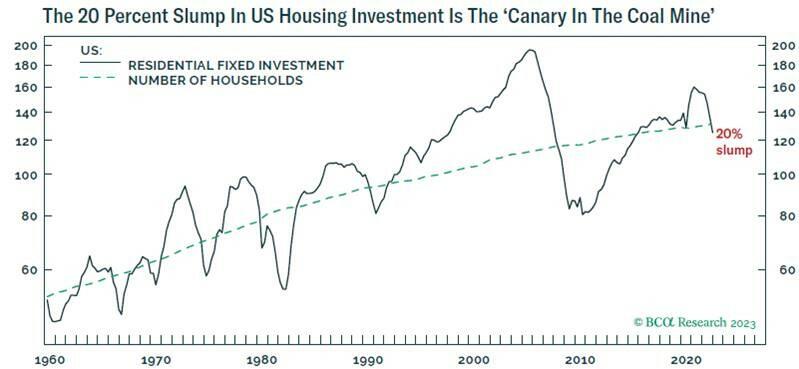
Quietly and off most people’s radar screens, US residential fixed investment (home building) has slumped by 20 percent in the past year – a rate of decline that puts it on a par with the major housing recessions of 1990, 1980, 1973, 1965, and 1951.

Housing recessions matter because they are the ‘canary in the coal mine’ for economy-wide recessions. Not all economic recessions follow housing recessions1, but most housing recessions presage economic recessions.

US Housing Recessions Are The ‘Canary In The Coal Mine’

Housing recessions are the canary in the coal mine for interest rate induced economic recessions. This is because, just as the canary is hyper-sensitive to toxic gases, housing investment is hyper-sensitive to interest rates.

Higher interest rates transfer more income from borrowers to lenders, making it more costly to service existing debt and take on new debt. This suffocates the most indebted parts of the economy – homeowners, homebuilders, and housing investment – before it suffocates the broader economy. So, just as the canary keels over before the coal miner, housing investment keels over before the broader economy.

Continue reading